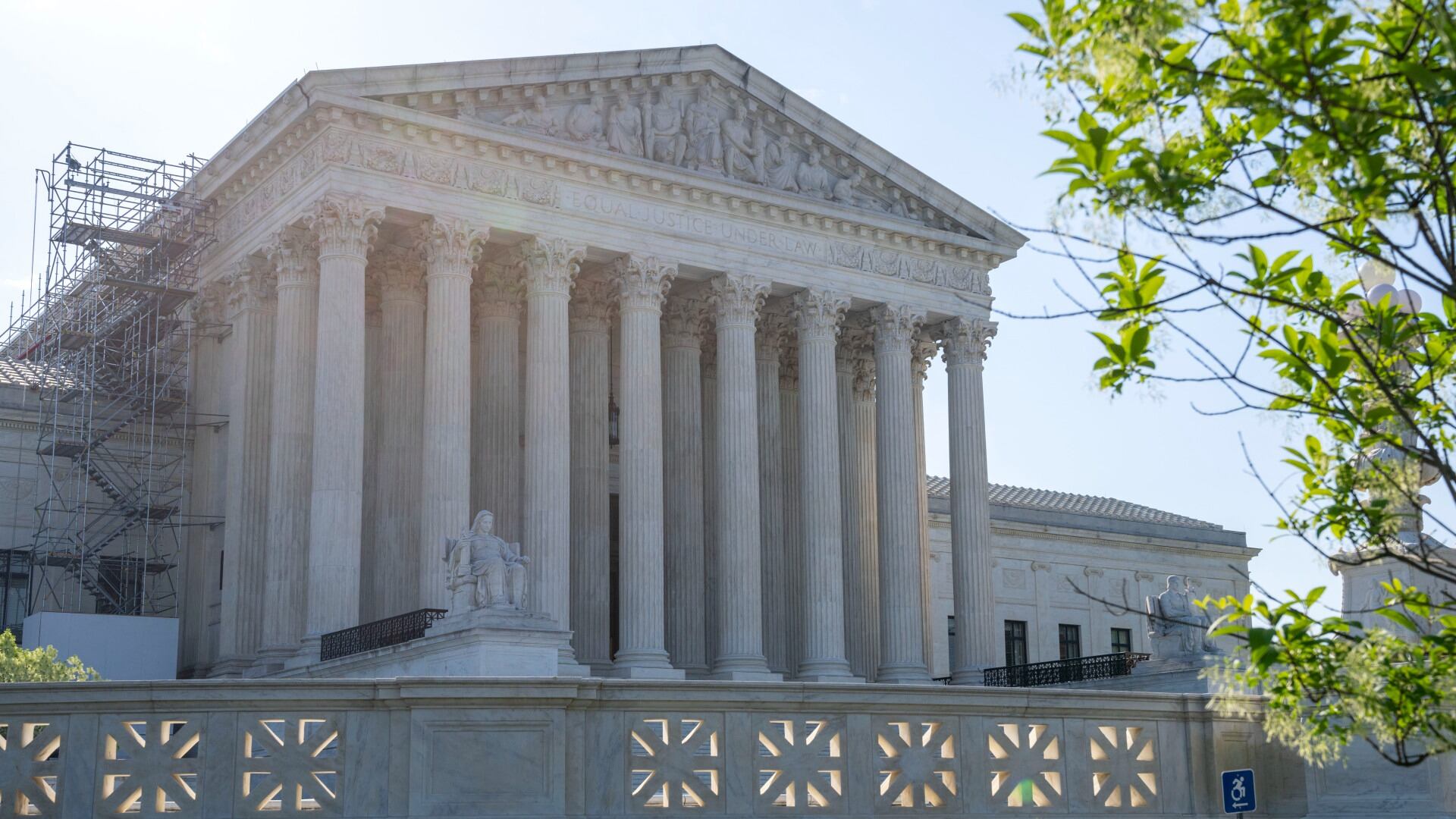
The Supreme Court is seen, Friday, April 21, 2023, ahead of an abortion pill decision in Washington. (AP Photo/Jacquelyn Martin)
The Supreme Court on Tuesday dismissed a case surrounding a Maine hotel that could have made it harder for people with disabilities to learn in advance whether a hotel's accommodations meet their needs.
Hotels and other business interests had urged the justices to limit the ability of so-called testers to file lawsuits against hotels that fail to disclose accessibility information on their websites and through other reservation services.
The information is required by a 2010 Justice Department rule. People who suffer discrimination can sue under the landmark Americans With Disabilities Act, signed into law in 1990.
The justices did not issue a decision on the substance of the case. Instead, they dismissed the case and threw out a lower court ruling in favor of tester lawsuits. The outcome leaves the issue unresolved nationally.
Federal courts in some parts of the country allow such lawsuits. In others, those suits are barred.
The case in front of the court involved whether Deborah Laufer, a woman with disabilities, has the right to sue a hotel in Maine that lacked the accessibility information on its website, despite having no plans to visit it.
In an effort to forestall an unfavorable ruling, Laufer withdrew her lawsuit against the hotel.
When Treasury Secretary Scott Bessent (above) and Fed chair Jay Powell jointly summon America’s top bankers to a meeting in Washington, you know it’s big.
Kim Crawford Goodman, CEO of Smarsh, breaks down how financial firms are scaling AI while managing compliance, risk, and regulation in a changing landscape.
Elizabeth Renter, Senior Economist at NerdWallet, breaks down how inflation and oil price shocks are driving higher costs and squeezing consumers today.
David Branch of Wells Fargo explains why cocoa prices are falling but some candy costs remain high and when consumers may finally see relief at checkout.
Colonel Chris Hadfield, astronaut and best-selling author, breaks down Artemis II and why NASA’s next crewed mission is key to returning humans to the Moon.
Ben Geman, Energy Reporter at Axios, explains how the Iran war could reshape global energy—disrupting supply, shifting power, and accelerating a new regime.