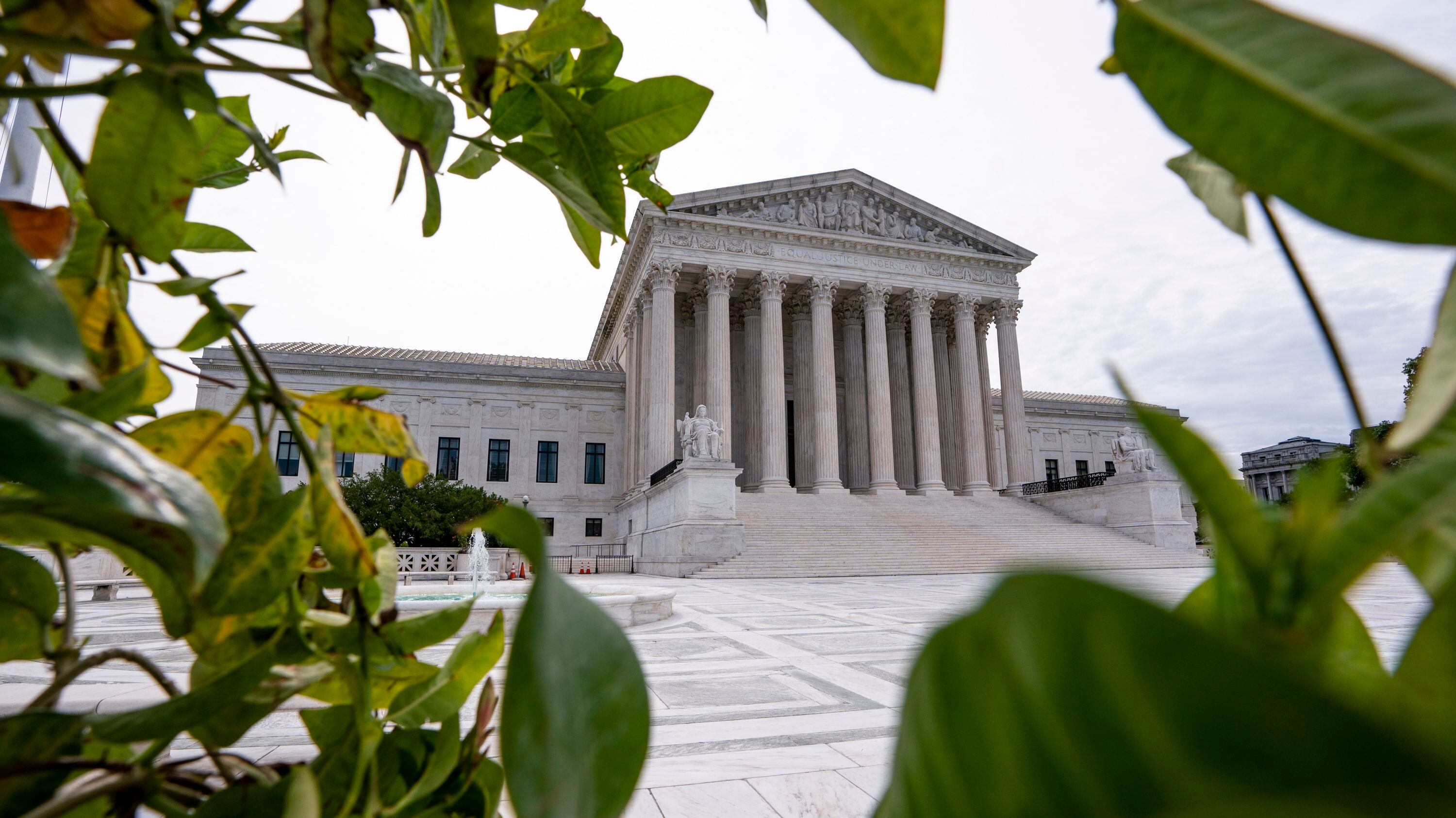
The Supreme Court is seen in Washington, early Monday, June 15, 2020. (AP Photo/J. Scott Applewhite)
By Mark Sherman
Updated 11:36 am ET
A divided Supreme Court on Monday struck down a Louisiana law regulating abortion clinics, reasserting a commitment to abortion rights over fierce opposition from dissenting conservative justices in the first big abortion case of the Trump era.
Chief Justice John Roberts and his four more liberal colleagues ruled that the law requiring doctors who perform abortions have admitting privileges at nearby hospitals violates the abortion rights the court first announced in the landmark Roe v. Wade decision in 1973.
The Louisiana law is virtually identical to one in Texas that the court struck down in 2016.
But Roberts, who had dissented in that Texas case, did not join the opinion written by Justice Stephen Breyer for the other liberals in Monday's decision, and his position left abortion-rights supporters more relieved than elated.
The chief justice explained that he continues to think the Texas case was wrongly decided, but believes it's important for the court to stand by its prior decisions.
"The result in this case is controlled by our decision four years ago invalidating a nearly identical Texas law," Roberts wrote.
In dissent, Justice Clarence Thomas wrote, "Today a majority of the Court perpetuates its ill-founded abortion jurisprudence by enjoining a perfectly legitimate state law and doing so without jurisdiction."
President Donald Trump's two appointees, Justices Neil Gorsuch and Brett Kavanaugh, were in dissent, along with Justice Samuel Alito. The presence of the new justices is what fueled hopes among abortion opponents, and fears on the other side, that the Supreme Court would be more likely to uphold restrictions.
Nancy Northup, president and CEO of the Center for Reproductive Rights, said Monday's decision by no means ends the struggle over abortion rights in legislatures and the courts.
"We're relieved that the Louisiana law has been blocked today but we're concerned about tomorrow. With this win, the clinics in Louisiana can stay open to serve the one million women of reproductive age in the state. But the Court's decision could embolden states to pass even more restrictive laws when clarity is needed if abortion rights are to be protected," Northup said.
Marjorie Dannenfelser, president of the anti-abortion Susan B. Anthony List, said, "Today's ruling is a bitter disappointment. It demonstrates once again the failure of the Supreme Court to allow the American people to protect the well-being of women from the tentacles of a brutal and profit-seeking abortion industry."
A trial judge had said the law would not provide health benefits to women and would leave only one clinic open in Louisiana, in New Orleans. That would make it too hard for women to get an abortion, in violation of the Constitution, the judge ruled.
But the appeals court in New Orleans rejected the judge's findings and upheld the law in 2018, doubting that any clinics would have to close and saying the doctors had not tried hard enough to establish relationships with local hospitals.
The clinics filed an emergency appeal at the Supreme Court, asking that the law be blocked while the justices evaluated the case.
Early last year, Roberts joined with the four liberal members of the court to grant that request and keep the law on hold.
Roberts' vote was a bit of a surprise because he voted in the Texas case to uphold the clinic restrictions. It may have reflected his new role since Justice Anthony Kennedy's retirement as the court's swing justice, his concern about the court being perceived as a partisan institution and respect for a prior decision of the court, even one he disagreed with. Roberts didn't write anything explaining his position at the time, but he had never before cast a vote on the side of abortion rights.
The regulations at issue in Louisiana are distinct from other state laws making their way through court challenges that would ban abortions early in a pregnancy. Those include bans on abortion once a fetal heartbeat is detected, as early as 6 weeks, and the almost total ban passed in Alabama.
Markets closed the day mixed, and well off their lows of the day following a market meltdown earlier in the session. The Nasdaq staged a comeback late in the day, even amid ongoing worries about the Federal Reserve raising interest rates. Doug Flynn, certified financial planner and co-founder of Flynn Zito Capito, joined Cheddar News' Closing Bell to discuss the markets' close and what's driving the major indexes.
Two companies recently announced a new partnership aimed at addressing the growing demand to borrow against crypto - digital assets capital markets firm CrossTower is partnering with commercial bank, BankProv. The companies are launching a crypto lending platform that will allow Bitcoin miners to receive loans to invest in crypto mining equipment. The companies say the program also addresses the difficulty of breaking into crypto mining due to the high cost. CrossTower research analyst Martin Gaspar joins Cheddar News' Closing Bell to discuss.
Next-gen social sports platform Break the Love recently raised $2.5 million in seed funding. Break the Love's platform and iOS app allows users to discover and book group-based tennis activities, to either learn, train, or compete. The new company has already gotten support from a few big names in the world of tennis, including the coach of Naomi Osaka, as well as the United States Tennis Association and the brand Wilson. Break the Love founder and CEO Trisha Goyal joins Cheddar News' Closing Bell to discuss.
As the Omicron variant continues to sweep across the country. The US Supreme Court is expected to hear arguments at the end of this week on whether or not the Biden administration can force private companies to vaccinate or test millions of their employees. In addition, the National Nurses United has spearheaded legal action to protect nurses and health care workers, patients, and the public while on the job. President of the National Nurses Union, Zenei Cortez, joined Cheddar to discuss more.
China's ongoing crackdown of its own entertainment industry has been raising eyebrows for once now. With the ruling Communist Party instructing media companies to boycott immoral and overly entertaining stars. But the country has gone even further. Now experts warn that this could lead to further issues such as gender-based violence. Professor at the Institute of Sociology at National Tsinghua University, Hsiu-Hua Shen, and Associate Professor of Politics at Keough School of Global Affairs at the University of Notre Dame Joshua Eisenman, joined Cheddar to discuss more.
Today marks one year since the January 6 Attack on the United States Capitol. The Country watched as supporters of then-President Trump stormed what was assumed to be the most secure building in the country in an attempt to stop the certification of the 2020 Election. Several lawmakers, including the Vice President, could be seen ducking down as they feared for their lives. Democratic Michigan Representative Dan Kildee, joined Cheddar to discuss more.
Bed Bath & Beyond delivered disappointing fiscal third-quarter results for 2022. Shares initially dove more than 9% in premarket trading on the news but finished the day up nearly 8%. Bed Bath & Beyond has been a meme-stock target for online investors in the past -- so was meme-stock mania a factor in the recent stock movement for the company? Jaime Rogozinski, the founder of the subreddit WallStreetBets, joins Cheddar News' Closing Bell for more, as his forum helped spark the meme stock phenomena. He also discussed some decentralized finance services and trends for the retail investor to watch for in 2022.
Digital medical care provider Pear Therapeutics rang the closing bell on the Nasdaq Friday and President and CEO Dr. Corey McCann, joined Cheddar to talk about how the company plans to grow the business of software-based therapeutics and how the first FDA authorized prescription digital therapeutics company will go about treating illnesses like insomnia and addiction. "These really are pieces of software. In many cases, they're apps and in the cases of our addiction products, these are based on something called cognitive behavioral therapy or CBT," he said. "These products change the patient's brain circuitry to help them be abstinent, to help them stay in treatment, and that's exactly what we see in randomized clinical trials and that's what we see in the real world." He also addressed the ongoing mental health crises brought on by the pandemic. **copy updated to remove IPO information as Pear Therapeutics went public in December**
James Tattersall, director of sales and marketing for Lake Nona Wave Hotel, talks about the hotel's initiatives to foster diversity and how these amenities champion inclusivity in the Orlando area.