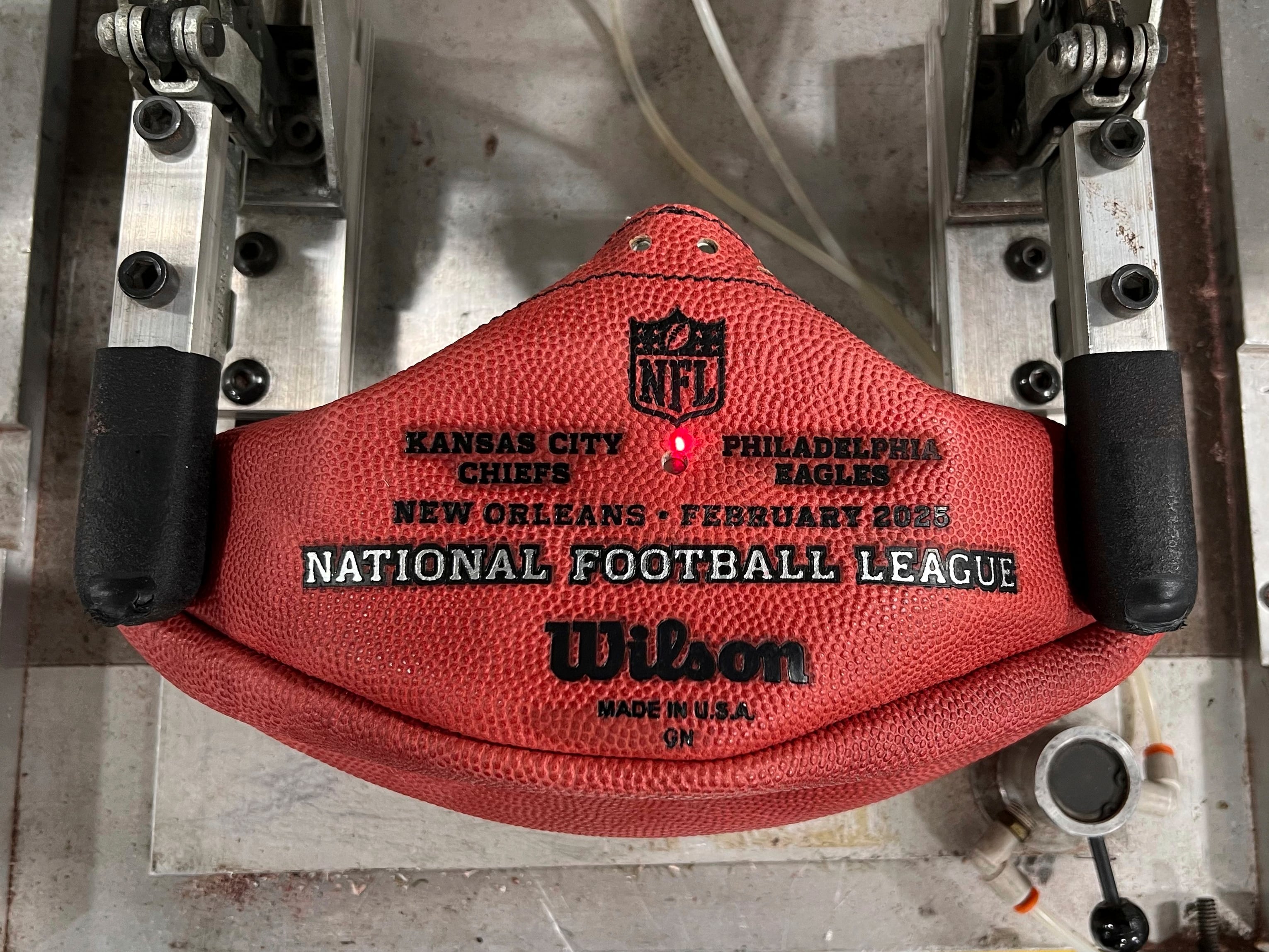
A machine imprints the names of the Philadelphia Eagles and the Kansas City Chiefs onto a football for the upcoming Super Bowl matchup at the Wilson Sporting Goods football factory, Monday, January 27, 2025, in Ada, Ohio. (AP Photo/Patrick Aftoora-Orsagos)
As soon as this year’s Super Bowl matchup was set, workers at the Wilson Sporting Goods football factory jumped into action.
The factory in the rural village of Ada, Ohio, makes the game balls used by every NFL team along with many of the nation’s top college programs and high schools.
But this time of year it's all about the Super Bowl. The Philadelphia Eagles and Kansas City Chiefs will face off for the Lombardi Trophy for the second time in three years on Feb. 9 in New Orleans.
Here’s a look at the footballs, by the numbers:
How many balls are made for the big game?
The two teams will each get a shipment of 108, plus a dozen more for the kickers, all stamped with the Super Bowl logo and team names. Some of the balls will be for practices, while the best ones will be set aside by the quarterbacks. About 50 of those will be bagged and locked away for each team until it's time for kickoff.
How are NFL footballs different from other footballs?
Wilson makes five different sizes for players of all levels, from the pros to youth leagues. Some have different patterns. NFL balls are notable for the lack of a stripe on the ends. They're also embedded with a chip that tracks the ball's position on the field, how far it travels and its trajectory.
How long does it take to make a football?
Normally it takes three days from start to finish. But the first batch of footballs must be sent to the Super Bowl teams Monday, within about 18 hours, so they have enough time to break them in for practices and the game. That's why the workers start production right away the night of the conference title games.
How are they made?
It's a 20-step process, most of it by hand, from cutting out the four leather panels that are sewn together with 250 stitches to putting in the laces. For NFL footballs, the work goes to the factory's most experienced and skilled workers. “Certain parts of the process require a handmade feel,” said Kevin Murphy, general manager of Wilson Team Sports. “It's like making a beautiful, sculpted pair of shoes.”
How do they become game ready?
Throughout production the balls are weighed, measured and inspected for flaws. Once finished, they're checked again. By the time they're packaged and ready for shipping, each one will have been touched by about 50 workers.
How many does the factory normally produce?
It churns out roughly 500,000 footballs each year, or about 2,500 per day. NFL teams go through several hundred during a season. For the Super Bowl, Wilson will make between 10,000-20,000 commemorative balls that will be sold by retailers nationwide and at the game site. If there's high demand, the factory will keep producing the souvenir balls well after.
How long has Wilson made footballs for the NFL?
Since 1941, Wilson has made every football used by the league. Its factory in Ada has been making the official game balls since 1955. This year the company opened a new plant in the village that allows for more production and a museum. Fans can tour the factory, too.
While many are excited to watch the final two NFL teams square-off and see which one ultimately takes home the trophy, some, on the other hand, are there for another mian attraction -- the commercials. Companies during this year's game are looking towards the future From electric vehicles, to robots, and crypto-currency, several first-time advertisers are expected to join long-time advertisers like Pepsi, Budweiser and Doritos during the NFL's biggest game. Tom Morton, Global Chief Strategy Officer at R/GA, joined Cheddar News' Big Game Special to discuss.
This week's Spring Training has been delayed as a result of the ongoing MLB Lockout. This past Saturday lead negotiators and lawyers from Major League Baseball and the players union met to discuss the economic hurdles needed to be cleared for a new labor deal, but from all accounts, it seems the sides are still far apart. Baseball Columnist and Publisher of "The Joe Sheehan" Baseball Newsletter, Joe Sheehan, joined Cheddar to discuss more.
The Super Bowl might be over, but people are still buzzing about the players, commercials, halftime show, and more. Google tracks the top searches before and after the game every year, revealing the show-stopping moments of the biggest sporting event of the year. Sadie Thoma, Director of US Creative Partnerships at Google, joined Cheddar's Opening Bell to discuss the top trends this year.
Private equity firms are taking a big interest in investing in NBA teams, the sports league showing the highest ROI over the last two decades according to Sportico, Forbes, and PitchBook. Wylie Fernyhough, lead analys for private equity at PitchBook joined Cheddar News to discuss the way firms are looking to get a piece of the action on the court. “There’s a certain amount of rarity, with these," Fernyhough said. "They’re not exactly printing new NBA franchises."
Kyle Jaeger, senior editor for Marijuana Moment, joined Cheddar News' Closing Bell, where he explains why a stigma still exists for the cannabis industry in advertising and social media after NBC rejected Weedmaps' ad for the big game even though more states across the country are legalizing cannabis.
We know that the Los Angeles Rams emerged as Super Bowl champions, but the crypto industry also came out a winner on Sunday with several notable companies getting airtime in primetime. However, Richard Smith, author of the Risk Rituals Newsletter, joins Cheddar News' Closing Bell, where he says the campaigns were a 'disappointment' and adds that crypto companies would be wiser spending their resources on creating value.
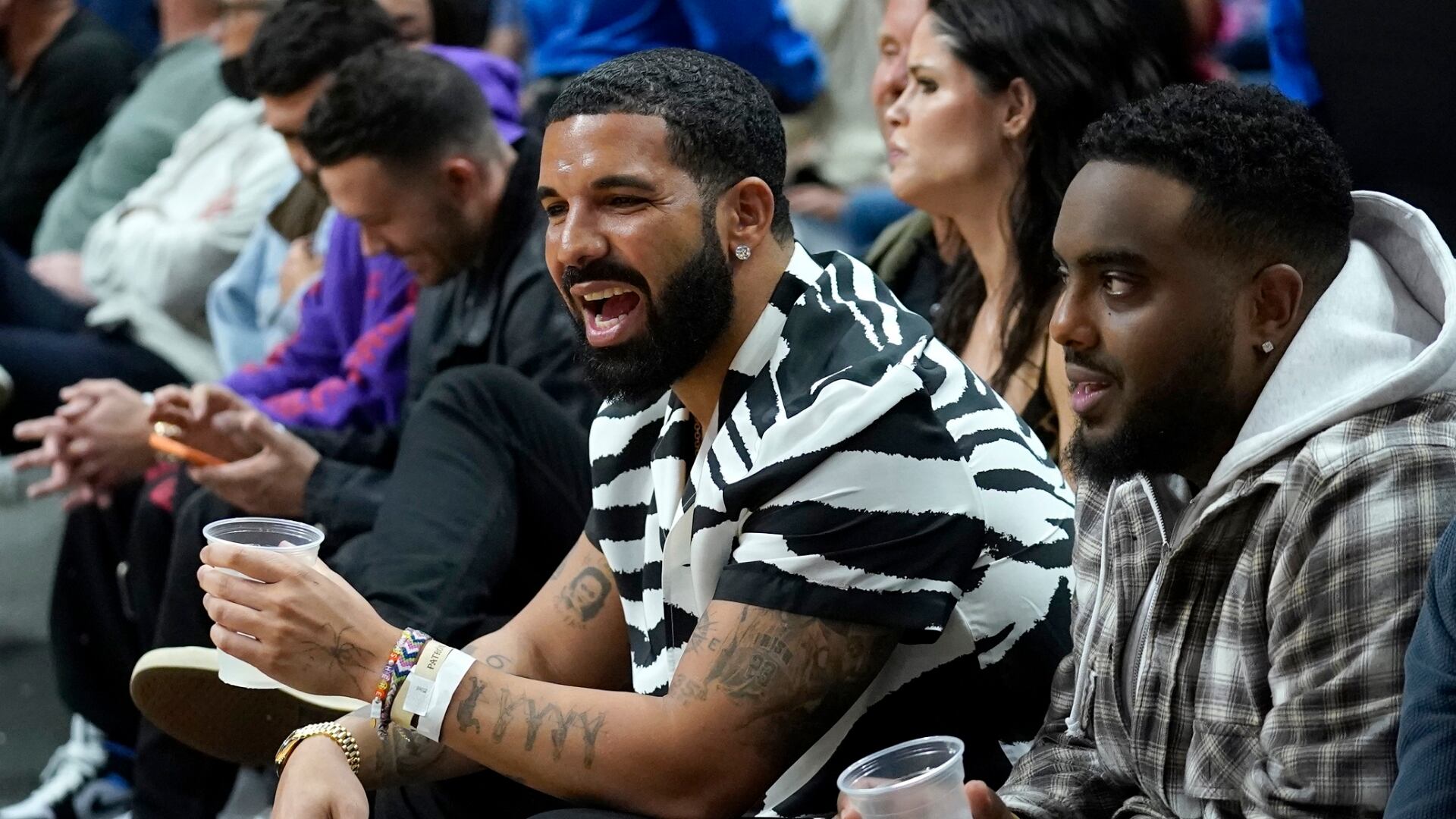
Drake gambled $1.3 million in Bitcoin on Sunday’s Super Bowl — and won. Some of the action that the rapper placed bets on included the LA Rams to win outright and Odell Beckham Jr. to score a touchdown.
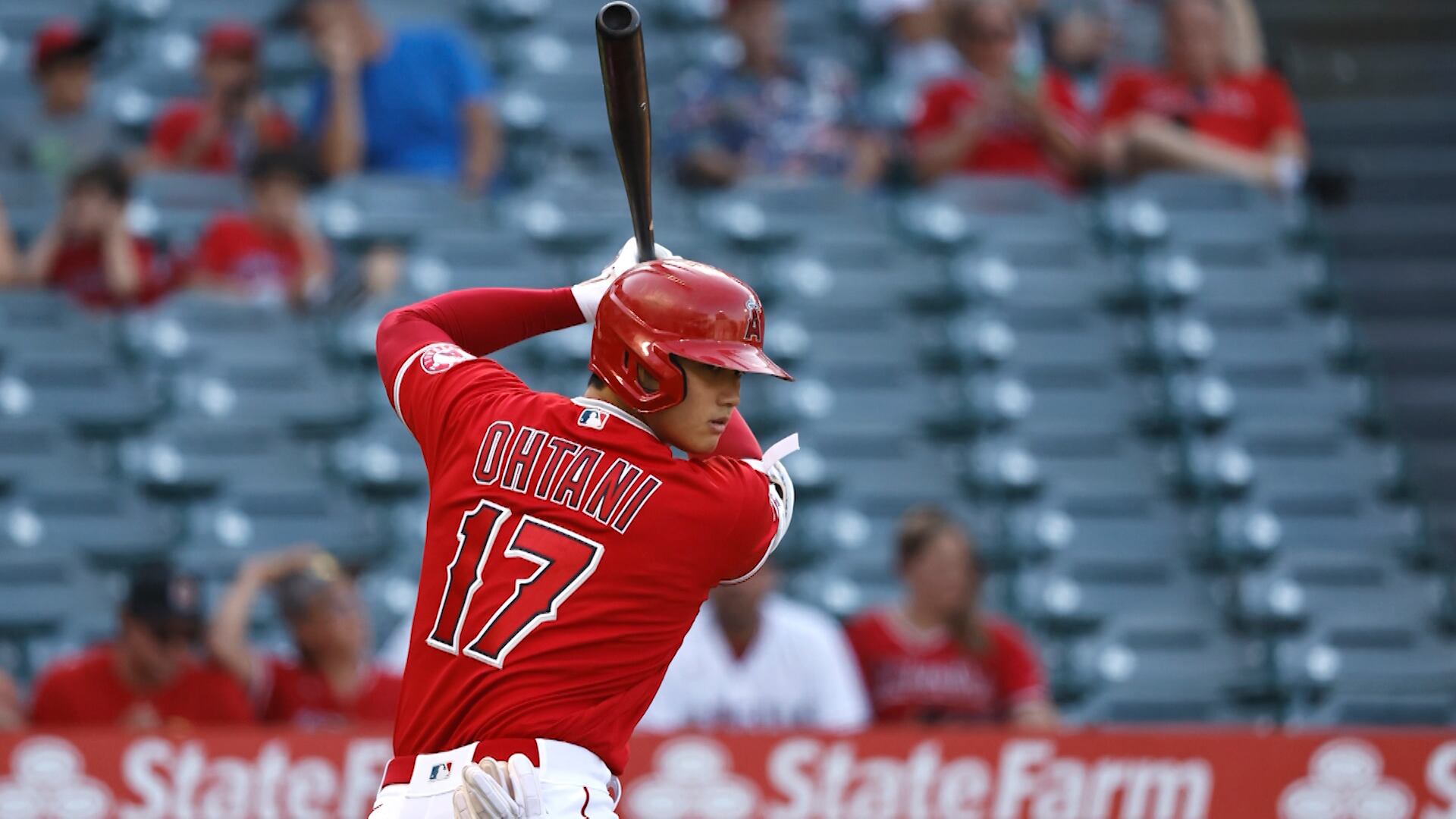
In late January, NFT company Candy Digital cashed in when a Shohei Ohtani Icon NFT sold for $100,000, breaking the six-figure sale price mark for MLB NFTs for the first time. Scott Lawin, CEO of Candy Digital, joins Cheddar News' Closing Bell, where he explains why his company is very excited about the future of digital collectibles and how the Ohtani NFT sale shows consumer confidence in the marketplace.