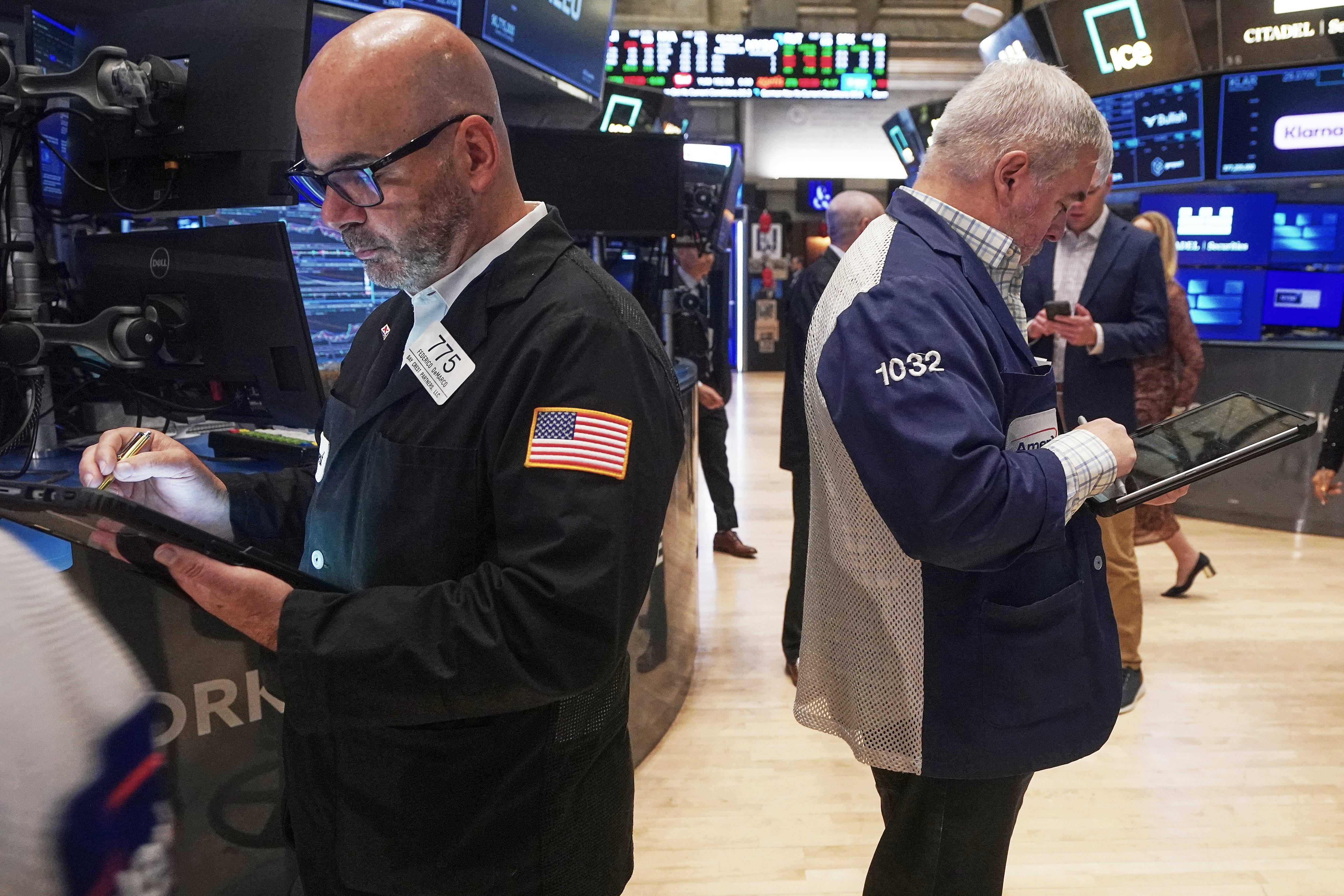
NEW YORK (AP) — Stocks nudged higher ahead of a week with several data reports that could dictate by how much or even whether the Federal Reserve will cut interest rates at its next meeting in a week. The S&P 500 added 0.2% and finished just below its record set last week. The Dow Jones Industrial Average rose 0.3%, and the Nasdaq composite climbed 0.5% to a record. AppLovin and Robinhood Markets helped lead the market after learning they will join the S&P 500 index later this month. Trading across Wall Street was relatively quiet ahead of updates coming later this week on the job market and inflation.
AppLovin and Robinhood Markets helped lead the market after learning they will join the S&P 500 index later this month, along with Emcor Group. Many investment funds directly mimic the index or at least compare their performance against it, so a stock’s joining the list of the 500 largest companies can draw investors’ dollars immediately.
AppLovin climbed 10.2%, and Robinhood jumped 13.4% while Emcor slipped 0.1%. They will replace three companies that have shrunk enough in size to get demoted to S&P’s index of small stocks, the SmallCap 600. Those stocks, MarketAxess Holdings, Caesars Entertainment and Enphase Energy, ranged from a 3.5% loss to a 0.3% gain.
EchoStar jumped 15.1% after saying it agreed to sell spectrum licenses to Elon Musk’s SpaceX for $17 billion in cash and stock. SpaceX also agreed to pay for roughly $2 billion of interest payments on EchoStar debt through November 2027.
The deal will help SpaceX’s Starlink business develop direct-to-cell service, and it knocked down stocks of other telecoms. Verizon sank 1.8%, and AT&T dropped 1.7%.
PNC Financial Services Group slipped 0.6% after it said it would pay $4.1 billion to buy FirstBank, a bank owner based in Lakewood, Colorado.
Trading across most of the market was relatively quiet ahead of several updates coming later this week on the economy and inflation. They could alter expectations among traders, who at the moment are unanimously forecasting the Fed will cut its main interest rate for the first time this year at its meeting two Wednesdays from now.
Investors tend to love such cuts because they can give a boost to the economy and to prices for investments. The downside of them is that they can also push inflation higher.
So far this year, the Fed has been more worried about the potential of inflation worsening because of President Donald Trump’s tariffs than about the job market. But a slew of recent reports showing the U.S. job market is slowing may be changing minds.
On Tuesday, the U.S. government will release preliminary revisions for job growth numbers it reported through March, and it could show that hiring was weaker than earlier thought.
Reports on inflation will follow on Wednesday and Thursday, showing how much prices rose last month at the wholesale and at the consumer levels. Bigger rises there than expected could tie the Fed’s hands. Officials would need to decide which problem is more pressing, either the job market or inflation, because they have only one tool to fix either. And raising or lowering interest rates to help one tends to hurt the other in the short term.
U.S. companies have been trying several ways to preserve their profits in the face of tariffs, which push up prices for things imported to the country. Many industrial companies are talking about their ability to raise own prices, according to strategists at Morgan Stanley led by Michelle Weaver. Companies that sell nonessentials directly to consumers, meanwhile, are talking more about stockpiled inventories, which could be delaying the hit that U.S. households will feel.
In the bond market, Treasury yields continued to ease as expectations remain high for the Fed to cut interest rates. The yield on the 10-year Treasury fell to 4.07% from 4.10% late Friday and from 4.28% last Tuesday.
In stock markets abroad, indexes rose across much of Europe and Asia.
Japan’s Nikkei 225 jumped 1.5% for one of the larger gains after Prime Minister Shigeru Ishiba announced that he plans to resign.
Analysts said Ishiba’s announcement was expected for some time and welcomed it as moving things forward, although uncertainty remains as the ruling Liberal Democratic Party will need to hold an election to choose a new leader. Ishiba will remain prime minister until his successor is chosen and approved by parliament.
Also Monday, Japan’s Cabinet Office said the economy expanded at a stronger rate in the fiscal first quarter than previously estimated, at a seasonally adjusted 2.2% annualized rate, better than the earlier 1.0% rate as solid consumer spending and inventories lifted growth more than previously thought.
___
AP Business Writers Yuri Kageyama and Matt Ott contributed.