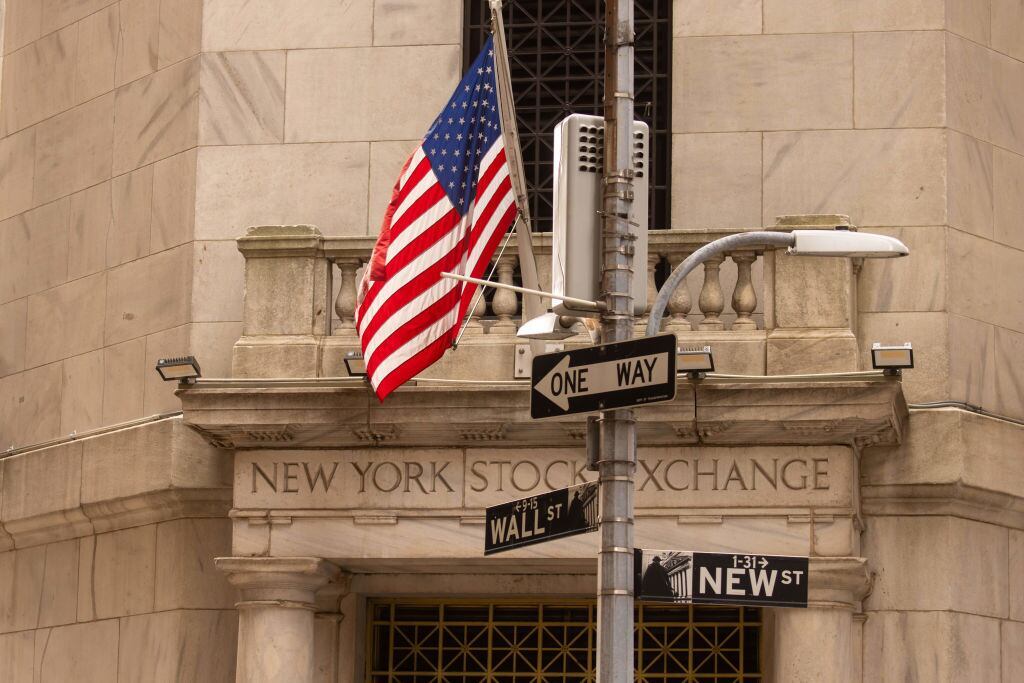
In this March 23, 2021 file photo, pedestrians walk past the New York Stock Exchange in New York's Financial District. (AP Photo/Mary Altaffer, File)
By Damian J. Troise and Alex Veiga
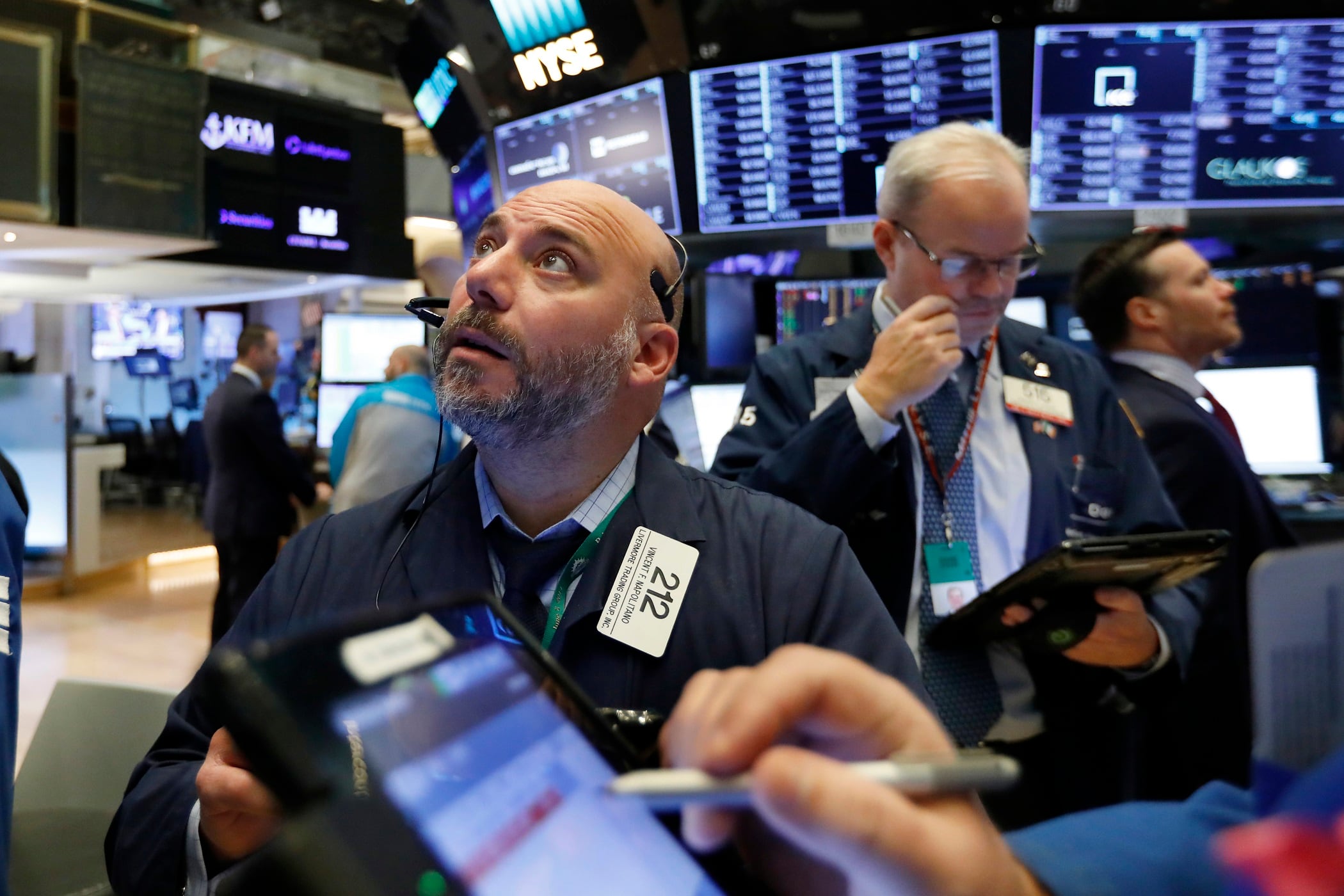
Technology and energy companies led stocks lower on Wall Street Monday, easing the market back from its recent all-time highs.
The S&P 500 slipped 0.1%, erasing an early gain. Technology companies accounted for a big share of the decline. Industrial and consumer-centric stocks also fell. Those losses outweighed gains in health care companies, banks and elsewhere in the market.
Energy companies slumped the most among S&P 500 stocks as the price of benchmark U.S. crude oil fell 2.6% to its lowest levels since May. The move lower follows a decline of 7.7% last week. Occidental Petroleum shed 3%.
Every major index was coming off weekly gains last week, which ended with record highs for the S&P 500 and the Dow Jones Industrial Average.
The modest pullback is another example of the volatility the market has seen amid uncertainty over the impact COVID-19 variants will have on the economy and the Federal Reserve’s next monetary policy moves, said Sylvia Jablonski, chief investment officer at Defiance ETFs.
“People who got in and saw some of the stocks that they hold at all-time highs on Friday, perhaps they’re selling a little bit off today and might be opportunistically trading some of this volatility,” she said.
The S&P 500 fell 4.17 points to 4,432.35. The Dow dropped 106.66 points, or 0.3%, to 35,101.85. The Nasdaq added 24.42 points, or 0.2%, to 14,860.18.
Smaller companies fell more than the rest of the market. The Russell 2000 index lost 12.95 points, or 0.6%, to 2,234.81.
Bond yields moved higher. The yield on the 10-year Treasury rose to 1.32% from 1.28% late Friday. Bond yields tend to move with expectations for the economy and for inflation.
The latest round of corporate earnings is winding down, and nearly 90% of companies in the S&P 500 have reported their latest results. The reports have been mostly solid. Tyson Foods jumped 8.7% for one of the biggest gains in the S&P 500 Monday after handily beating Wall Street's profit forecasts.
Investors are also closely watching the world's reaction to the latest surge of the coronavirus. Some governments have reimposed limits on business and travel. China canceled flights as it tries to stop a rash of outbreaks. Australia’s two most populous states have told people to stay home except to go to work or for a handful of other reasons.
Analysts expect the U.S. and global economies to continue growing, but have cautioned that the resurgent virus could slow down the pace.
“That's one part of the story and that could be holding back" the stock market, said David Kelly, chief global strategist at JPMorgan Funds. “We don't really have a handle on how bad the delta variant might get.”
Investors have been taking in a steady stream of encouraging economic reports. The latest from the Labor Department shows that U.S. employers posted a record 10.1 million job openings in June. That follows Friday's report that the economy generated 943,000 jobs last month and the unemployment rate fell to 5.4% from 5.9% in June.
The solid jobs figures also raise some concerns about wage inflation and the pace of economic growth.
“We’re burning our way back to full employment fast," Kelly said. “Once we get there the economy is going to slow down.”
The latest figures also raise concerns about inflation fueled by the improving job market, as employers are potentially forced to raise wages to fill jobs.
Investors will get another piece of data on inflation when the Labor Department releases its consumer price index for July on Wednesday. Wall Street is still trying to gauge how much inflation might rise as the economy recovers and whether that will push the Federal Reserve to trim back its support for the economy sooner than expected.
Major indexes Europe edged lower while indexes in Asia ended mixed.
Stocks closed lower Monday as investors continued to price in COVID-19 omicron variant fears. Reopening stocks like airlines, financial companies, restaurants and hotels, and more, dragged on the major indexes as businesses and events took a pause over the weekend amid rising case numbers in metropolitan areas. This comes a week after the Federal Reserve announced it plans to speed up its asset tapering timeline in January and institute three rate hikes next year. Is that plan aging well? Robert Conzo, CEO of The Wealth Alliance, joins Cheddar News' Closing Bell to discuss market movement, how stocks could close out the year, what the Fed could do in 2022, and more.
After a vote in one Buffalo, New York-area Starbucks created the first workers union in the coffee chain's history, the company has announced that it is ready to negotiate in good faith with the new bargaining unit. But a tense process where labor organizers leveled accusations of anti-union activity at the coffee giant may make that difficult. Cortlin Harrison, a barista at the unionized store, spoke to Cheddar about making a deal. "We can move past all the dirty tricks, the union-busting, the captive audience meetings," he said. "I'm ready to go to the table, and my fellow baristas are ready to go to the table, and just move forward."
This year's worldwide semiconductor shortage limited the supply of everything from new cars to smartphones; and now, many in the chip industry expect the shortage to continue deep into 2022, and maybe even 2023. Semiconductor senior research analyst for Robert W. Baird & Co., Tristan Gerra, joins Cheddar News' Closing Bell to discuss.
Direct health care company Nomi Health recently raised $110 million in a Series A round. Nomi Health lets public and private organizations directly purchase healthcare at reduced costs, and pay providers in real-time. It also delivers healthcare directly to under-served communities via its fleet of mobile care units, which the company says is the largest in the country. Nomi Health says its mission is to improve the health care experience for all Americans. Nomi Health CEO Mark Newman joined Cheddar News' Closing Bell to discuss.
American Express and Nova Credit have partnered the credit passport program aimed at expanding access to credit for immigrants from the Dominican Republic, Nigeria, Kenya, and Brazil. Misha Esipov, co-founder and CEO of Nova Credit, joined Cheddar's Ken Buffa to talk about the program's benefits for immigrants who have to start over in the U.S. and are looking to establish a credit history. "If you were a good borrower in your home country — and you can prove you were a borrower in your home country — when you first arrive here, you can use that information to continue to be a good borrower," he said of the service.
Despite the rising cost of a home in the U.S., sales rose 1.9 percent in November, and according to Zillow, prices are expected to climb even higher in 2022. M. Ryan Gorman, president and CEO of Coldwell Banker Real Estate, told Cheddar's "Closing Bell" that while median prices are high, demand for a new home is just as high, particularly in "tax and weather favorable" destinations like Florida, Tennessee, and Texas. Gorman also said he sees buyer demand remaining high next year even if interest rates rise somewhat, noting that the already tight housing inventory is expected to slim down even more and foreign purchasers return to the market. "As we get past the holidays and those foreign buyers are able to come back and actually acquire homes and go shopping, I think that may be a bigger driver of some of that increase in buyer demand," he said.
The airline industry says it is contending with staff shortages that threaten to hamper operations amid the COVID resurgence, andDelta Airlines CEO Ed Bastian called on the CDC to revise its guidance for vaccinated workers who test positive from a 10-day quarantine to just five. Chuck Liberman, chief investment officer and managing partner at Advisors Capital Management LLC, joined Cheddar to talk about the current guidance on isolation and why he believes the omicron variant calls for more relaxed guidance given its reportedly mild symptoms.
A new series is looking to advance Black founders who have disruptive ideas and companies. 'Bet on Black' is a new series that allows black entrepreneurs to pitch their businesses in the hopes of securing $200,000 in funding. Revolt TV and Target teamed up to create the show. Detavio Samuels, CEO of Revolt, joins Cheddar News to discuss.