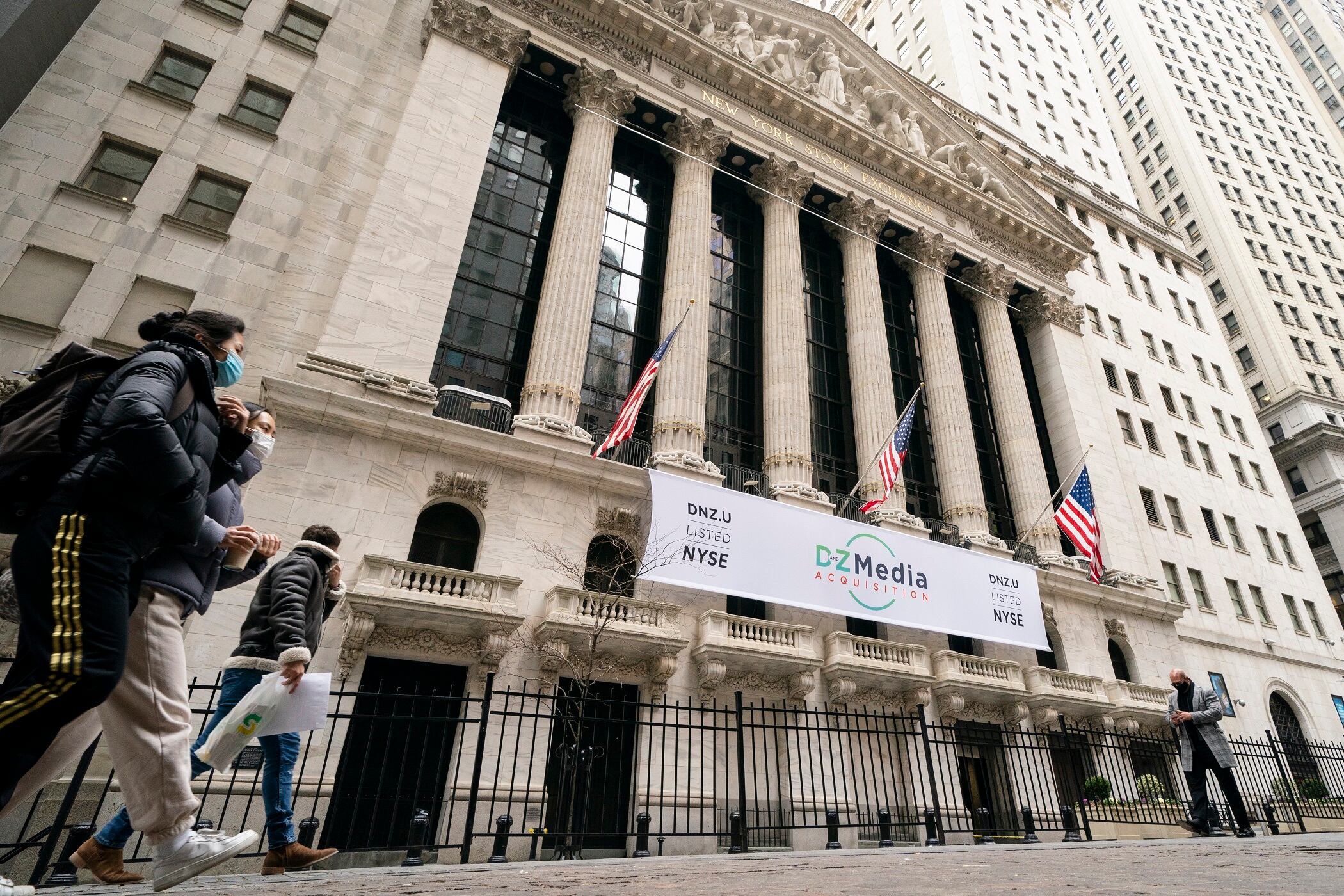
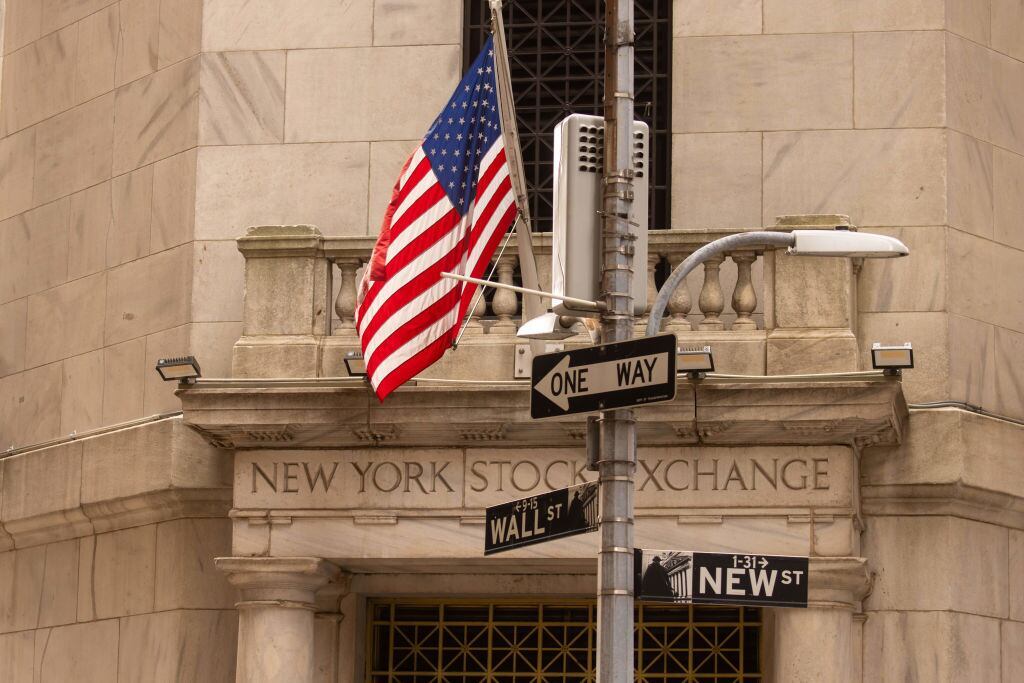
Pedestrians pass the New York Stock Exchange, Wednesday, Jan. 27, 2021, in New York. Stocks are inching higher in early trading on Wall Street Friday, Aug. 20, but not enough to erase their losses from the week. (AP Photo/John Minchillo, File)
By Alex Veiga
Technology companies led stocks broadly higher on Wall Street Friday, though the gains were not enough to erase the market's losses from earlier in the week.
The S&P 500 index rose 0.8%, but still posted a weekly loss of 0.6% after two weeks of gains. Even so, the benchmark index is less than 1% from the all-time high it set Monday.
More than 80% of S&P 500 companies notched gains, including tech sector stocks. Microsoft rose 2.6% and chipmaker Nvidia gained 5.1% for the biggest gain in the index. A mix of companies that rely on consumer spending and communications stocks also made up a big share of the rally. Energy stocks also rose, despite another decline in the price of U.S. crude oil. Treasury yields mostly rose.
Investors turned cautious this week following some disappointing economic reports on retail sales, housing and consumer sentiment. Escalating coronavirus infections across the U.S. and around the globe due to the highly contagious delta variant have also given traders reason to pause with the market near all-time highs.
“Today was the first day that the market didn’t have to deal with disappointing economic data,” said Willie Delwiche, investment strategist at All Star Charts. “We also need to remember it's a Friday in August, not typically an environment where we look for big signals out of the market.”
The S&P 500 rose 35.87 points to 4,441.67. The Dow Jones Industrial Average added 225.96 points, or 0.7%, to 35,120.08. The Nasdaq composite picked up 172.87 points, or 1.2%, to 14,714.66. The Dow and Nasdaq also posted weekly losses.
Small company stocks recovered some of their losses from earlier in the week. The Russell 2000 index added 35.18 points, or 1.7%, to 2,167.60. The index still finished with a 2.5% weekly drop.
Bond trading was quiet. The yield on the 10-year Treasury note rose to 1.26% from 1.24% late Thursday.
With earnings season winding down, investors got to see quarterly report cards from mostly retailers this week. On Friday, Ross Stores fell 2.7%, the biggest decline among S&P 500 companies, after issuing a full-year forecast that fell short of Wall Street’s expectations. Foot Locker jumped 7.3% after blowing past analysts’ forecasts for its latest quarter.
Fund managers aren’t expecting much volatility this month as investors will have little data to work with. August also tends to be a popular time for investors to take vacations, so trading volume typically declines. September tends to be a much more volatile month once Wall Street is back to work.
Still, next week could provide Wall Street with more insight on what the Federal Reserve may do about inflation. Earlier this week, minutes from the most recent Fed meeting showed that officials had discussed reducing the central bank's bond-buying program later this year to start winding down some of the emergency measures that were implemented during the pandemic. But they stopped short of setting a firm timeline.
The Fed's annual conference in Jackson Hole, Wyoming next week could offer hints on when such tapering may begin.
“From a historical perspective, the Fed doesn't make news in its minutes, but it does tend to set out policy shifts at its symposium,” Delwiche said.
We're entering a brave new world of broadly legal sports betting. Over 30 states and Washington, DC, have legalized sports betting in the year and a half since the supreme court struck down the federal ban on the activity.
But legalization isn't a simple proposition. The federal law might be struck down but its still up to each state to decide whether to legalize sports betting, and answer a litany of questions that come with it. Should you include online gambling? How much should people be allowed to bet? Should there be limits on advertising for sports betting?
Darren Heitner, founder of Heitner Legal, and Daniel Wallach, founder of Wallach Legal, join None of the Above's "Business of Sports: The Year Gambling Took Over" special to discuss.
Over the past decade, the resale market has completely transformed, allowing people to utilize platforms such as Etsy, Poshmark, eBay, and more to create a lucrative business from the comfort of their homes. However, as the space of secondhand sellers and thrifters gets more and more crowded, small businesses are facing bigger obstacles to not only thrive in the market but also survive. Yvette Liebesman, a law professor at Saint Louis, joins Cheddar News to discuss.
Even as tech giant Google implements a vaccination mandate, charging its employees to declare their vaccine status within a time frame or risk dismissal, the federal government is tangled up in the court system trying to impose one of its own. Cindy Cohn, the executive director of the Electronic Frontier Foundation, and Harry Nelson, founder and managing partner of Nelson Hardiman LLP, joined Cheddar to debate the ethics, efficacy, and legality surrounding the issue. While Cohn noted that she thinks the federal mandate might be legally sound, her organization is also concerned with a separate question of privacy. "At EFF what we're most interested in is the digital surveillance that's going along with some of these attempts to try to track and confirm whether people are vaccinated or not," she said.
A new report from CNBC says Instagram recently reached a new milestone -- 2 billion monthly active users. It comes amid a year of controversy for the photo-sharing app and its parent company, Meta. SocialFlow CEO Jim Anderson joins Cheddar News' Closing Bell to discuss.
A report from KPMG International found that global mergers and acquisitions in 2021 reached $5.1 trillion in transactions. Carol Streicher, U.S. deal advisory and strategy service group leader for KPMG, joined Cheddar's "Closing Bell" to talk about the record-breaking year and next year's outlook, which KPMG says could be even more staggering. "We're not seeing any slow down in '22," she said, regarding survey results of 350 business leaders. "Things that were tailwinds for us in M&A activity this past year are going to continue to be tailwinds for us in 2022."
MotorTrend named the Rivian R1T as the 2022 truck of the year - a prestigious title given by the publication as a way for automakers to tout third-party validation. Rivian beat out traditional, legacy truck favorites like Ford and General Motors.
MotorTrend said the company earned high marks for safety, efficiency, value, advanced design, engineering excellence, and performance of intended function. MotorTend head of editorial Ed Loh joins Cheddar News' Closing Bell to discuss.
Stocks closed higher Wednesday on the heels of the Federal Reserve's December meeting. Chairman Jerome Powell announced the central bank would leave interest rates low and unchanged for now, with the anticipation of three hikes next year. The Fed will also speed up the timeline of its asset tapering, beginning in January 2022. Dan Russo, Portfolio Manager and Director of Research at Potomac Fund Management joins Cheddar News' Closing Bell to discuss today's close, how investors reacted to the Fed's announcements, and more.
There is a new way for investors to bet on cannabis - the AdvisorShares Poseidon Dynamic Cannabis ETF targets about 20 of the biggest names in U.S. cannabis. It comes at a time when it's still difficult for investors to access the space. Cheddar News cannabis reporter Chloe Aiello spoke with co-founder and managing director for Poseidon Investment Management, Emily Paxhia.
Victor Li, an economics professor at the Villanova School of Business, joins Cheddar News' Closing Bell, where he discusses the latest Fed decision and the implications it has on the stock market.