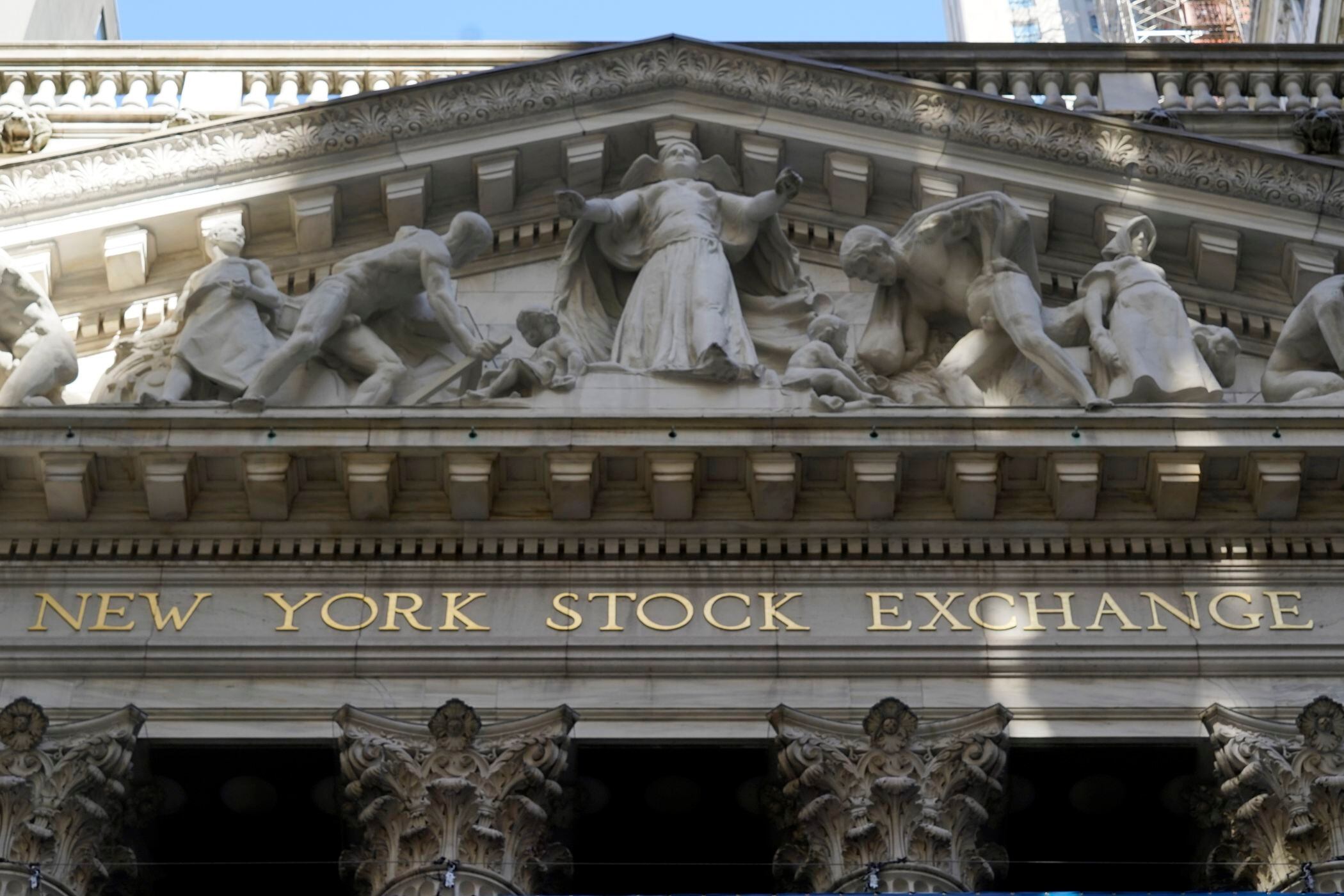
The facade of the New York Stock Exchange, is seen Wednesday, June 16, 2021. Stocks are wobbling between small gains and losses in the early going on Wall Street, keeping major indexes close to the record highs they set last week. The S&P 500 and the Dow Jones Industrial Average were little changed in the early going Monday, July 26. (AP Photo/Richard Drew, File)
By Damian J. Troise and Alex Veiga
Wall Street capped a wobbly day for stocks with modest gains Monday, nudging the major indexes further into record territory.
The S&P 500 shrugged off an early slide and gained 0.2%. Consumer-oriented companies, banks and energy and communications stocks helped lift the market. Those gains were kept in check by a pullback in health care and technology companies. Treasury yields mostly rose.
The modest gains follow a turbulent week for the market. A week ago, stocks fell sharply amid worries that fast-spreading variants of the coronavirus could threaten the economic recovery. But the swoon was short-lived, and the major stock indexes rallied to record highs on Friday.
Trading was more muted Monday, as investors monitored a steady flow of corporate earnings and looked ahead to Wednesday, when the Federal Reserve is due to deliver an update on the economy and its interest rate policy.
Traders will be listening for clues as to when the central bank might start winding down its extraordinary support measures for the economy and how concerned it is about inflation.
“The mood still revolves around inflation and whether it is transitory or not,” said Keith Buchanan, senior portfolio manager at Globalt Investments.
The S&P 500 rose 10.51 points to 4,422.30. The Dow Jones Industrial Average gained 82.76 points, or 0.2%, to 35,144.31. The Nasdaq composite added 3.72 points, or less than 0.1%, to 14,840.71.
Smaller companies fared slightly better than the broader market. The Russell 2000 index rose 7.27 points, or 0.3%, to 2,216.92.
Cruise lines, hotels and retailers were among the winners. Carnival rose 5.5%, Caesars Entertainment added 3.3% and Gap rose 3%. Among stocks that lost ground: Drugmaker Moderna slid 3.7% and chipmaker Nvidia fell 1.4%.
Treasury yields mostly rose. The yield on the 10-year Treasury rose to 1.30% from 1.28% late Friday. The yield, which is a benchmark for interest rates on mortgages and other consumer loans, has been mostly falling amid increasing unease over the economy since climbing to about 1.75% in late March.
Chinese technology companies slipped as China increases restrictions on them. China’s industry ministry announced a 6-month campaign to clean up what it says are serious problems with internet apps violating consumer rights, cyber security and “disturbing market order.” Internet giant Tencent's U.S.-listed shares slid 10% following orders by regulators to end exclusive contracts with music copyright holders.
The announcement pulled most indexes in Asia lower. Hong Kong’s Hang Seng sank 4.1%, marking its biggest drop in more than a year, and the Shanghai Composite index fell 2.3%.
A wide range of companies reported earnings. While the results have been mostly solid, Wall Street's reaction has been mixed. Elevator maker Otis rose just 0.6%, despite reporting solid financial results, while toymaker Hasbro jumped 12.2% for the biggest gain in the S&P 500 after handily beating analysts' profit forecasts.
Investors are awaiting earnings reports from several large companies this week. Google's parent company, Alphabet, will report earnings Tuesday, along with Apple and Microsoft. Pfizer and Boeing report their results on Wednesday.
Electric vehicle company Lucid Motors, now dubbed Lucid Group, rose 10.6% in its public debut after being bought by blank-check company Churchill Capital Corp.
The price of Bitcoin rose about 9% to $37,500, according to Coindesk. Amazon is reportedly considering accepting it as payment and considering its own cryptocurrency for purchases.
The New York Times and President Donald Trump are fighting again. The news outlet said Wednesday it won't be deterred by Trump's “false and inflammatory language” from writing about the 79-year-old president's health. The Times has done a handful of stories on that topic recently, including an opinion column that said Trump is “starting to give President Joe Biden vibes.” In a Truth Social post, Trump said it might be treasonous for outlets like the Times to do “FAKE” reports about his health and "we should do something about it.” The Republican president already has a pending lawsuit against the newspaper for its past reports on his finances.
OpenAI has appointed Slack CEO Denise Dresser as its first chief of revenue. Dresser will oversee global revenue strategy and help businesses integrate AI into daily operations. OpenAI CEO Sam Altman recently emphasized improving ChatGPT, which now has over 800 million weekly users. Despite its success, OpenAI faces competition from companies like Google and concerns about profitability. The company earns money from premium ChatGPT subscriptions but hasn't ventured into advertising. Altman had recently announced delays in developing new products like AI agents and a personal assistant.
President Donald Trump says he will allow Nvidia to sell its H200 computer chip used in the development of artificial intelligence to “approved customers” in China. Trump said Monday on his social media site that he had informed China’s leader Xi Jinping and “President Xi responded positively!” There had been concerns about allowing advanced computer chips into China as it could help them to compete against the U.S. in building out AI capabilities. But there has also been a desire to develop the AI ecosystem with American companies such as chipmaker Nvidia.
U.S. sports betting is booming as NFL and college football fuel massive activity. BetMGM CEO Adam Greenblatt breaks down trends, growth, and what’s next.
President Donald Trump says a deal struck by Netflix last week to buy Warner Bros. Discovery “could be a problem” because of the size of the combined market share. The Republican president says he will be involved in the decision about whether federal regulators should approve the deal. Trump commented Sunday when he was asked about the deal as he walked the red carpet at the Kennedy Center Honors. The $72 billion deal would bring together two of the biggest players in television and film and potentially reshape the entertainment industry.
Disney's changes to a program for disabled visitors are facing challenges in federal court and through a shareholder proposal. The Disability Access Service program, which allows disabled visitors to skip long lines, was overhauled last year. Disney now mostly limits the program to those with developmental disabilities like autism who have difficulty waiting in lines. The changes have sparked criticism from some disability advocates. A shareholder proposal submitted by disability advocates calls for an independent review of Disney's disability policies. Disney plans to block this proposal, claiming it's misleading. It's the latest struggle by Disney to accommodate disabled visitors while stopping past abuses by some theme park guests.
With a merger this big, creators, studios, and theaters all face uncertain futures. Here’s what experts are worried about and what good could come from it.
With disengagement rising and hybrid work shifting, 'Everybody Matters' author Bob Chapman explains why treating people well could define the future of work.
We sat down with Ali Furman, U.S. Consumer Markets Industry Leader at consulting firm PwC to ask what trends she garnered from the initial data this year.