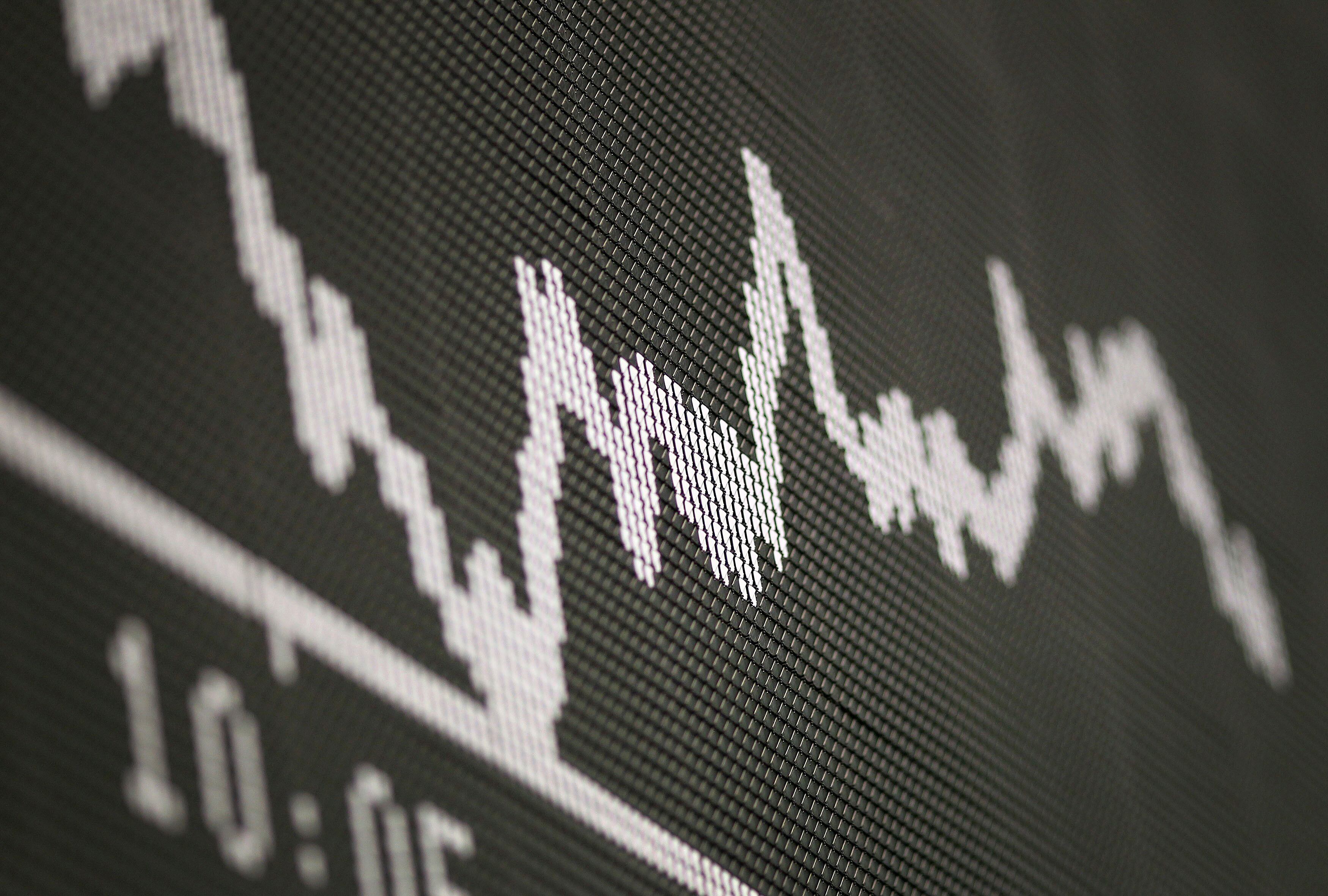
Stocks are opening sharply lower on Wall Street, putting the market on track for its worst week since October 2008 during the global financial crisis. U.S. indexes fell 1.8% following steep losses in Europe and Asia. The rout is driven by fear that the virus that emerged in China will derail the global economy. Investors continue to buy up low-risk assets like bonds, sending yields to record lows.
The Dow Jones Industrial Average lost 463 points, or 1.8%, to 25,311. The S&P 500 lost 54 points, or 1.8%, to 2,922. The Nasdaq fell 143 points, or 1.7%, to 8,423.
Germany's DAX skidded as much as 5% before stabilizing, Tokyo and Shanghai closed 3.7% lower. Wall Street looked set for more losses a day after enduring its biggest one-day drop in nine years. Futures for the Dow Jones Industrial Average and S&P 500 were down 0.4%.
Investors had been growing confident the disease that emerged in China in December might be under control. But outbreaks in Italy, South Korea, Japan and Iran have fueled fears the virus is turning into a global threat that might derail trade and industry.
Anxiety intensified Thursday when the United States reported its first virus case in someone who hadn't traveled abroad or been in contact with anyone who had.
Virus fears “have become full-blown across the globe as cases outside China climb,” Chang Wei Liang and Eugene Leow of DBS said in a report.
In Europe, London's FTSE 100 sank 2.9% to 6,599 and Frankfurt's DAX tumbled 3.3% to 11,955. France's CAC 40 lost 2.7% to 5,346. The Stoxx Europe 600 index is heading for its sharpest weekly drop since October 2008.
Markets in China and Hong Kong had been doing relatively well despite virus fears. Mainland markets were flooded with credit by authorities to shore up prices after trading resumed following an extended Lunar New Year holiday. Chinese investor sentiment also has been buoyed by promises of lower interest rates, tax breaks and other aid to help revive manufacturing and other industries.
But now, major companies are issuing profit warnings, saying factory shutdowns in China are disrupting supply chains. They say travel bans and other anti-disease measures are hurting sales in China, an increasingly vital consumer market.
In Asian trading on Friday, the Nikkei 225 in Tokyo tumbled 3.7% to 21,142.96 and the Shanghai Composite Index also fell 3.7%, to 2,880.30. Hong Kong's Hang Seng lost 2.5% to 26,129.93.
The Kospi in Seoul fell 3.3% to 1,987.01 and Sydney's S&P-ASX 200 sank 3.2% to 6,441.2. India's Sensex skidded 3.6% to 38,331.87. New Zealand and Southeast Asian markets also retreated.
On Thursday, the S&P 500 fell 4.4% to 2,978.76. The index is down 12% from its all-time high a week ago, putting the market into what traders call a correction.
Some analysts have said that was overdue in a record-setting bull market, though Mizuho Bank noted hitting that status in just six days was “the fastest correction since the Great Depression” in the 1930s.
Investors came into 2020 feeling confident the Federal Reserve would keep interest rates at low levels and the U.S.-China trade war posed less of a threat to company profits after the two sides signed a truce in January.
The market's sharp drop this week partly reflects increasing fears among many economists that the U.S. and global economies could take a bigger hit from the coronavirus than previously thought, weakening consumer confidence and depressing spending.
The Dow shed 1,190.95 points on Thursday, its largest one-day point drop in history, bringing its loss for the week to 3,225.77 points, or 11.1%. To put that in perspective, the Dow's 508-point loss on Oct. 19, 1987, was equal to 22.6%.
“It is a race to the bottom for U.S. indices,” Jingyi Pan of IG said in a report. “It may still be too early to call a bottom given the uncertainty around the matter of the coronavirus impact.”
U.S. bond prices soared Thursday as investors fled to safe investments. The yield on the benchmark 10-year Treasury note, or the difference between the market price and what an investor will be paid if the bond is held to maturity, fell to a record low of 1.16%.
A shrinking yield caused by investors shifting money into the relative safety of bonds and pushing up their market price is a sign of weakening confidence in the economy.
Most access to the city of Wuhan, a manufacturing hub of 11 million people at the center of the outbreak, was suspended Jan. 23. The Lunar New Year holiday was extended to keep factories and offices closed. The government told the public to stay home.
China has begun trying to reopen factories and other businesses in areas with low risk after shutting down much of its economy to stem the spread of the infection. Travel controls remain in effect in many areas and elsewhere governments are tightening anti-disease controls as new cases mount.
Japan is preparing to close schools nationwide and officials on the northern island of Hokkaido, where there are more than 60 confirmed cases of the virus, declared a state of emergency and asked residents to stay home over the weekend if possible. Saudi Arabia has banned foreign pilgrims from entering the kingdom to visit Islam’s holiest sites. Italy has become the center of the outbreak in Europe.
“The more countries that are faced with fighting a pandemic, the wider the potential for economic disruption and potential for increased recessionary risks,” said Tai Hui of J.P. Morgan Asset Management in a report.
In energy markets Friday, benchmark U.S. crude fell $1.35 to $45.74 per barrel in electronic trading on the New York Mercantile Exchange. The contract lost $1.64 on Thursday. Brent crude oil, used to price international oils, sank $1.11 to $50.62 per barrel in London. It declined $1.25 the previous session.
The dollar rose to 108.74 yen from Thursday's 109.58 yen. The euro dropped to $1.0991 from $1.0998.