By Stan Choe
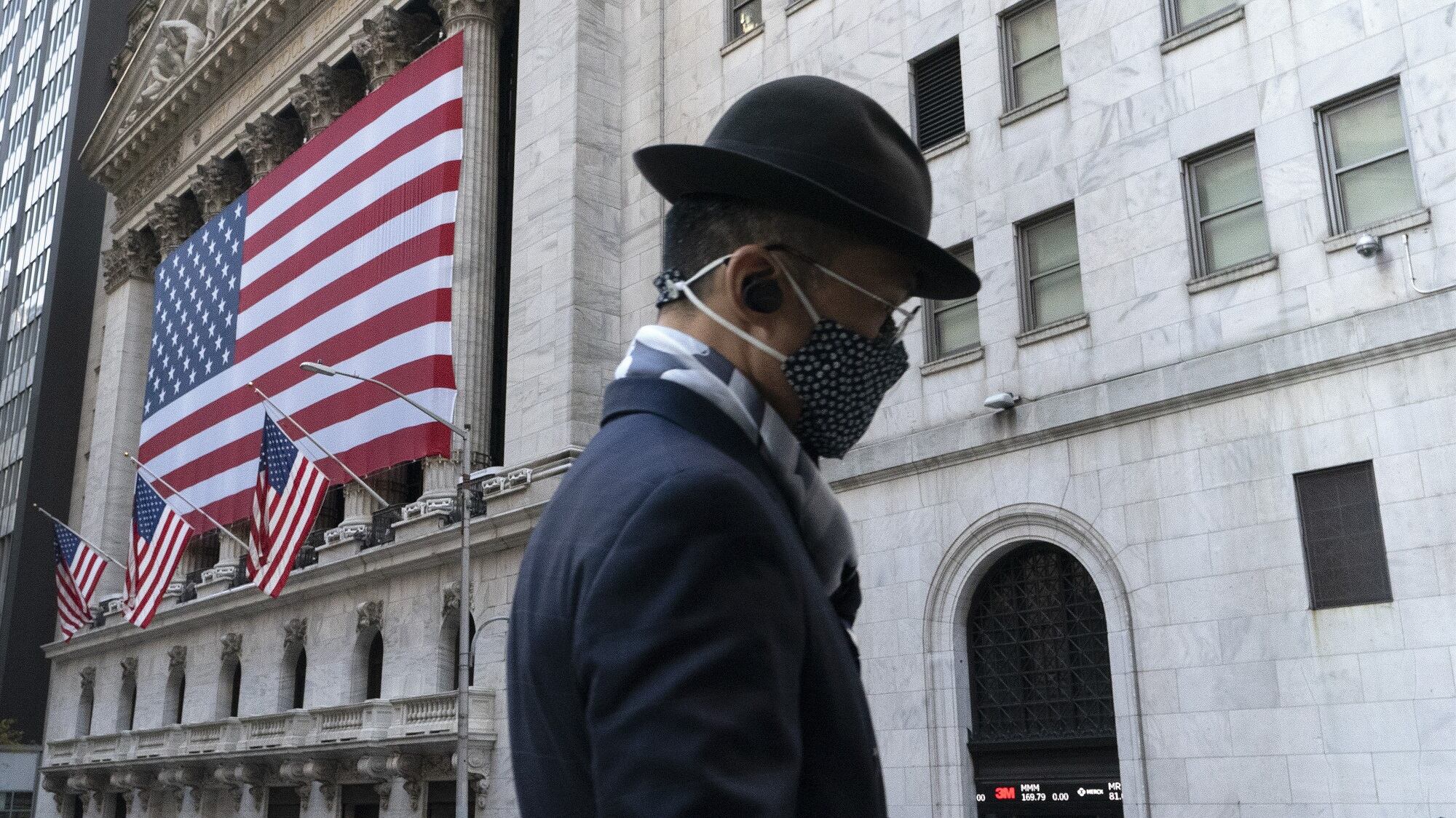
The Dow Jones Industrial Average returned to a record Monday for the first time since plunging nine months ago in despair about the pandemic, riding a swell of optimism that a vaccine may soon control the coronavirus and the economic destruction it’s caused.
Moderna said early in the morning that its COVID-19 vaccine appears to be 94.5% effective, according to preliminary data. It’s the second time this month that a company unveiled such encouraging numbers about a vaccine, boosting hopes that the global economy can return to some semblance of normal next year.
Leading the way again were stocks of companies that would benefit most from an economy busting out of its forced hibernation, such as airlines, movie theaters and banks. At the same time, pandemic-winning stocks that benefited from lockdown orders like Amazon and Zoom Video Communications lagged as they no longer looked like the only safe bets to play.
The Dow jumped 470.63 points, or 1.6%, to 29,950.44. It surpassed its prior closing record of 29,551.42, set in February before pandemic panic hit the market.
The S&P 500, which matters more to the performance of most 401(k) accounts, added to its own record set on Friday. It rose 41.76, or 1.2%, to 3,626.91. The Nasdaq composite gained 94.84, or 0.8%, to 11,924.13. It lagged the rest of the market amid lessened interest for tech stocks.
Treasury yields, oil prices and stocks around the world also rallied on the shot of increased optimism. A vaccine is precisely what markets have been waiting for to pull the global economy out of its cavern, and analysts say it’s a game-changer.
Of course, for all its euphoria, many risks remain for the market. It’s still not guaranteed when a vaccine could be widely available, let alone whether one ultimately will. The pandemic is continuing to worsen, meanwhile, with rising coronavirus counts across the United States and Europe pushing governments to bring back varying degrees of restrictions on businesses. Some areas of the economy have been slowing, particularly after big financial-support programs from Congress expired.
“The vaccine could help people breathe a sigh of relief, but the devil is in the details,” said Gene Goldman, chief investment officer at Cetera Financial Group, referring to the need for more complete data and eventual distribution plans.
But investors, for now, are focusing on the possibility of a world next year where customers are again going outside to work at offices, buying things at enclosed stores and heading on vacations.
It was just a week ago that Pfizer and BioNTech sent optimism soaring with their encouraging vaccine data results. Movie-theater chain Cinemark has surged 58.3% since just before the announcement. Stocks of smaller companies, whose prices tend to sway more with the strength of the economy, are up more than double their larger rivals over the same time: an 8.6% jump for the Russell 2000 index of small-cap stocks versus 3.5% for the S&P 500.
Stocks of companies that had thrived amid lockdowns and vigilance about the virus, meanwhile, have lagged. Amazon, Netflix and Etsy are all down more than 5% since just before Pfizer’s announcement. Zoom has sunk 20.2%.
The shift in market sentiment is perhaps most clear in the stock prices of Peloton, with its at-home exercise bikes, and the Planet Fitness chain of gyms. Peloton is down 18.8% since Nov. 6, versus a gain of more than 5.7% for Planet Fitness.
Investors aren’t abandoning Big Tech amid the vaccine hopes. But the ability of Apple, Microsoft and other behemoths to stand so clearly apart from the rest of the market has diminished a bit. That has many money managers pulling some of the big profits made on Big Tech and steering them into beaten-down areas of the market.
Of course, such movements could limit the gains for broad index funds. Stocks with bigger market values hold bigger sway on the S&P 500 and other indexes, which means any slowdown for Big Tech could diminish movements for the funds at the center of many 401(k) accounts, even if the rest of the market is rising.
“That’s sometimes what happens when you get a rotation, especially into the smaller stocks,” said Barry James, portfolio manager with James Investment Research. “You don’t see it. It’s almost invisible.”
Even before Moderna's vaccine news, markets had been trading higher as investors welcomed the signing on Sunday of an agreement establishing the world’s biggest trade bloc, a group of 15 countries that includes China, Japan, South Korea, 10 countries in Southeast Asia, New Zealand and Australia. The United States, the No. 1 economy, is not a part of it.
Called the Regional Comprehensive Economic Partnership, the pact mostly will bring already low tariffs lower over a 20-year period. It is expected to have a positive but incremental impact on trade in the region.
Japan’s Nikkei 225 rose 2.1%, South Korea’s Kospi gained 2% and Hong Kong’s Hang Seng added 0.9%. France’s CAC 40 jumped 1.7%, and Germany’s DAX returned 0.5%. The FTSE 100 in London gained 1.7%.
Benchmark U.S. crude oil climbed 3% to settle at $41.34 per barrel amid hopes that a healthier economy would burn more fuel. Brent crude, the international standard, rose 2.4% to settle at $43.82 per barrel.
The yield on the 10-year Treasury rose to 0.90% from 0.87% late Friday.
AP Business Writers Elaine Kurtenbach, Joe McDonald and Yuri Kageyama contributed.
Updated November 16, 2020 at 4:35pm with latest information.