Stocks rose solidly in early trading Wednesday as investors regained an appetite for risk after two days of heavy losses.
The sharp drops, which wiped out the market's gains for the year, were brought on by worries over economic fallout from the virus outbreak that originated in China.
The virus continues to spread and threatens to hurt industrial production, consumer spending, and travel. More cases are being reported in Europe and the Middle East. Health officials in the U.S. have been warning Americans to prepare for the virus.
Investors are setting aside some of their concerns for the time being and bid up technology stocks. Microsoft rose 1.5 percent and Adobe rose 1.8 percent. The tech sector was among the worst hit by sell-offs this week as many of the companies rely on global sales and supply chains that could be stifled by the spreading coronavirus.
Health care companies also climbed. UnitedHealth Group rose 1.9 percent.
Bond prices fell and pushed yields higher. The yield on the 10-year Treasury rose to 1.36 percent from 1.33 percent late Tuesday.
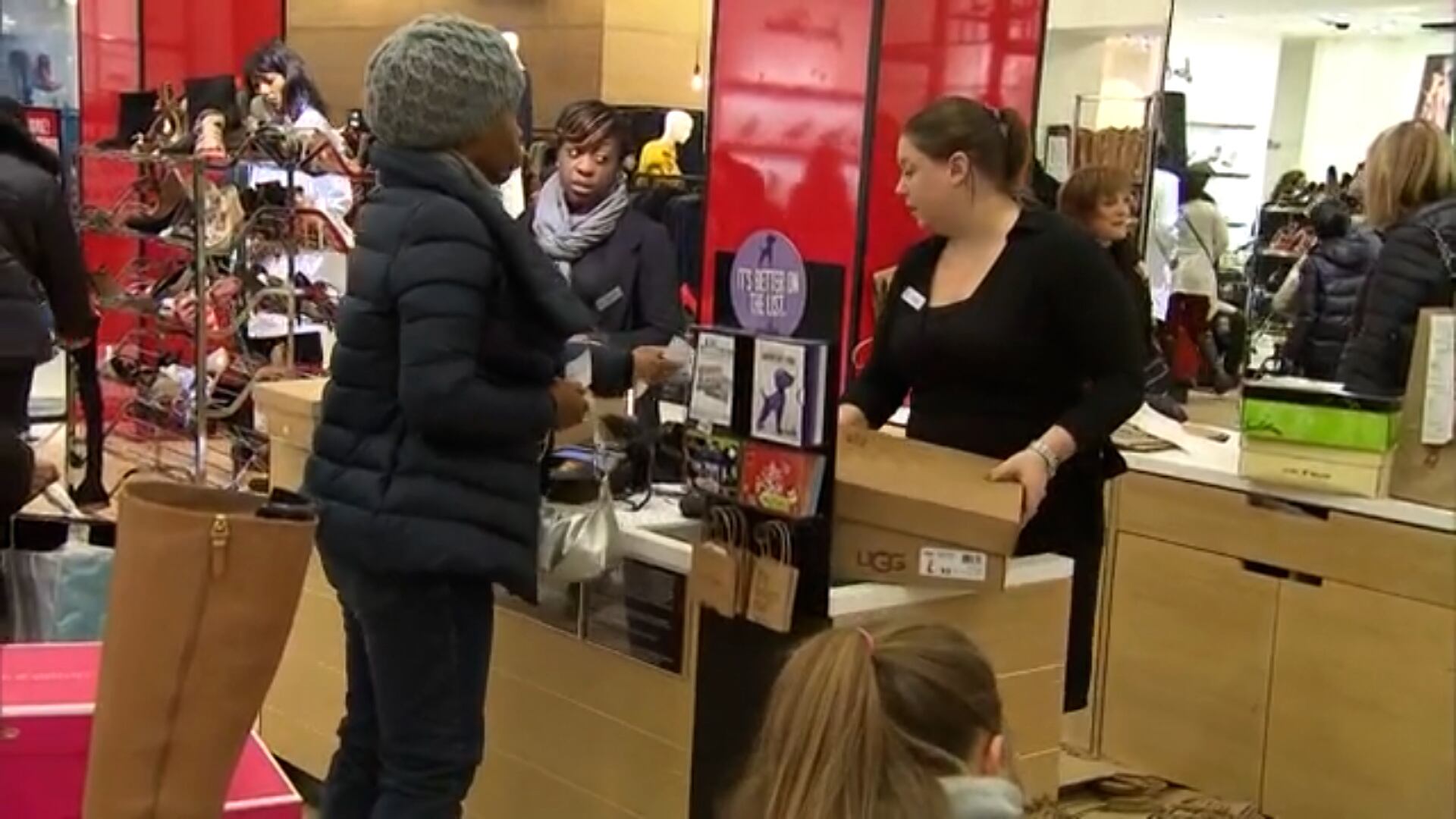
TJX, the parent of retailer TJ Maxx, surged 7.7 percent after beating Wall Street's fourth-quarter profit forecasts and raising its dividend.
Utilities and real estate companies lagged the market in another sign that investors were shifting away from safe-play stocks.
VIRUS UPDATE: The virus outbreak has now infected more than 81,000 people globally and continues spreading. Brazil has confirmed the first case in Latin America. Germany, France, and Spain were among the European nations with growing caseloads. New cases are also being reported in several Middle Eastern nations.
President Donald Trump will hold a news conference later Wednesday, along with representatives from the Centers for Disease Control, to discuss the virus.
KEEPING SCORE: The S&P 500 index rose 1.2 percent as of 10:20 a.m. Following its two-day drop, it's still down 6.4 percent from the record high it reached last Wednesday.
The Dow Jones Industrial Average rose 335 points, or 1.2 percent, to 27,423. The Nasdaq rose 1.5 percent. The Russell 2000 index of smaller-company stocks rose 0.6 percent.
European markets were mixed and Asian markets fell.
MOUSE EXIT: Disney fell 0.5 percent following Bob Iger's surprise announcement that he will immediately step down as CEO of the entertainment company. Iger steered the company's absorption of big moneymakers, including Star Wars, Pixar, Marvel and Fox's entertainment businesses. He also oversaw the launch of the Disney Plus streaming video service.
BUSTED BUILDERS: Toll Brothers fell 10.1 percent and weighed down other homebuilders after reporting disappointing fiscal first-quarter profit. D.R. Horton fell 2.7 percent and PulteGroup shed 2.9 percent.
Wine subscription service Winc is officially a publicly-traded company after debuting on the New York Stock Exchange. CEO Geoff McFarlane and President Brian Smith joined Cheddar to talk about the decision behind the public offering and noted that its service goes beyond just subscriptions. "We're an omnichannel platform, so the subscription is a great way for us to really generate a ton of data from our customers, launch new products, and market our portfolio," McFarlane said. "But ultimately when we find great products that our customers really love, we want them to be everywhere." He went on to point to distribution partners like Whole Foods, Walmart, and Trader Joe's.
Roy Banks, CEO of Weave Communication, a cloud-based software company for small businesses, joined Cheddar to talk about the company's New York Stock Exchange debut. Banks broke down just how his company helps small businesses manage relationships with their customer base and also laid out how the funds raised will be used to grow the business and its short and long term goals.
Jeff Powell, Managing Partner & CIO at Polaris Wealth Advisory Group, discusses how supply chain issues and inflation will impact consumer spending, and discusses the future of the electric vehicle market.
Sotheby's is getting into the crypto game. The auction house announced it will now be accepting bids in increments of ETH, marking the first time that an auction will field live bids in crypto. This announcement comes just a week ahead of Sotheby's contemporary art auction 'The Now Evening Auction' for two works by Banksy: Trolley Hunters and Love is in the Air. Alex Branczik, Sotheby's Chairman for Modern & Contemporary Art joined Cheddar's Opening Bell to discuss what went into this move.
Jim Worden, Chief Investment Officer, Wealth Consulting Group, talks about the consumer spending headwinds and breaks down the bright spots from Disney's earnings and Rivian's IPO.
Autonomous tech developer Embark made its Nasdaq debut on Thursday via a SPAC merger, making its CEO Alex Rodrigues, the youngest chief executive of a publicly-traded company at the age of 26. He joined Cheddar's "Between Bells" to discuss what led to the IPO and what it means for the trucking industry as it looks to navigate ongoing supply chain issues. "I think there are really three major benefits to autonomous trucks. You think about the benefit from an efficiency perspective, from a safety perspective, and from an environmental perspective," Rodrigues noted.
AppHarvest CEO Jonathan Webb joined Cheddar's "Opening Bell" to talk about the company's Q3 earnings, stating sales data showed the indoor farming tech firm remained on track with its 2021 outlook. Webb also discussed a new campaign called "Fight The Food Fight," to encourage consumers to support a more resilient, sustainable food system.
Inflation hit a concerning milestone last month, rising by as much as 6.2 percent, the highest that it's been since 1990. Consumer pockets felt the increase the most in gas and food costs. Jason Ware, Chief Investment Officer at Albion Financial Group spoke to Cheddar about what lead to the spike in costs and if high inflation will be here to stay in 2022.
Mike Proulx, VP and research director at Forrester, joined Cheddar to talk all about Disney's lackluster Q3 earnings after the company reported a slowdown in Disney+ subscriber growth. Proulx discussed a Forrester study that found 45 percent of U.S. adults subscribed to streaming services because of the pandemic but 26 percent had plans to cancel a service over the next two years. "We're always going to look at growth, and we also have to look at engagement," he said. "But both of those metrics come down to having either original or exclusive content that will offer value to the subscriber base."