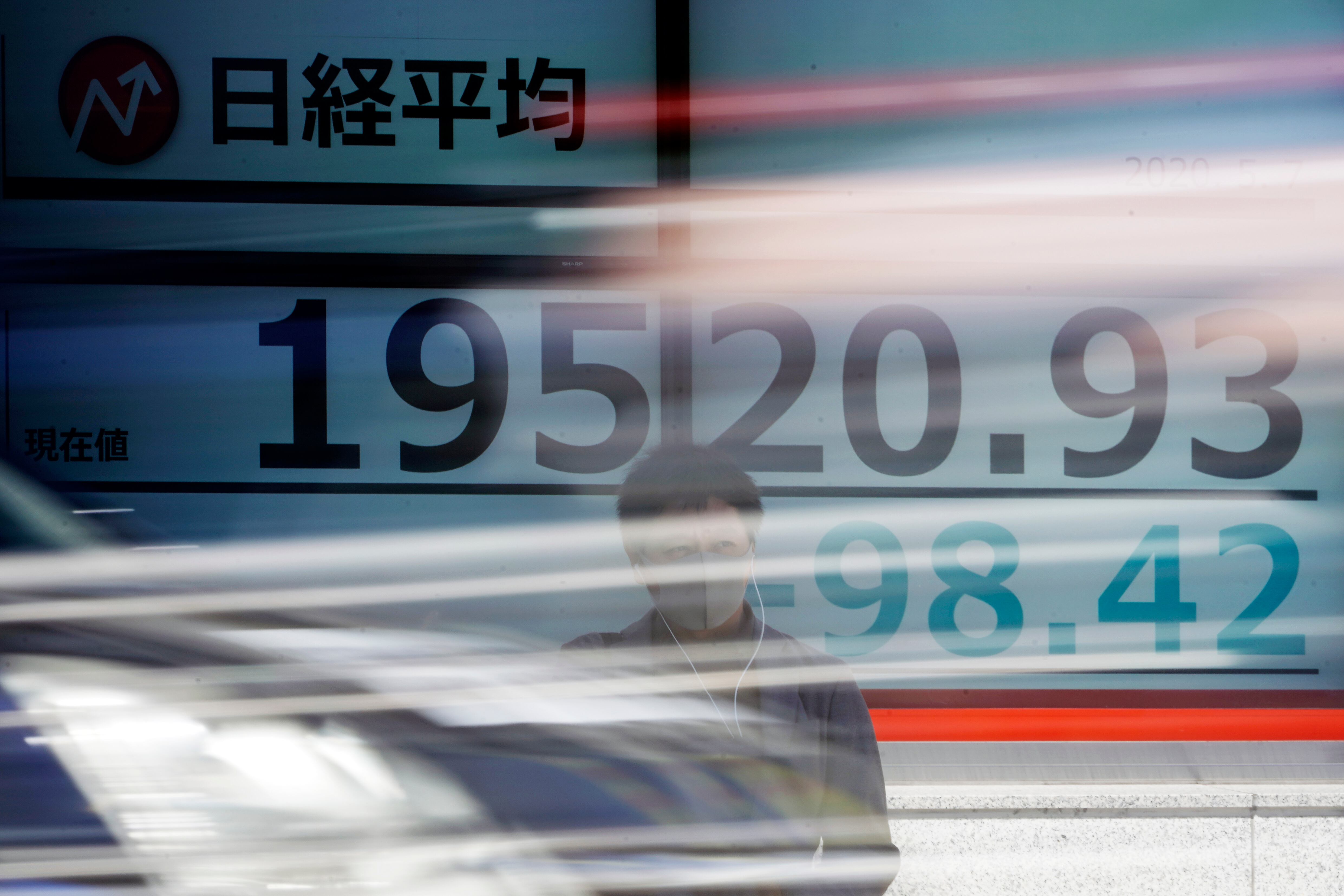
A man stands near an electronic stock board showing Japan's Nikkei 225 index at a securities firm in Tokyo Thursday, May 7, 2020. Asian shares were mixed Thursday after a decline on Wall Street after more depressing data rolled in on the devastation sweeping the global economy. (AP Photo/Eugene Hoshiko)
Stocks climbed in early trading on Wall Street Thursday as reports suggested that even though the economy is still suffering severely, the pace of pain may be decelerating. The S&P 500 rose 1.3%, following similar gains in Europe. The day’s headliner economic report showed another 3.2 million U.S. workers applied for jobless benefits last week, bringing the total over the last seven weeks to 33.5 million. It’s a shocking number, but it’s also the fifth straight week of decline since hitting a peak in late March. Several companies including Lyft and PayPal said they were seeing some encouraging trends in their businesses.
THIS IS A BREAKING NEWS UPDATE. AP’s earlier story is below:
Stock markets and the price of oil pushed higher on Thursday ahead of the latest weekly jobless claims figures in the U.S. and after China reported a rise in exports as its pandemic lockdown eased.
As more countries start to remove the draconian limits on business and public life, investors are trying to gauge how quickly the global economy might bounce back.
The labor market in the United States has been a focal point. On Thursday, government data will likely show that about 3.5 million people sought jobless aid last week, bringing the total to nearly 34 million since the shutdowns began seven weeks ago. On Friday, a monthly report is expected to show that the unemployment rate jumped to at least 16% in April — from just 4.4% in March.
Wall Street futures were up ahead of the start to trading, with Dow futures up 1.3% and those for the S&P 500 up 1.4%.
In Europe, France’s CAC 40 gained 0.8% to 4,470. Germany’s DAX also added 0.8%, to 10,692, while Britain’s FTSE 100 rose 0.7% to 5,895.
The Chinese trade data showed an encouraging 3.5% rise in exports in April, driven by electronics shipments and textiles, which included a surge in mask exports.
The data show China’s exports to the United States rose 2.2% in April, while imports of American goods fell 11% in a reflection of weak Chinese industrial and consumer demand despite the lifting of most anti-virus controls.
Imports fell 13.7% from a year earlier to $179.6 billion, worse than the first quarter’s 2.9% decline. But total exports rose to $200.3 billion, a turnaround from the 13.3% contraction in the three months ending in March.
Forecasters warned that strength is unlikely to last as the coronavirus pandemic depresses global consumer demand.
Comments by President Donald Trump raising the possibility of further trade friction with Beijing have worried investors hoping for better times as other economies begin to reopen from pandemic shutdowns.
Trump said he would soon assess progress in a preliminary trade agreement with China that took effect in January, extending a truce in a painful tariffs war between the world’s two biggest economies.
The possibility of revived friction over trade at a time when economies have been slammed by the pandemic and resulting travel restrictions has rattled investors in Asia, where China is the main driver for regional growth.
“President Trump’s latest threat to impose additional tariffs on China could also bring some front-loading exports in the near term," Wang said.
Most Asian markets slipped Thursday, but Japan's benchmark Nikkei 225, reopening after Golden Week holidays, gained 0.3% to finish at 19,674.77.
South Korea's Kospi was little changed, inching down less than 0.1% to 1,928.61. Australia's S&P/ASX 200 lost 0.4% to 5,364.20. Hong Kong's Hang Seng fell 0.7% to 23,980.63, while the Shanghai Composite fell 0.2% to 2,871.52.
Benchmark U.S. crude surged $2.51 to $26.50a barrel in electronic trading on the New York Mercantile Exchange. It fell 57 cents, or 2.3%, to $23.99 a barrel Wednesday.
Brent crude oil, the international standard, gained $1.98 to $31.70 a barrel.
The dollar inched up to 106.60 Japanese yen from 106.13 yen Wednesday. The euro weakened to $1.0790 from $1.0795.
The one-hour special 'Cannabiz: Legalization Goes Mainstream' explores the state of marijuana. Cheddar News is joined by Rep. Earl Blumenauer (D-OR), Village CEO Dan Pettigrew, and many more.
Bitcoin is still struggling to hold $47,000 and is well off from the near $68,000 high it saw in November. As the Federal Open Market Committee wraps up its two-day monetary policy meeting, some crypto investors are worried as they wait for news on policy. Shiv Madan, CEO of Moonwalk joins Cheddar News to discuss what's in store for the industry.
We're entering a brave new world of broadly legal sports betting. Over 30 states and Washington, DC, have legalized sports betting in the year and a half since the supreme court struck down the federal ban on the activity.
But legalization isn't a simple proposition. The federal law might be struck down but its still up to each state to decide whether to legalize sports betting, and answer a litany of questions that come with it. Should you include online gambling? How much should people be allowed to bet? Should there be limits on advertising for sports betting?
Darren Heitner, founder of Heitner Legal, and Daniel Wallach, founder of Wallach Legal, join None of the Above's "Business of Sports: The Year Gambling Took Over" special to discuss.
Over the past decade, the resale market has completely transformed, allowing people to utilize platforms such as Etsy, Poshmark, eBay, and more to create a lucrative business from the comfort of their homes. However, as the space of secondhand sellers and thrifters gets more and more crowded, small businesses are facing bigger obstacles to not only thrive in the market but also survive. Yvette Liebesman, a law professor at Saint Louis, joins Cheddar News to discuss.
Even as tech giant Google implements a vaccination mandate, charging its employees to declare their vaccine status within a time frame or risk dismissal, the federal government is tangled up in the court system trying to impose one of its own. Cindy Cohn, the executive director of the Electronic Frontier Foundation, and Harry Nelson, founder and managing partner of Nelson Hardiman LLP, joined Cheddar to debate the ethics, efficacy, and legality surrounding the issue. While Cohn noted that she thinks the federal mandate might be legally sound, her organization is also concerned with a separate question of privacy. "At EFF what we're most interested in is the digital surveillance that's going along with some of these attempts to try to track and confirm whether people are vaccinated or not," she said.
A new report from CNBC says Instagram recently reached a new milestone -- 2 billion monthly active users. It comes amid a year of controversy for the photo-sharing app and its parent company, Meta. SocialFlow CEO Jim Anderson joins Cheddar News' Closing Bell to discuss.
A report from KPMG International found that global mergers and acquisitions in 2021 reached $5.1 trillion in transactions. Carol Streicher, U.S. deal advisory and strategy service group leader for KPMG, joined Cheddar's "Closing Bell" to talk about the record-breaking year and next year's outlook, which KPMG says could be even more staggering. "We're not seeing any slow down in '22," she said, regarding survey results of 350 business leaders. "Things that were tailwinds for us in M&A activity this past year are going to continue to be tailwinds for us in 2022."
MotorTrend named the Rivian R1T as the 2022 truck of the year - a prestigious title given by the publication as a way for automakers to tout third-party validation. Rivian beat out traditional, legacy truck favorites like Ford and General Motors.
MotorTrend said the company earned high marks for safety, efficiency, value, advanced design, engineering excellence, and performance of intended function. MotorTend head of editorial Ed Loh joins Cheddar News' Closing Bell to discuss.