Stocks climbed in early trading on Wall Street Thursday as reports suggested that even though the economy is still suffering severely, the pace of pain may be decelerating. The S&P 500 rose 1.3%, following similar gains in Europe. The day’s headliner economic report showed another 3.2 million U.S. workers applied for jobless benefits last week, bringing the total over the last seven weeks to 33.5 million. It’s a shocking number, but it’s also the fifth straight week of decline since hitting a peak in late March. Several companies including Lyft and PayPal said they were seeing some encouraging trends in their businesses.

THIS IS A BREAKING NEWS UPDATE. AP’s earlier story is below:

Stock markets and the price of oil pushed higher on Thursday ahead of the latest weekly jobless claims figures in the U.S. and after China reported a rise in exports as its pandemic lockdown eased.

As more countries start to remove the draconian limits on business and public life, investors are trying to gauge how quickly the global economy might bounce back.

The labor market in the United States has been a focal point. On Thursday, government data will likely show that about 3.5 million people sought jobless aid last week, bringing the total to nearly 34 million since the shutdowns began seven weeks ago. On Friday, a monthly report is expected to show that the unemployment rate jumped to at least 16% in April — from just 4.4% in March.

Wall Street futures were up ahead of the start to trading, with Dow futures up 1.3% and those for the S&P 500 up 1.4%.

In Europe, France’s CAC 40 gained 0.8% to 4,470. Germany’s DAX also added 0.8%, to 10,692, while Britain’s FTSE 100 rose 0.7% to 5,895.

The Chinese trade data showed an encouraging 3.5% rise in exports in April, driven by electronics shipments and textiles, which included a surge in mask exports.

The data show China’s exports to the United States rose 2.2% in April, while imports of American goods fell 11% in a reflection of weak Chinese industrial and consumer demand despite the lifting of most anti-virus controls.

Imports fell 13.7% from a year earlier to $179.6 billion, worse than the first quarter’s 2.9% decline. But total exports rose to $200.3 billion, a turnaround from the 13.3% contraction in the three months ending in March.

Forecasters warned that strength is unlikely to last as the coronavirus pandemic depresses global consumer demand.

Comments by President Donald Trump raising the possibility of further trade friction with Beijing have worried investors hoping for better times as other economies begin to reopen from pandemic shutdowns.

Trump said he would soon assess progress in a preliminary trade agreement with China that took effect in January, extending a truce in a painful tariffs war between the world’s two biggest economies.

The possibility of revived friction over trade at a time when economies have been slammed by the pandemic and resulting travel restrictions has rattled investors in Asia, where China is the main driver for regional growth.

“President Trump’s latest threat to impose additional tariffs on China could also bring some front-loading exports in the near term," Wang said.

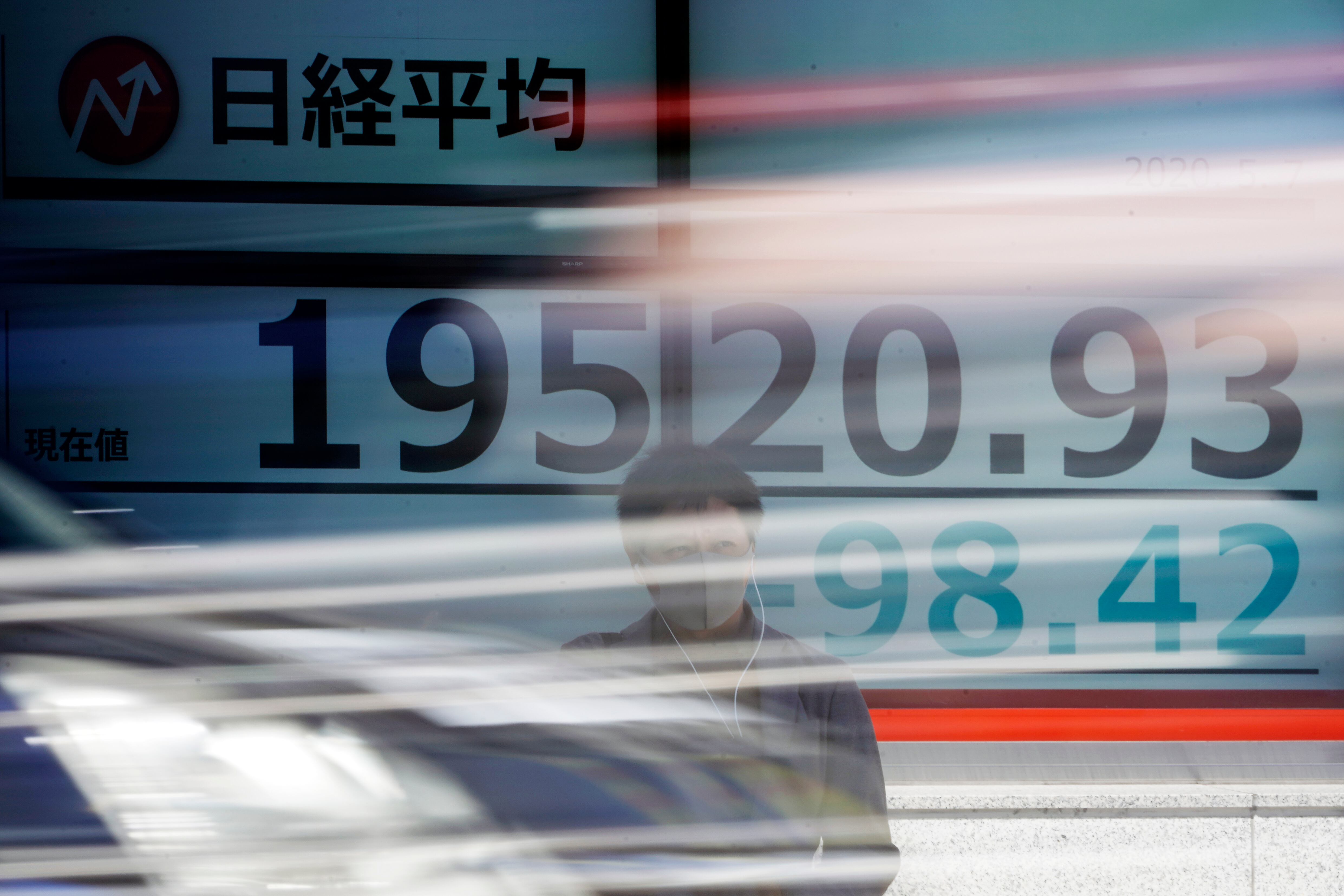
Most Asian markets slipped Thursday, but Japan's benchmark Nikkei 225, reopening after Golden Week holidays, gained 0.3% to finish at 19,674.77.

South Korea's Kospi was little changed, inching down less than 0.1% to 1,928.61. Australia's S&P/ASX 200 lost 0.4% to 5,364.20. Hong Kong's Hang Seng fell 0.7% to 23,980.63, while the Shanghai Composite fell 0.2% to 2,871.52.

Benchmark U.S. crude surged $2.51 to $26.50a barrel in electronic trading on the New York Mercantile Exchange. It fell 57 cents, or 2.3%, to $23.99 a barrel Wednesday.

Brent crude oil, the international standard, gained $1.98 to $31.70 a barrel.

The dollar inched up to 106.60 Japanese yen from 106.13 yen Wednesday. The euro weakened to $1.0790 from $1.0795.

___

AP Business Writer Joe McDonald contributed.

Share:
More In Business
Holiday Retail Sales Rose 8.5% From 2020, Mastercard Says
Despite challenges like inflation, labor and product shortages, and the Omicron variant, holiday sales saw record levels of growth this year, according to a new report from Mastercard SpendingPulse. The group reports on national retail sales across all payment types, finding that holiday sales rose at the fastest pace in 17 years this year. Mastercard senior advisor and former chariman and CEO of Saks Incorporated Steve Sadove joined Cheddar News' Closing Bell to discuss.
Talking Tesla EV Challengers in China: Huawei, Nio, and XPeng
Keith Fitz-Gerald, chief investment officer at Fitz-Gerald Group, spoke to Cheddar about the growing competition for Tesla's electric cars in China as tech giant Huawei enters the race. "There's a lot of legacy worry, but that does not discount the possibility that Elon might have a contender on his hands," he said about the sometimes troubled telecom company. Fitz-Gerald also gave a nod to two other local rivals, Nio and XPeng, noting the latter as having something of an edge with its CEO He Xiopeng being lauded by Chinese state media.
Home Essentials Brand Parachute Sees Strong 2022 for Brick and Mortar Retail
Ariel Kaye, ​founder and CEO of home goods business Parachute, joined Cheddar to discuss the company's sales success over the holidays as it navigated supply chain issues. She also expects a strong showing in 2022 with the continuation of 2021 trends. "The hybrid work model is going to be here for a long time," Kaye said. The business, which currently has 12 physical locations, plans to expand to 30 brick-and-mortar shops by the end of 2022.
Nikola Delivery of First Electric Trucks Sets Stage for EVs in 2022
Nikola announced that it delivered its first electric semi trucks last week, sending the embattled EV company's stock soaring. There is a lot of competition in this space, though, said Lauren Fix, an automotive analyst with Car Coach Reports. While every country has companies racing to dominate the electric trucking industry, she explained, a shortage of graphite, used in batteries, and a dearth of convenient charging stations will still keep growth slow in 2022. "You really have to be very careful when you're investing in this marketplace," Fix said. "That's great that [Nikola was] able to deliver one, but can they deliver more?"
Holiday Retail Sales Soared 8.5 Percent Despite Supply Chain Woes
It looks like the supply chain didn't steal Christmas this year after all. Retail sales jumped 8.5 percent between November 1 and December 24, compared with the same period last year, according to a report from Mastercard. That's the strongest growth in 17 years. Jharonne Martis, director of consumer research at Refinitiv, joined Cheddar to discuss how retailers were able to do so well despite inflation, supply chain issues, and the COVID-19 omicron variant but gave a subdued outlook for the retail sector at the beginning of 2022. "Consumers are not just completely isolated from the inflation issues," she said. "This is definitely going to continue into the first half of the year, as per our IFR data."
Travel Cancellations Rise As Omicron Spreads
Hotel cancellations are on the rise ahead of the holidays as the omicron variant spreads around the world. Online hotel search site Trivago noted a 35 percent jump in cancellations since November. Axel Hefer, managing director and CEO at Trivago, joined Cheddar to discuss this worrying trend. Hefner said it is important for both travelers and businesses to watch how the 2021-2022 winter travel season unfolds as it will help them prepare for next year as the pandemic will likely be ongoing.
Markets Open Slightly Higher As Investors Monitor Omicron Risk
Markets opened slightly higher to kick off the final trading week of the year as investors continue to watch the Omicron variant in the U.S. Sean O'Hara, President, Pacer ETFs joined Cheddar's Opening Bell to discuss what drove early market activity.
Load More