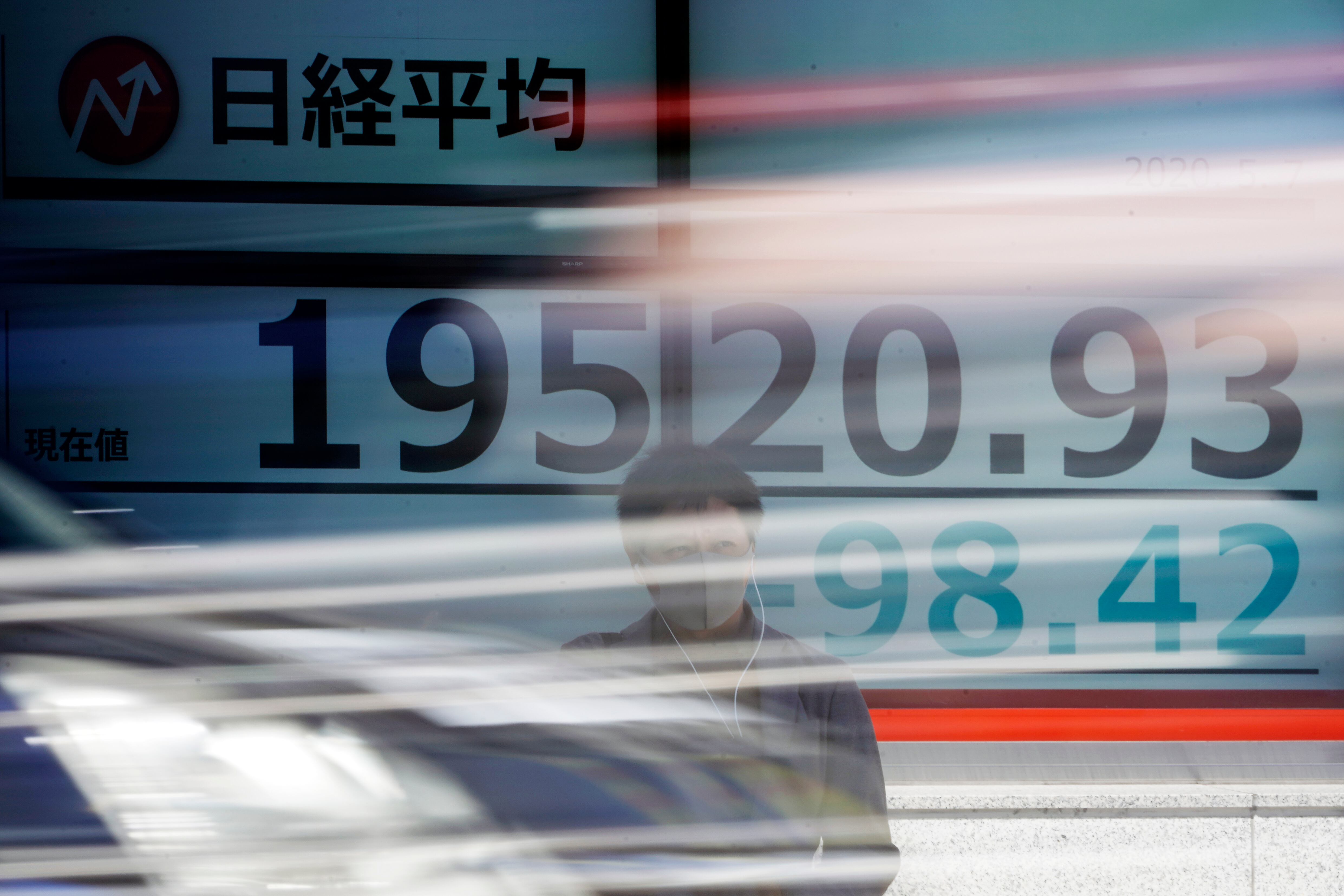
A man stands near an electronic stock board showing Japan's Nikkei 225 index at a securities firm in Tokyo Thursday, May 7, 2020. Asian shares were mixed Thursday after a decline on Wall Street after more depressing data rolled in on the devastation sweeping the global economy. (AP Photo/Eugene Hoshiko)
Stocks climbed in early trading on Wall Street Thursday as reports suggested that even though the economy is still suffering severely, the pace of pain may be decelerating. The S&P 500 rose 1.3%, following similar gains in Europe. The day’s headliner economic report showed another 3.2 million U.S. workers applied for jobless benefits last week, bringing the total over the last seven weeks to 33.5 million. It’s a shocking number, but it’s also the fifth straight week of decline since hitting a peak in late March. Several companies including Lyft and PayPal said they were seeing some encouraging trends in their businesses.
THIS IS A BREAKING NEWS UPDATE. AP’s earlier story is below:
Stock markets and the price of oil pushed higher on Thursday ahead of the latest weekly jobless claims figures in the U.S. and after China reported a rise in exports as its pandemic lockdown eased.
As more countries start to remove the draconian limits on business and public life, investors are trying to gauge how quickly the global economy might bounce back.
The labor market in the United States has been a focal point. On Thursday, government data will likely show that about 3.5 million people sought jobless aid last week, bringing the total to nearly 34 million since the shutdowns began seven weeks ago. On Friday, a monthly report is expected to show that the unemployment rate jumped to at least 16% in April — from just 4.4% in March.
Wall Street futures were up ahead of the start to trading, with Dow futures up 1.3% and those for the S&P 500 up 1.4%.
In Europe, France’s CAC 40 gained 0.8% to 4,470. Germany’s DAX also added 0.8%, to 10,692, while Britain’s FTSE 100 rose 0.7% to 5,895.
The Chinese trade data showed an encouraging 3.5% rise in exports in April, driven by electronics shipments and textiles, which included a surge in mask exports.
The data show China’s exports to the United States rose 2.2% in April, while imports of American goods fell 11% in a reflection of weak Chinese industrial and consumer demand despite the lifting of most anti-virus controls.
Imports fell 13.7% from a year earlier to $179.6 billion, worse than the first quarter’s 2.9% decline. But total exports rose to $200.3 billion, a turnaround from the 13.3% contraction in the three months ending in March.
Forecasters warned that strength is unlikely to last as the coronavirus pandemic depresses global consumer demand.
Comments by President Donald Trump raising the possibility of further trade friction with Beijing have worried investors hoping for better times as other economies begin to reopen from pandemic shutdowns.
Trump said he would soon assess progress in a preliminary trade agreement with China that took effect in January, extending a truce in a painful tariffs war between the world’s two biggest economies.
The possibility of revived friction over trade at a time when economies have been slammed by the pandemic and resulting travel restrictions has rattled investors in Asia, where China is the main driver for regional growth.
“President Trump’s latest threat to impose additional tariffs on China could also bring some front-loading exports in the near term," Wang said.
Most Asian markets slipped Thursday, but Japan's benchmark Nikkei 225, reopening after Golden Week holidays, gained 0.3% to finish at 19,674.77.
South Korea's Kospi was little changed, inching down less than 0.1% to 1,928.61. Australia's S&P/ASX 200 lost 0.4% to 5,364.20. Hong Kong's Hang Seng fell 0.7% to 23,980.63, while the Shanghai Composite fell 0.2% to 2,871.52.
Benchmark U.S. crude surged $2.51 to $26.50a barrel in electronic trading on the New York Mercantile Exchange. It fell 57 cents, or 2.3%, to $23.99 a barrel Wednesday.
Brent crude oil, the international standard, gained $1.98 to $31.70 a barrel.
The dollar inched up to 106.60 Japanese yen from 106.13 yen Wednesday. The euro weakened to $1.0790 from $1.0795.
Jim Worden, Chief Investment Officer at Wealth Consulting Group, joins Cheddar News' Closing Bell, where he says the period between Christmas and New Year's is difficult to predict due to a lack of institutional volume, with the Omicron variant adding even more uncertainty on Wall Street.
Prices at the pump this year reached a seven-year high, and a new forecast from GasBuddy shared with CNN predicts that gas prices will only continue to rise in 2022 and that the national average could even reach $4.00 a gallon; however, analysts at GasBuddy say anything could happen when it comes to gas prices in the future, as the pandemic has made it difficult to make any predictions about the economy. Consumer Energy Alliance federal policy advisor Michael Zehr joins Cheddar News' Closing Bell to discuss.
The record-breaking success of "Squid Game" on Netflix has many media companies competing to produce, stream, and invest in new content from South Korea. Netflix has spent half a billion dollars on developing Korean content this year, and other streaming services are taking note. Seth Schachner, managing director at StratAmericas and digital business executive, joins Cheddar News to discuss.
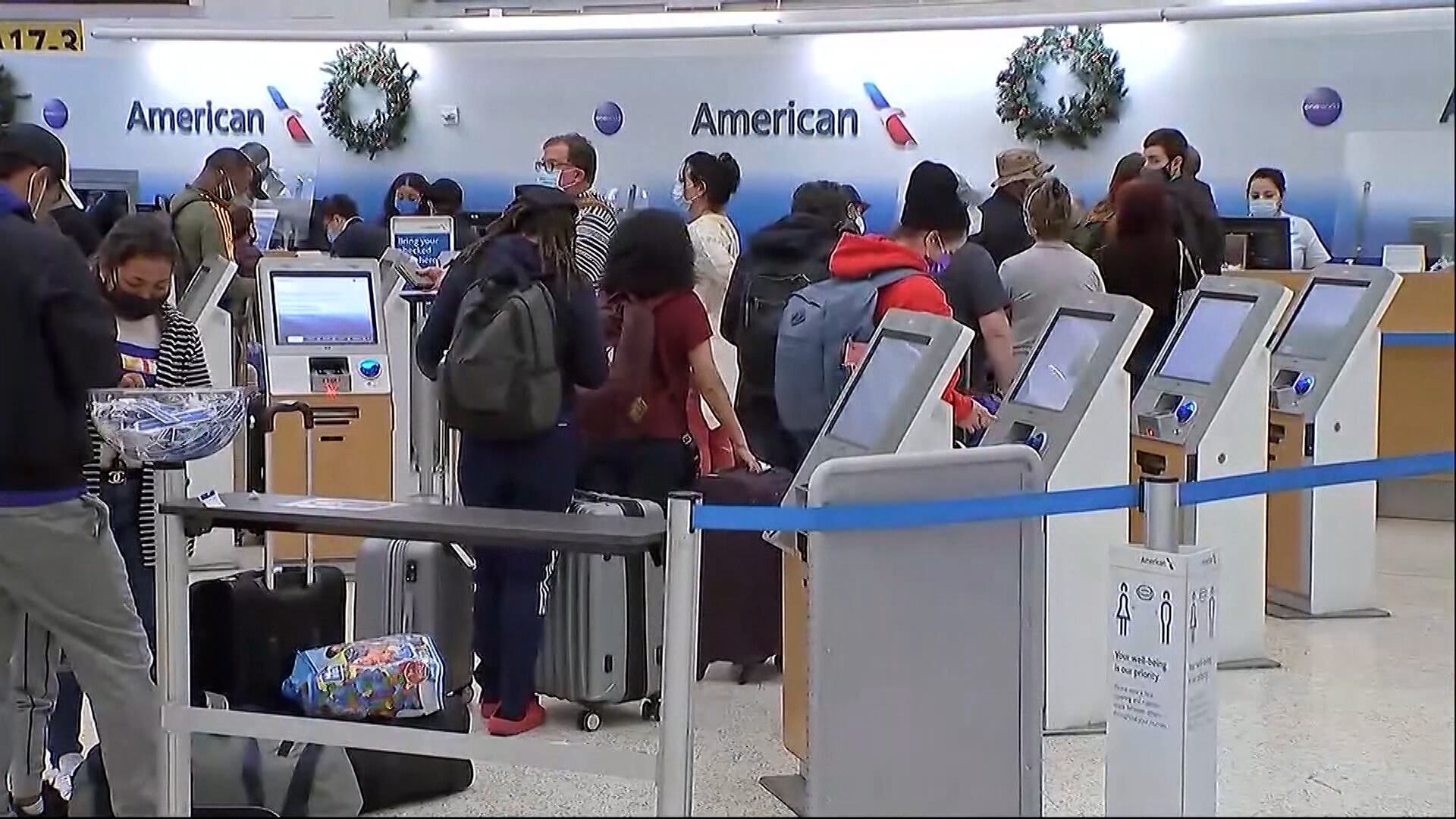
Airlines had to ground 2,500 flights in the U.S. on Tuesday, with bad weather and workers out with COVID-19 blamed as the main culprits. Scott Keyes, founder of ScottsCheapFlights.com and author of "Take More Vacations," joined Cheddar News Wrap to discuss how the surge from the omicron variant has been creating havoc in the air travel industry. Keyes noted that a lack of personnel from pilots to gate agents had been exacerbated by the coronavirus, an issue also disrupting labor markets throughout the economy. "Add to that the fact that travel has rebounded far quicker than many analysts and experts predicted, this is why I think you're seeing so many airlines caught a bit flat-footed in having to pare back the schedules they had set months ago," he said.
Barstool Sports CEO Erika Nardini joined Cheddar's Kristen Scholer to discuss plans for the future even as COVID-19 upended Barstool's sponsorship of the Arizona Bowl featuring the Boise State Broncos and the Central Michigan Chippewas due to the spreading omicron variant. "In our case as a company, coronavirus has been a big boom for us," she noted. "We've been able to create a lot of new programming, launch a lot of different personalities, and frankly take share from traditional media, and that's what we've done the entire pandemic." While she admitted to taking a hit on the canceled Bowl game, live events aren't completely off the table for Barstool in 2022. Nardini also talked about potential sports betting expansion following its partnership with Penn National Gaming.
Interest in the concept of the metaverse is heating up as more companies get on board, and Cathy Hackl, CEO of Futures Intelligence Group, a metaverse-focused consultancy, joined Cheddar to talk about trends to watch out for in 2022 and what it will take for it to be more than just a buzzword. Hackl noted that businesses likely will have to consider big technology upgrades in the upcoming year in order to keep up. "We're going to need new levels of computing power to be able to enable shared virtual experiences, both in VR but also in augmented reality," she said.
Stocks closed near session highs today amid a rebound from sell-offs fueled by fears of the Omicron COVID-19 variant. 1879 Advisors Vice Chairman Jim Bruderman joined Cheddar News' Closing Bell to discuss the markets' close and new economic data out today.
Small businesses in Washington, DC, are getting a visibility boost through the non-profit Grow Golden. The initiative connects local entrepreneurs with empty storefronts to establish pop-up shops in the heart of the DC business district, called the Golden Triangle. Cheddar's Arielle Hixson spoke with the small business owners about their experience building exposure through the program during the holiday season.
Home flipping is turning into a competitive space and a less profitable one according to the property database ATTOM. Todd Teta, chief product officer at ATTOM Data Solutions, joined Cheddar to break down key findings of the report, why the home-flipping market is raking in fewer returns, and what he thinks may have been behind real estate marketplace Zillow withdrawing from the business.