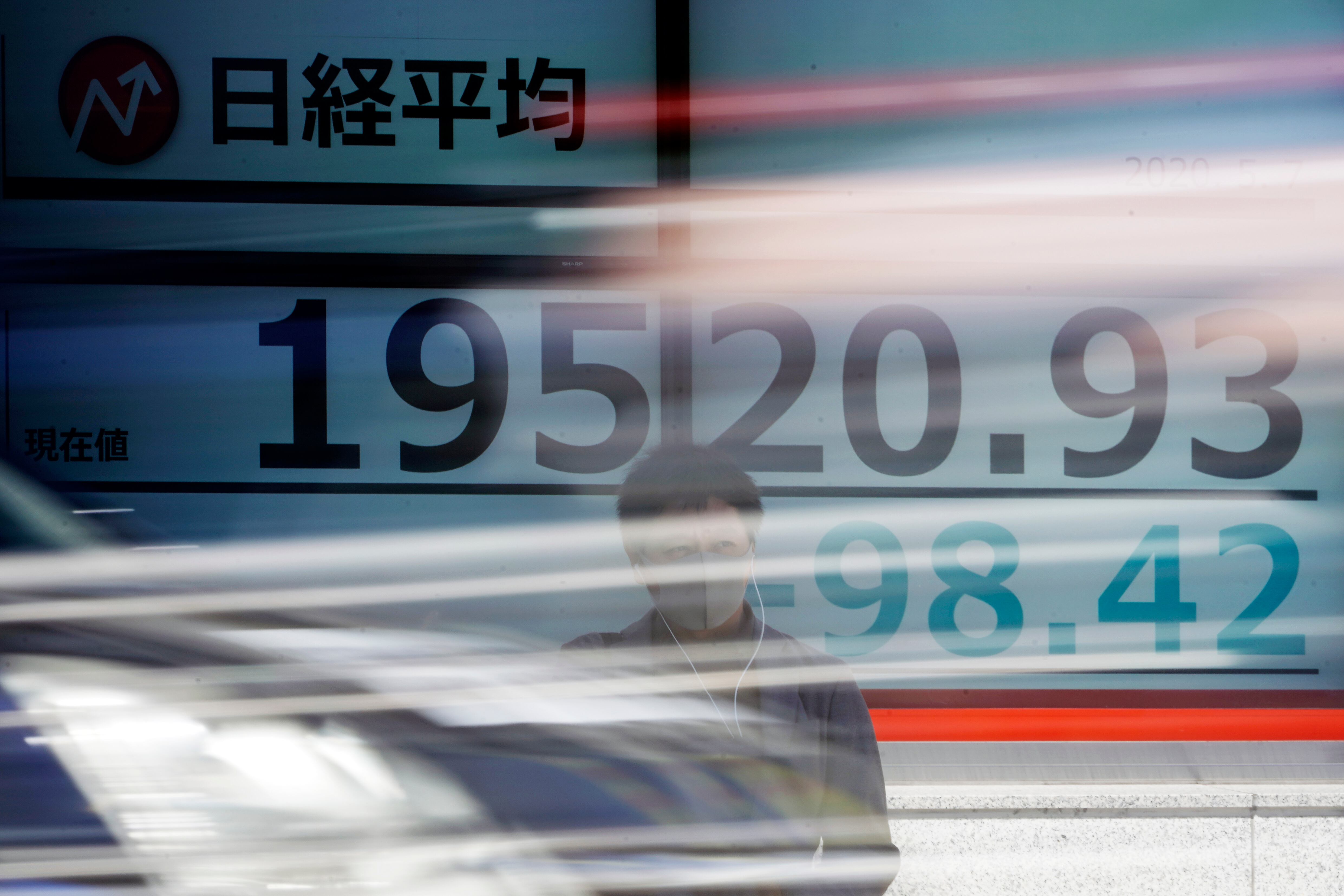
Stocks climbed in early trading on Wall Street Thursday as reports suggested that even though the economy is still suffering severely, the pace of pain may be decelerating. The S&P 500 rose 1.3%, following similar gains in Europe. The day’s headliner economic report showed another 3.2 million U.S. workers applied for jobless benefits last week, bringing the total over the last seven weeks to 33.5 million. It’s a shocking number, but it’s also the fifth straight week of decline since hitting a peak in late March. Several companies including Lyft and PayPal said they were seeing some encouraging trends in their businesses.
THIS IS A BREAKING NEWS UPDATE. AP’s earlier story is below:
Stock markets and the price of oil pushed higher on Thursday ahead of the latest weekly jobless claims figures in the U.S. and after China reported a rise in exports as its pandemic lockdown eased.
As more countries start to remove the draconian limits on business and public life, investors are trying to gauge how quickly the global economy might bounce back.
The labor market in the United States has been a focal point. On Thursday, government data will likely show that about 3.5 million people sought jobless aid last week, bringing the total to nearly 34 million since the shutdowns began seven weeks ago. On Friday, a monthly report is expected to show that the unemployment rate jumped to at least 16% in April — from just 4.4% in March.
Wall Street futures were up ahead of the start to trading, with Dow futures up 1.3% and those for the S&P 500 up 1.4%.
In Europe, France’s CAC 40 gained 0.8% to 4,470. Germany’s DAX also added 0.8%, to 10,692, while Britain’s FTSE 100 rose 0.7% to 5,895.
The Chinese trade data showed an encouraging 3.5% rise in exports in April, driven by electronics shipments and textiles, which included a surge in mask exports.
The data show China’s exports to the United States rose 2.2% in April, while imports of American goods fell 11% in a reflection of weak Chinese industrial and consumer demand despite the lifting of most anti-virus controls.
Imports fell 13.7% from a year earlier to $179.6 billion, worse than the first quarter’s 2.9% decline. But total exports rose to $200.3 billion, a turnaround from the 13.3% contraction in the three months ending in March.
Forecasters warned that strength is unlikely to last as the coronavirus pandemic depresses global consumer demand.
Comments by President Donald Trump raising the possibility of further trade friction with Beijing have worried investors hoping for better times as other economies begin to reopen from pandemic shutdowns.
Trump said he would soon assess progress in a preliminary trade agreement with China that took effect in January, extending a truce in a painful tariffs war between the world’s two biggest economies.
The possibility of revived friction over trade at a time when economies have been slammed by the pandemic and resulting travel restrictions has rattled investors in Asia, where China is the main driver for regional growth.
“President Trump’s latest threat to impose additional tariffs on China could also bring some front-loading exports in the near term," Wang said.
Most Asian markets slipped Thursday, but Japan's benchmark Nikkei 225, reopening after Golden Week holidays, gained 0.3% to finish at 19,674.77.
South Korea's Kospi was little changed, inching down less than 0.1% to 1,928.61. Australia's S&P/ASX 200 lost 0.4% to 5,364.20. Hong Kong's Hang Seng fell 0.7% to 23,980.63, while the Shanghai Composite fell 0.2% to 2,871.52.
Benchmark U.S. crude surged $2.51 to $26.50a barrel in electronic trading on the New York Mercantile Exchange. It fell 57 cents, or 2.3%, to $23.99 a barrel Wednesday.
Brent crude oil, the international standard, gained $1.98 to $31.70 a barrel.
The dollar inched up to 106.60 Japanese yen from 106.13 yen Wednesday. The euro weakened to $1.0790 from $1.0795.
___
AP Business Writer Joe McDonald contributed.