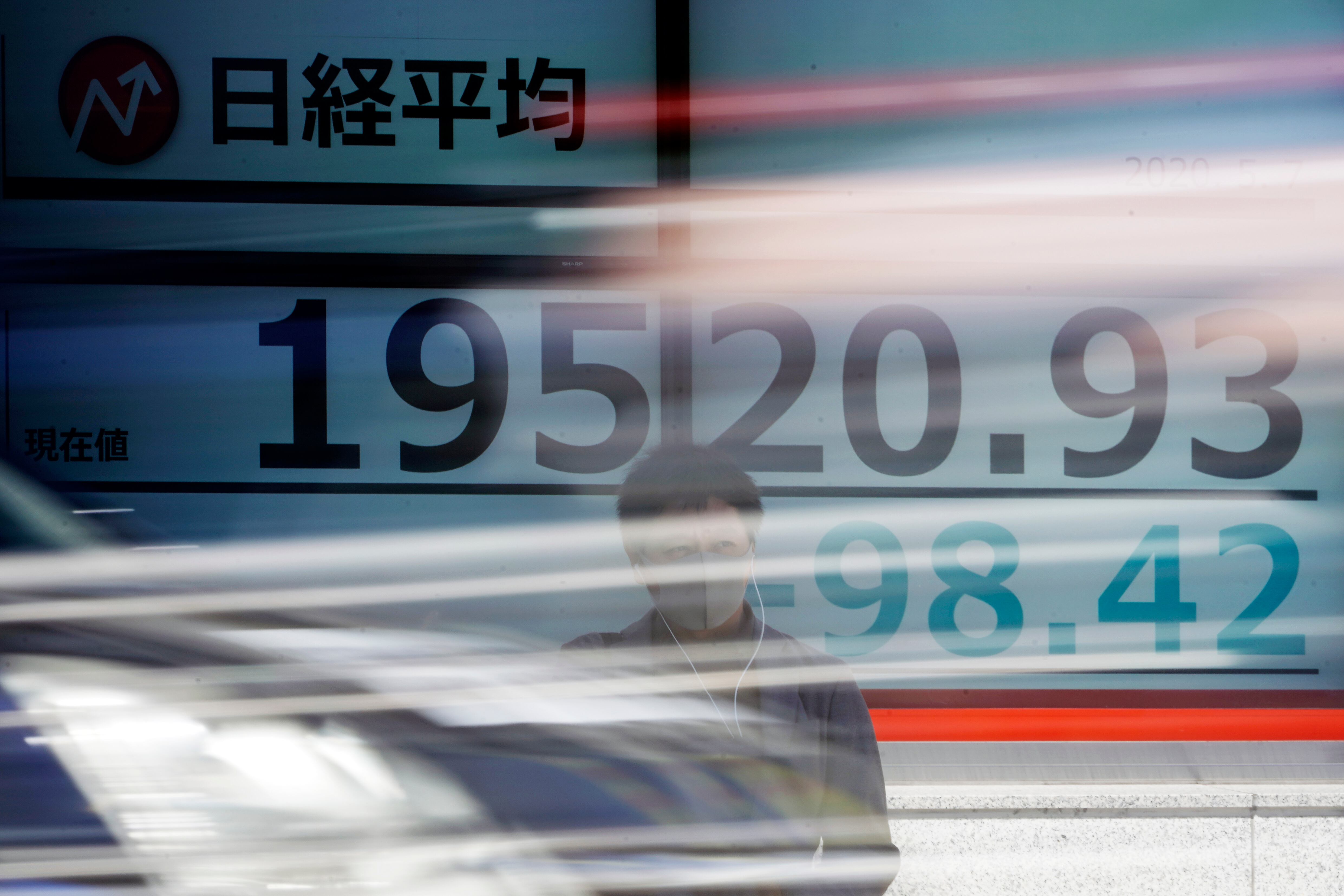
A man stands near an electronic stock board showing Japan's Nikkei 225 index at a securities firm in Tokyo Thursday, May 7, 2020. Asian shares were mixed Thursday after a decline on Wall Street after more depressing data rolled in on the devastation sweeping the global economy. (AP Photo/Eugene Hoshiko)
Stocks climbed in early trading on Wall Street Thursday as reports suggested that even though the economy is still suffering severely, the pace of pain may be decelerating. The S&P 500 rose 1.3%, following similar gains in Europe. The day’s headliner economic report showed another 3.2 million U.S. workers applied for jobless benefits last week, bringing the total over the last seven weeks to 33.5 million. It’s a shocking number, but it’s also the fifth straight week of decline since hitting a peak in late March. Several companies including Lyft and PayPal said they were seeing some encouraging trends in their businesses.
THIS IS A BREAKING NEWS UPDATE. AP’s earlier story is below:
Stock markets and the price of oil pushed higher on Thursday ahead of the latest weekly jobless claims figures in the U.S. and after China reported a rise in exports as its pandemic lockdown eased.
As more countries start to remove the draconian limits on business and public life, investors are trying to gauge how quickly the global economy might bounce back.
The labor market in the United States has been a focal point. On Thursday, government data will likely show that about 3.5 million people sought jobless aid last week, bringing the total to nearly 34 million since the shutdowns began seven weeks ago. On Friday, a monthly report is expected to show that the unemployment rate jumped to at least 16% in April — from just 4.4% in March.
Wall Street futures were up ahead of the start to trading, with Dow futures up 1.3% and those for the S&P 500 up 1.4%.
In Europe, France’s CAC 40 gained 0.8% to 4,470. Germany’s DAX also added 0.8%, to 10,692, while Britain’s FTSE 100 rose 0.7% to 5,895.
The Chinese trade data showed an encouraging 3.5% rise in exports in April, driven by electronics shipments and textiles, which included a surge in mask exports.
The data show China’s exports to the United States rose 2.2% in April, while imports of American goods fell 11% in a reflection of weak Chinese industrial and consumer demand despite the lifting of most anti-virus controls.
Imports fell 13.7% from a year earlier to $179.6 billion, worse than the first quarter’s 2.9% decline. But total exports rose to $200.3 billion, a turnaround from the 13.3% contraction in the three months ending in March.
Forecasters warned that strength is unlikely to last as the coronavirus pandemic depresses global consumer demand.
Comments by President Donald Trump raising the possibility of further trade friction with Beijing have worried investors hoping for better times as other economies begin to reopen from pandemic shutdowns.
Trump said he would soon assess progress in a preliminary trade agreement with China that took effect in January, extending a truce in a painful tariffs war between the world’s two biggest economies.
The possibility of revived friction over trade at a time when economies have been slammed by the pandemic and resulting travel restrictions has rattled investors in Asia, where China is the main driver for regional growth.
“President Trump’s latest threat to impose additional tariffs on China could also bring some front-loading exports in the near term," Wang said.
Most Asian markets slipped Thursday, but Japan's benchmark Nikkei 225, reopening after Golden Week holidays, gained 0.3% to finish at 19,674.77.
South Korea's Kospi was little changed, inching down less than 0.1% to 1,928.61. Australia's S&P/ASX 200 lost 0.4% to 5,364.20. Hong Kong's Hang Seng fell 0.7% to 23,980.63, while the Shanghai Composite fell 0.2% to 2,871.52.
Benchmark U.S. crude surged $2.51 to $26.50a barrel in electronic trading on the New York Mercantile Exchange. It fell 57 cents, or 2.3%, to $23.99 a barrel Wednesday.
Brent crude oil, the international standard, gained $1.98 to $31.70 a barrel.
The dollar inched up to 106.60 Japanese yen from 106.13 yen Wednesday. The euro weakened to $1.0790 from $1.0795.
There may be some light at the end of the tunnel for struggling retailer Kohl's. Shares soared more than 35 percent on Monday on reports that a second takeover could potentially be in the works - just days after a group backed by activist investment firm Starboard Value proposed buying the company. Private equity firm Sycamore Partners has allegedly reached out to Kohl's, offering to pay at least $65 per share in cash for the company - giving it a valuation of close to $9 billion. Joel Bines, Global Head of Retail at AlixPartners, joined Cheddar Movers to discuss the potential takeover as well as the state of retail in the U.S.
Big Apple workers who deliver for food apps like Doordash and Grubhub will now receive a number of legal protections provided through a package of new regulations that have started going into effect. These updated rules include more control over their deliveries, pay and tip transparency, a higher minimum pay rate, and access to restaurant bathrooms during the workday. New York City Comptroller Brad Lander joined Cheddar to elaborate on the regulations and how the platform holders reacted. "I have to say it's a mixed bag," he said. "Grubhub actually welcomed the legislation and said they recognize they need to do better by their deliveristas, but DoorDash, unfortunately, has actually been pushing back against the legislation."
Stocks closed mixed Wednesday after the Federal Reserve's announcement about potential rate hikes this year, beginning as soon as March. That would be the central bank's first rate hike since 2018, and Chair Jerome Powell also didn't rule out a potential rate hike at every meeting in order to combat inflation. RC Peck, CIO of Fearless Wealth, joined Closing Bell to discuss today's close, the Fed's announcement, Tesla's Q4 2021 earnings results, and more.
Stocks closed lower Tuesday, but off session lows amid continued volatility as investors await this week's Federal Reserve meeting, where the central bank is expected to introduce tighter monetary policy. Microsoft also reported second quarter fiscal 2022 earnings after the bell. The tech giant beat on both top and bottom lines, but shares fell after hours. David Stryzewski, CEO of the Sound Planning Group, joins Cheddar News' Closing Bell to discuss today's close, predictions for this week's Fed meeting, Microsoft's earnings report, and more.
Thomas Hoenig, Former CEO of Federal Reserve Bank of Kansas City and currently Distinguished Senior Fellow with the Mercatus Center, joined Cheddar News' Closing Bell, where he says the Fed's decision was no surprise, but believes the Fed is behind the curve on raising rates.
Business communication platform Slack, recently released its fifth wave of results from its global workplace survey from its Future Forum consortium, showing that the workforce has already moved to a split between working from home and going to the office. “We are now officially in the hybrid era of work,” Slack Future Forum VP Sheela Subramanian said when discussing the findings. "Hybrid is a work model where people can come into the office as well as work remotely, and what we're seeing is that the majority of knowledge workers are now in this arrangement — and that number is set to grow."
Legal cannabis businesses are having a hard time surviving in California with the high cost of doing business and a still-thriving illicit market. In response, nonprofit Supernova Women, founded by women of color, is advocating on behalf of Black and brown shareholders in the cannabis industry. Amber Senter, co-founder, executive director, and chairman of the organization, spoke with Cheddar News about calling for changes in the Golden State's taxation system for legal marijuana. "We're really leaning on the legislators now to support the industry and make sure that this industry, in particular craft cannabis, can survive," said Senter.
After being among the hardest-hit industries by the pandemic, restaurants are still having a hard time staying afloat, with owners claiming that business is worse now due to closures from staff shortages and customer decline than it was three months ago. Mike Whatley, vice president of state affairs and grassroots advocacy for the National Restaurant Association, spoke to Cheddar News about how the sector is reaching out to lawmakers for help. "Working with Senators Wicker, Sinema, and a whole host of bipartisan leaders, we're trying to get the Restaurant Revitalization Fund replenished," Whatley said.
Alex Soojung-Kim Pang, founder of Strategy + Rest,
joins Cheddar News to discuss UK's pilot four-day workweek and its impact on workers' mental health.