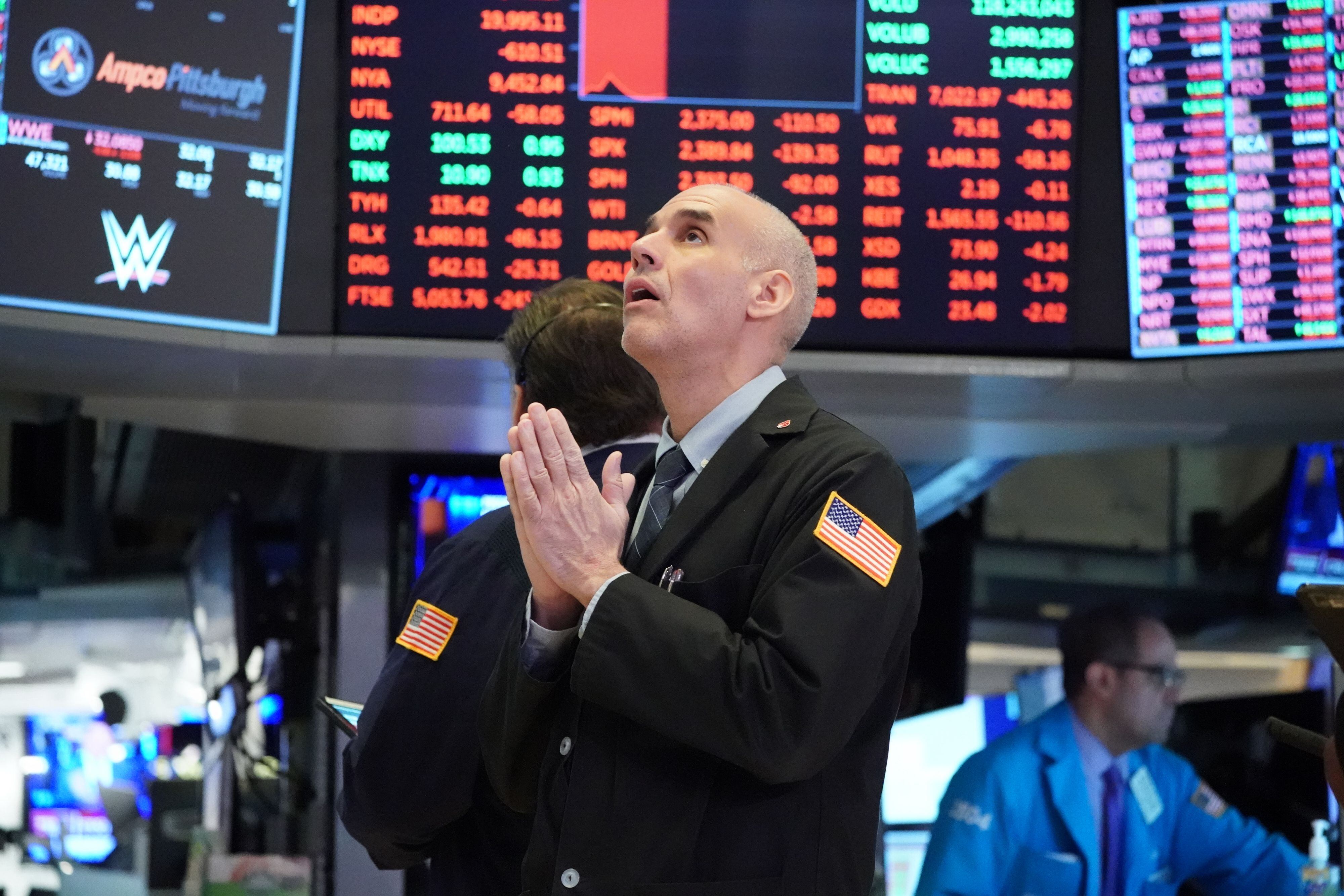
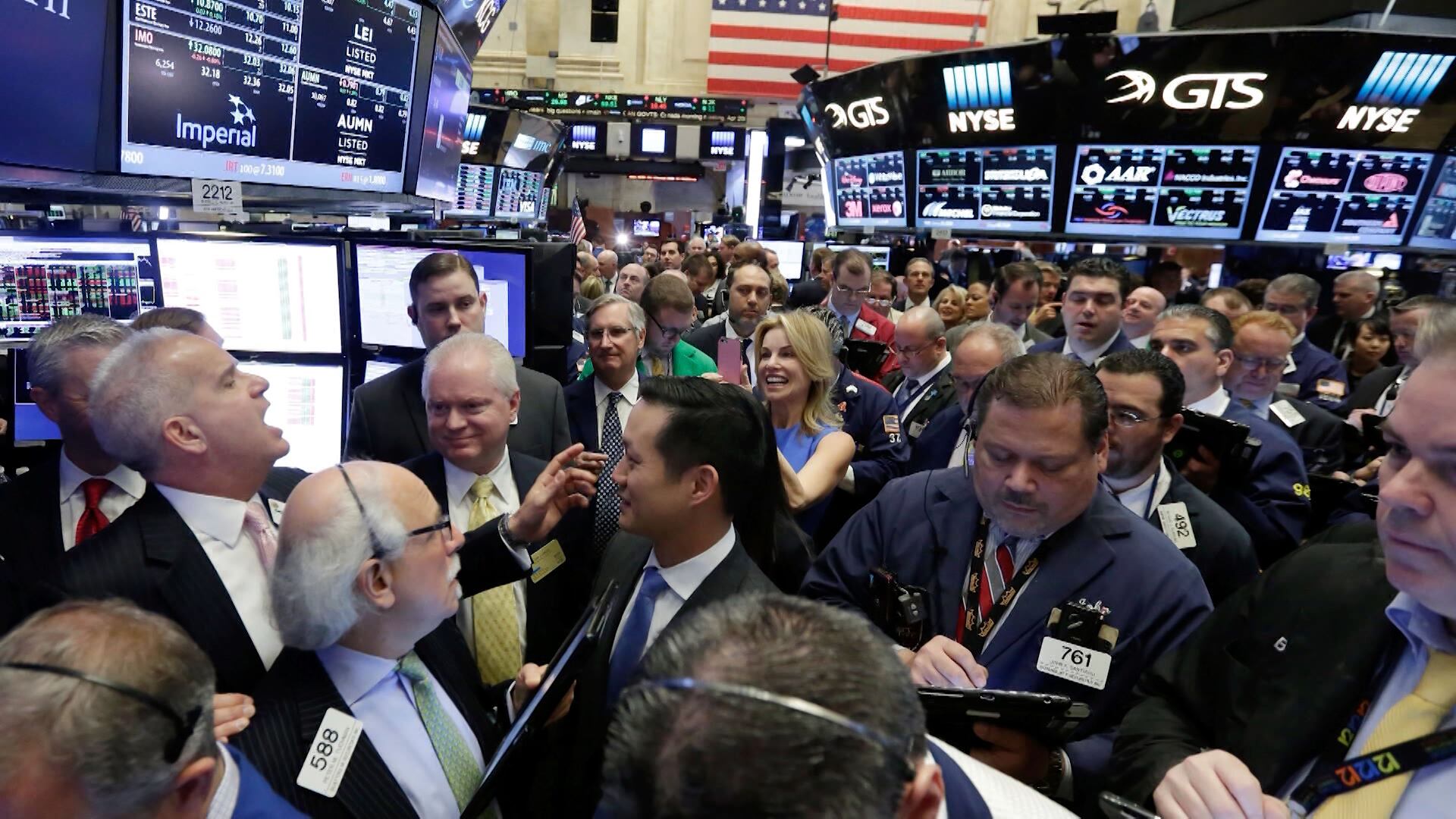
Traders work on the floor at the opening bell of the Dow Industrial Average at the New York Stock Exchange on March 18, 2020 in New York. (Photo by BRYAN R. SMITH/AFP via Getty Images)
By Stan Choe
The vicious swings keep coming for the stock market, and the S&P 500 sank more than 3 percent in early trading Wednesday to erase much of the prior day's big gain.
Markets have been incredibly volatile for weeks as Wall Street and the White House acknowledge an increasing risk of a recession due to the coronavirus outbreak. The typical day this month has seen the stock market swing up or down by 4.9 percent. Over the last decade, the typical move was just 0.4 percent.
The selling pressure swept markets around the world. Benchmark U.S. oil fell 10 percent and dropped below $25 per barrel for the first time since 2002. European stock indexes lost 4 percent following broad losses in Asia. Even prices for longer-term U.S. Treasurys, which are seen as some of the safest possible investments, fell as investors flocked to the very shortest-term Treasury debt.
It was just a day ago that the S&P 500 surged 6 percent after President Donald Trump said he's "going big" in plans to aid an economy that's increasingly shutting down by the day. The program could approach $1 trillion, and it would follow a spate of emergency actions by the Federal Reserve and other central banks to get financial markets running more smoothly.
Despite all that, investors are struggling with how much to pay for anything — stocks, bonds, oil — when it's so uncertain how badly the economy is getting hit, how much profit companies will make and how many companies may go into bankruptcy due to a cash crunch.
"These are truly unprecedented events with no adequate historical example with which to precisely anchor our forecast," Deutsche Bank economists wrote in a report Wednesday.
With all the uncertainty and early evidence that China's economy was hit much harder by the virus than earlier thought, they now see "a severe global recession occurring in the first half of 2020."
But they also are still forecasting a relatively quick rebound, with activity beginning to bounce back in the second half of this year in part because of all the aid promised from central banks and governments.
Investors say they need to see the number of infections slow before markets can find a bottom. The number of new cases reported in China, where the virus emerged in December, is declining but infections in the United States, Europe and elsewhere are increasing.
The number of infections has topped 200,000 worldwide, and the virus has killed more than 8,000.
For most people, the coronavirus causes only mild or moderate symptoms, such as fever and cough, and those with mild illness recover in about two weeks. Severe illness including pneumonia can occur, especially in the elderly and people with existing health problems, and recovery could take six weeks in such cases.
The Dow Jones Industrial Average was down 828 points, or 3.9 percent, shortly after 10 a.m. Eastern time. after being down as many as 1,365 shortly after trading began. If it crosses back over the 1,000 threshold — which is not a big if given how steep swings have been within the same day — it would be the eighth straight day the Dow has moved by that much.
The S&P 500, which dictates how 401(k) accounts perform much more than the Dow, is down nearly 29 percent from its record set last month.
All the uncertainty has pushed many people toward safety. Last month, investors pulled $17.5 billion out of stock mutual funds and exchange-traded funds, even though stocks set all-time highs in the middle of the month. Money-market funds, meanwhile, drew $25.5 billion, according to Morningstar.
That was all before the market's sell-off accelerated this month, as broad swaths of the economy shut down in hopes of better containing the outbreak. Restaurants have closed to dine-in customers, planes are parked and sports arenas have been dimmed. Goldman Sachs strategists describe this month as "March Sadness."
With real estate being a largely male-dominated industry, Stephanie Shojaee, vice president and chief marketing officer at development company Shoma Group, joined Cheddar News to discuss how she took on the gender gap for women to achieve leadership roles, starting at her own company. “It's been very important to teach all the women that work here, especially the younger ones, that they shouldn't change themselves," she said. "You need to be happy with who you are and just keep breaking barriers."
We are already starting to feel the effects of summer. Heat waves in Texas and California are already sending temperatures soaring. That could spell trouble for the nation's power supply. there are new concerns about outages in many areas of the country. Cheddar's Shannon Lanier explains the two main causes of blackouts, and what states are doing to keep the lights on and the air conditioning running.
Pinterest is making a big move as it pushes further into online shopping. The image-focused social media site is acquiring A.I.-powered shopping platform THE YES as it focuses on enhancing the user shopping experience. THE YES's technology gives users a personalized feed of products based on their preferences, and Pinterest is banking on the tech to give it an advantage among other social media apps with built-in shopping features. Julie Bornstein, founder and CEO of THE YES, joins Closing Bell to discuss the company's unique technology, why it agreed to sell to Pinterest, her vision as she takes over shopping initiatives, and more.
Keith Barr, CEO of InterContinental Hotel Group, says he is expecting an 'incredible' summer for his business as pandemic conditions have normalized and people are ready to travel.
Dann Ryan, Chief Investment Officer at Sincerus Advisory, discusses what drove markets lower on Wednesday, as well as what investors are anticipating when it comes to the upcoming CPI report and Fed decision.
U.S. stocks close Tuesday at session highs after a subpar start to the trading day. Tim Chubb, Chief Investment Officer at the wealth advisory firm, Girard, joins Cheddar News' Closing Bell to discuss. 'We're starting to see the moderation of three core things -- we've seen the moderation of prices, we've seen the moderation of wage growth we've seen in the labor market, and we've also seen a moderation of job openings,' he says.
The victims from the USA gymnastics sexual abuse scandal continue to seek justice. Survivors of Larry Nassar are seeking more than one-billion dollars from the FBI for failing to stop the convicted sports doctor when the agency first received allegations. According to a report released by the Justice Department's Inspector General, FBI agents knew
in July of 2015 that Nassar was accused of abusing gymnasts; however, Nassar wasn't arrested until December of 2016. The group that filed the claim includes Olympic medalist Simone Biles and around 90 other women. Louise Radnofsky, sports reporter at The Wall Street Journal, joins Cheddar News' Closing Bell to discuss.
A controversial professional golf tour backed by Saudi Arabia tees off on Thursday. Today, two-time Major winner Dustin Johnson announced he's resigned from the PGA Tour ahead of headlining the Saudi-backed tour, called the LIV Golf Invitation Series. The announcement comes as the PGA tour has threatened disciplinary action for its golfers who take part in the Saudi golf league event, which will also feature notable golf stars like Phil Mickelson and Sergio Garcia; however, LIV Golf's CEO, Greg Norman, told The Washington Post that Tiger Woods rejected a contract worth 'high nine digits' to play in the tour. Chris Bumbaca, reporter for USA Today Sports, joins Cheddar News' Closing Bell to discuss.
CreditCards.com senior industry analyst Ted Rossman compares the Apple Pay Later offering to similar four-step processes at Affirm and Klarna, and says this is a way for the tech giant to dive deeper into the financial industry.