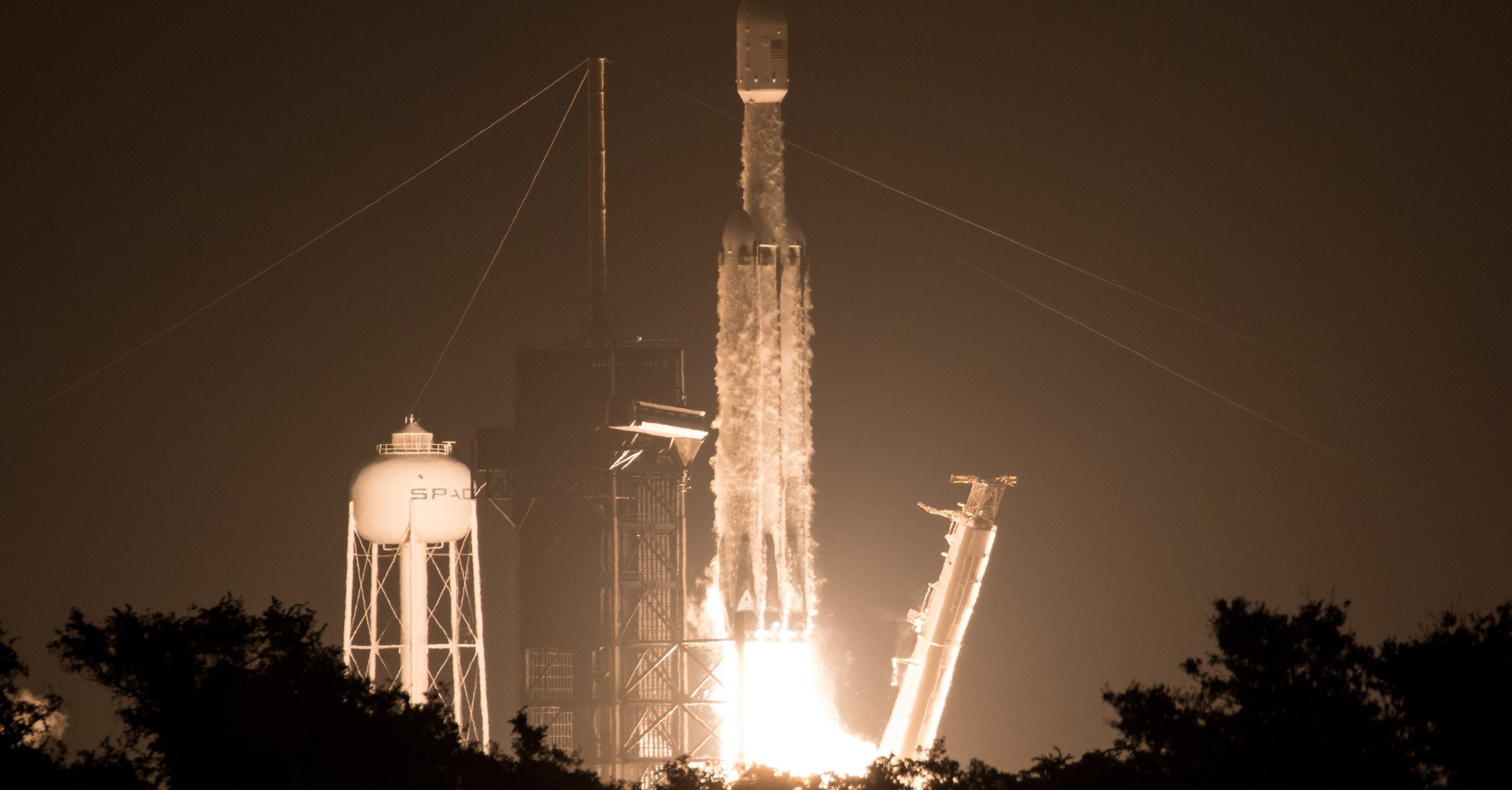
Elon Musk had called Tuesday's launch of SpaceX's Falcon Heavy rocket the "most difficult" yet. So the fact that the rocket made it into space — even if one of its core boosters did end up crashing into the sea — is "a huge deal," according to the former NASA astronaut Leroy Chiao.

Chiao has flown on three Space Shuttle flights, and lived aboard the International Space Station for several months as the commander of the 10th-ever expedition to the habitable satellite.

He adds that SpaceX's mostly successful launch is a promising sign to government agencies — including the Air Force, the Defense Department, and NASA — that commercial, reusable space rockets could make travel beyond earth easier.

"It showed a very high level of sophistication," Chiao told Cheddar. "It all seems to have gone off without a hitch. And so this demonstrates to the Air Force that SpaceX is up to this kind of sophistication and that they're ready, hopefully, to launch more sophisticated and expensive Air Force payloads in the future."

In the early morning hours on Tuesday, the vehicle ascended from NASA's Kennedy Space Center in Florida, beginning its third trip since 2018. After takeoff, the rocket's two side-boosters — which the rocket uses to propel its launch — successfully returned to the ground, landing vertically at the Air Force station on Cape Canaveral.

Leroy said the rocket's greatest challenge was launching myriad spacecraft, including 24 satellites, a new, solar-powered space 'sail,' and NASA's Deep Space Atomic Clock — a tool that should help future vehicles navigate farther into space — to three different orbits. That task required reigniting and shutting off its upper stage, a smaller portion of the rocket that is meant to position payloads into the orbit, several times.

While the rocket's center booster didn't land quite so perfectly (missing its intended target and dramatically crashing into the sea), Falcon Heavy did manage to deploy its payload, an important victory for future flights.

In addition to its spacecraft, the flight also carried the ashes of 152 people.

The former astronaut explained that successfully landing side-boosters has become "more and more routine."

As for the Falcon Heavy's central booster, he says: "It was coming in so hot because of the trajectory of the launch, it looks like it didn't have enough control-authority and fuel to make a successful landing."

The launch marked the first time the Defense Department has deployed its hardware on a rocket that had been launched previously, the New York Times reported.

Falcon Heavy's third ascent also comes amid vigorous competition in the burgeoning commercial space industry, where SpaceX faces tough foes in both Blue Origin and Virgin Galactic.

Meanwhile, government agencies have increasingly looked to private companies to assist in their ventures into space. For instance, the Defense Department's research arm, DARPA, has begun a competition among space launch firms, including Vector Launch and Virgin Orbit, to make the process of delivering small payloads like satellites more flexible.

NASA has also announced that it will soon allow private companies onto its flights to the International Space Station.

"It's a natural progression," said Chiao. "This is the next step. NASA never wanted to be the only customer for these services, and so it's natural that NASA would step up and provide a destination for some of these activities, be it research, tourism, or something else."

But spending time in space? That will still require some adjustment.

"You can't go home when you want to go home. You're going to be there for the time of your planned journey," said Chiao. "It can be frustrating at times, but it's definitely worth it."

Share:
More In Science
Energy Vault Begins Trading on the NYSE Following SPAC Merger
Energy Vault, the company developing sustainable, grid-scale energy storage solutions, is now trading on the New York Stock Exchange following the completion of its business combination with Novus Capital Corporation II. Energy Vault develops sustainable, grid-scale energy storage solutions designed to advance the transition to a carbon free, resilient power grid. Robert Piconi, co-founder and CEO of Energy Vault, joins Cheddar News' Closing Bell to disucss.
Large Companies Accused of Exaggerating Climate Actions
In an effort to fight climate change several corporations have vowed to work to fight climate change by 2030. They say the goal is to reduce carbon emissions by 40% or even close to 100%. However, according to a new study, many of these companies are not actually practicing what they preach. Tom Egger, senior lecturer at Emeritus at the University of Wisconsin, joins Cheddar News to discuss more.
Getlabs Raises $20 Million to Expand At-Home Lab Appointments Nationwide and Launches API
At-home medical labs company Getlabs raised $20 million in a Series A round, led by Emerson Collective and the Minderoo Foundation. Getlabs aims to be the boots-on-the-ground partner to telehealth. The company says more than 70% of medical decisions still require collecting diagnostic tests in person, and that it fills that void by delivering health care directly to their patients' homes. Founder & CEO of Getlabs Kyle Michelson joined Cheddar News' Closing Bell to discuss.
Innovation in Eyecare; Tech to Detect Cancer in Pets
On this episode of Cheddar Innovates: WALDO CEO breaks down why now is a good time to make eyecare a priority, and how they are democratizing access to eyecare for all; COO at PetDx explains how next-generation sequencing technology is being used to detect cancer in pets early; Cheddar gets a look at Curiosity Stream's 'Inside The Mind of a Con Artist.'
Canopy Growth Q3 Earnings Shows Record Sales for Its BioSteel, Storz & Bickel Brands
Shares of Canadian cannabis giant Canopy Growth surged after the company reported Q3 earnings Wednesday morning, with shares up more than 15 percent at the close of the day's trading session. Despite net revenue declining year-over-year, Canopy beat analyst expectations and has ramped up efforts to develop a "THC ecosystem' in the U.S. Canopy Growth's CEO, David Klein, joined Cheddar News' Closing Bell to discuss the report. He noted that its brands Storz & Bickel vaporizers and BioSteel beverages showed record growth.
New York's Central Park Fighting Back Against Climate Change
The Central Park Conservancy announced last month it has partnered with the Yale School of the Environment and the New York City-based Natural Areas Conservancy to study the on-the-ground impacts of climate change on urban parks. Salmaan Khan, Director of Research and Special Projects at the Central Park Conservancy joins Cheddar Climate to explain what factors put this initiative into motion and what data his team will be looking to uncover.
Energy Impact Partners Aims to Scale Climate Tech With New Fund
Energy Impact Partners is a VC firm committed to helping the world move toward a more sustainable future. The tech-focused fund aims to reach $350 million for its Deep Decarbonization Frontier Fund,' which aims to support early-stage companies working on innovative solutions. Energy Impact Partners' Managing Director Andy Lubershane joined Cheddar Climate to discuss.
School mask mandates to be lifted in four states
The Democratic governors of New Jersey, Connecticut, Delaware, and Oregon say they will lift mask requirements for schools in the coming weeks, reflecting a nationwide shift away from restrictions. Cheddar News speaks with internist Dr. Vivek Cherian whether it's safe to relax the regulation.
Load More