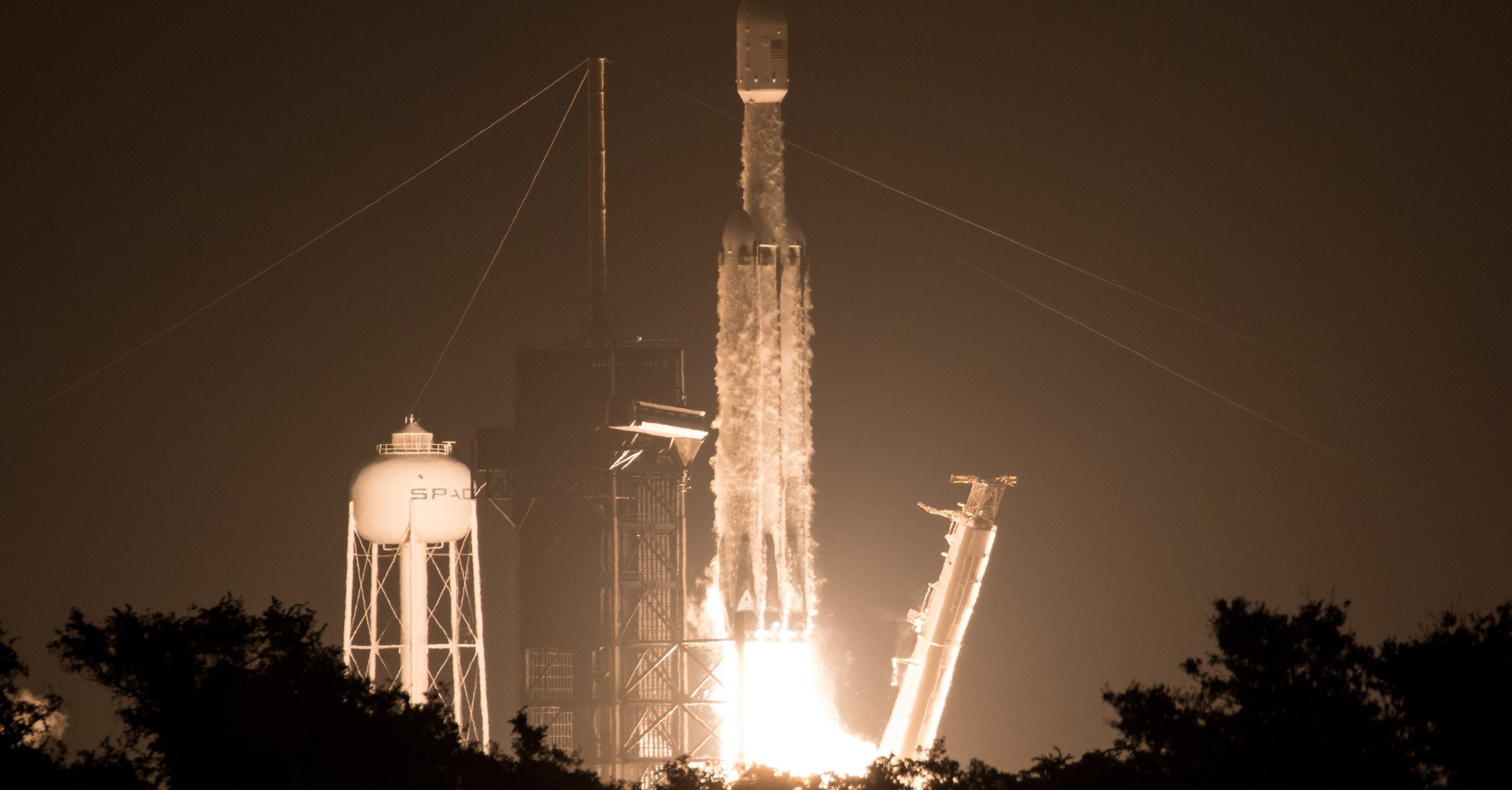
Elon Musk had called Tuesday's launch of SpaceX's Falcon Heavy rocket the "most difficult" yet. So the fact that the rocket made it into space — even if one of its core boosters did end up crashing into the sea — is "a huge deal," according to the former NASA astronaut Leroy Chiao.
Chiao has flown on three Space Shuttle flights, and lived aboard the International Space Station for several months as the commander of the 10th-ever expedition to the habitable satellite.
He adds that SpaceX's mostly successful launch is a promising sign to government agencies — including the Air Force, the Defense Department, and NASA — that commercial, reusable space rockets could make travel beyond earth easier.
"It showed a very high level of sophistication," Chiao told Cheddar. "It all seems to have gone off without a hitch. And so this demonstrates to the Air Force that SpaceX is up to this kind of sophistication and that they're ready, hopefully, to launch more sophisticated and expensive Air Force payloads in the future."
In the early morning hours on Tuesday, the vehicle ascended from NASA's Kennedy Space Center in Florida, beginning its third trip since 2018. After takeoff, the rocket's two side-boosters — which the rocket uses to propel its launch — successfully returned to the ground, landing vertically at the Air Force station on Cape Canaveral.
Leroy said the rocket's greatest challenge was launching myriad spacecraft, including 24 satellites, a new, solar-powered space 'sail,' and NASA's Deep Space Atomic Clock — a tool that should help future vehicles navigate farther into space — to three different orbits. That task required reigniting and shutting off its upper stage, a smaller portion of the rocket that is meant to position payloads into the orbit, several times.
While the rocket's center booster didn't land quite so perfectly (missing its intended target and dramatically crashing into the sea), Falcon Heavy did manage to deploy its payload, an important victory for future flights.
In addition to its spacecraft, the flight also carried the ashes of 152 people.
The former astronaut explained that successfully landing side-boosters has become "more and more routine."
As for the Falcon Heavy's central booster, he says: "It was coming in so hot because of the trajectory of the launch, it looks like it didn't have enough control-authority and fuel to make a successful landing."
The launch marked the first time the Defense Department has deployed its hardware on a rocket that had been launched previously, the New York Times reported.
Falcon Heavy's third ascent also comes amid vigorous competition in the burgeoning commercial space industry, where SpaceX faces tough foes in both Blue Origin and Virgin Galactic.
Meanwhile, government agencies have increasingly looked to private companies to assist in their ventures into space. For instance, the Defense Department's research arm, DARPA, has begun a competition among space launch firms, including Vector Launch and Virgin Orbit, to make the process of delivering small payloads like satellites more flexible.
"It's a natural progression," said Chiao. "This is the next step. NASA never wanted to be the only customer for these services, and so it's natural that NASA would step up and provide a destination for some of these activities, be it research, tourism, or something else."
But spending time in space? That will still require some adjustment.
"You can't go home when you want to go home. You're going to be there for the time of your planned journey," said Chiao. "It can be frustrating at times, but it's definitely worth it."
On this episode of Cheddar Innovates: President of The Pillow Bar breaks down how everyone can benefit from a pillow customized to their unique way of sleeping; CEO of H2Pro explains how to bring environmentally friendly hydrogen to scale; Cheddar gets a look at Curiosity Stream's 'Suppressed Science.'
On this episode of Cheddar Innovates: Gardenuity CEO breaks down how gardening can improve your wellbeing; Augmedix CEO discusses how this technology is helping doctors fight burnout; Cheddar gets a look at Curiosity Stream's 'Suppressed Science.'
On this episode of Cheddar Innovates: Atom Limbs CEO breaks down how the Atom Touch prosthetic is different from other prosthetics on the market; CEO & Chief Scientific Officer of MyMD explains how the MYMD-1 is on track to be the first FDA-approved drug to treat aging and age-related diseases; A look at Curiosity Stream's 'The Future of Warfare.'
On this episode of Cheddar Innovates: SkilsVR CEO explains how virtual reality is being used to train frontline workers to handle difficult customers; Rubicon CEO breaks down how technology and sustainability will go hand in hand in the future; Cheddar gets a look at 'Our Infinite Universe.'
A UN report is warning that relying on seawalls and other engineering fixes will not be enough to keep communities safe from rising sea levels and climate change consequences. Dr. Steve Rose, a senior research economist at the Electric Power Research Institute, joins Cheddar News to discuss.
As gas prices surge amid the Russian invasion of Ukraine, other nations could potentially transition faster to using clean energy than previously expected. Philip K. Verleger, a senior fellow at the Niskanen Center, joined Cheddar News to explain how this could be a possibility in the near future. "Part of the reason I think we have this invasion and the tantrum that's being thrown by Russia, terrible tantrum, is because the Russians were trying to slow down the transition," he said. "Ironically they speeded it up."
As Russia intensifies its war on Ukraine, President Biden announced a ban on oil imported from the aggressor nation. Critics of Russia have said this would be the best way to force Putin to pull back, but curbs on Russian oil exports are expected to send already skyrocketing oil and gas prices even higher, further impacting consumers, businesses, financial markets, and the global economy. Leslie Beyer, CEO of the Energy Workforce and Technology Council, joined Cheddar News' Closing Bell to discuss. "It's certainly going to increase pricing, but it is the right thing to do," she said. "The industry itself has already pulled out of the significant portion of its operations in Russia."
On this episode of Cheddar Innovates: Vision Marine Technologies CEO discusses how e-boats will play a role in the fight against the climate crisis; Lasso CEO breaks down how the design behind these compression socks can prevent injuries and improve performance; Cheddar gets a look at Curiosity Stream's 'The Tombs Of Egypt.'
Vaccine maker Pfizer delayed its COVID shot for kids allegedly due to a lack of data on how it would perform against the omnicron variant, according to the Wall Street Journa. Peter Pitts, professor and founder of the Center for Medicine in the Public Interest and a former FDA associate commissioner, joined Cheddar News Wrap to break down why the authorization can't be rushed. "Going forward, the FDA wants to look at data specifically against omicron, and it looks like that's going to be a three-shot regimen versus two, which was efficient against delta but not omicron because obviously omicron is more infectious," said Pitts.
Walker Ross, Assistant Professor of Sports Business Management at Florida Southern College, joins Business of Sports: The Beijing Winter Olympics 2022, where he says that actions Beijing and other Olympic host sites have been implementing to combat climate change has simply not been enough to offset their carbon footprint.