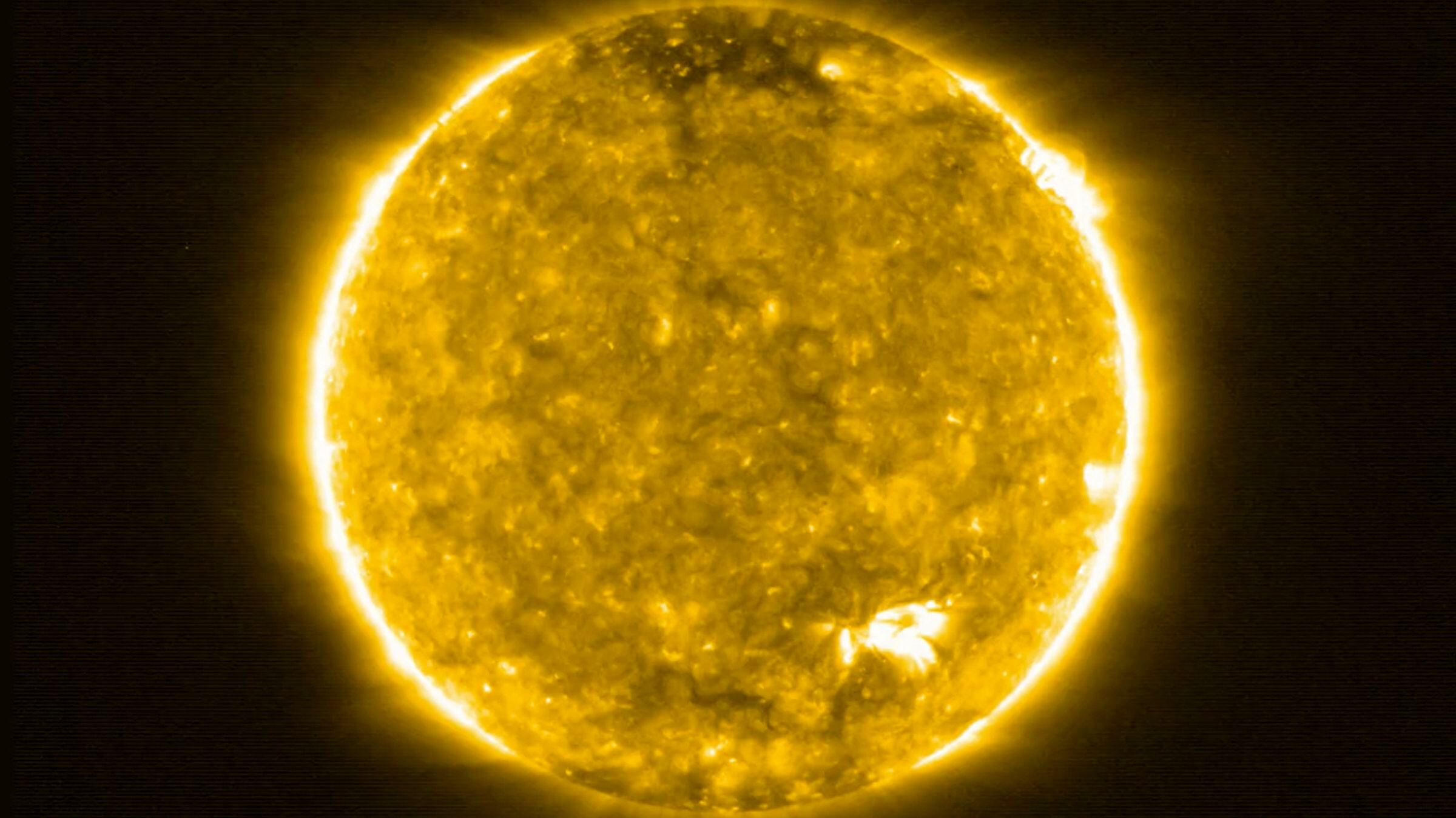
This image, provided by the European Space Agency (ESA) on Thursday, July 16, 2020, shows the Sun. The Extreme Ultraviolet Imager (EUI) on ESA's Solar Orbiter spacecraft took this image on 30 May 2020. It shows the Sun's appearance at a wavelength of 17 nanometers, which is in the extreme ultraviolet region of the electromagnetic spectrum. During an online press briefing with Solar Orbiter mission experts, the first images from ESA's new Sun-observing spacecraft were released on Thursday. (Solar Orbiter/EUI Team (ESA & NASA); CSL, IAS, MPS, PMOD/WRC, ROB, UCL/MSSL/ via AP)
By Marcia Dunn
A European and NASA spacecraft has snapped the closest pictures ever taken of the sun, revealing countless little "campfires" flaring everywhere.
Scientists on Thursday released the first images taken by Solar Orbiter, launched from Cape Canaveral in February.
The orbiter was about 48 million miles (77 million kilometers) from the sun — about halfway between Earth and the sun — when it took the stunning high-resolution pictures last month.
NASA's Parker Solar Probe is flying much closer to the sun than Solar Orbiter — too close for cameras to safely photograph the sun. Its lone camera faces away from the sun to observe the solar wind.
That's why Solar Orbiter's new pictures showing vibrant swirls of yellow and dark smoky gray — the first images from so close and at such small scale — are so precious. The team had to create a new vocabulary to name these tiny flare-ups, said European Space Agency project scientist Daniel Muller.
Muller described the observed multitude of "campfires" shooting into the corona, or sun's crown-like outer atmosphere, as quite possibly "the tiny cousins of the solar flares that we already know." Millions if not billions of times smaller, these tiny flares may be heating the corona, he said, long known to be hundreds of times hotter than the actual solar surface for unknown reasons.
The Royal Observatory of Belgium's David Berghmans, principal scientist of the instrument that captured the images, said he was blown away. He said his first response was: "This is not possible. It cannot be that good."
"It was really much better than we expected, but what we dared to hope for," Berghmans said.
These so-called campfires, Berghmans noted, are "literally everywhere we look." Not yet well understood, they could be mini explosions, or nanoflares. More measurements are planned.
The $1.5 billion spacecraft will tilt its orbit as the mission goes on, providing unprecedented views of the sun's poles. This vantage point will allow it to capture the first pictures of the solar poles.
Solar Orbiter will get even closer to the sun in two years.
"This is just the beginning of the long epic journey of Solar Orbiter," Muller said.
The pandemic has forced Solar Orbiter's scientists to work from home for months. Only a few engineers are allowed at any one time inside the control center in Darmstadt, Germany.
___
The Associated Press Health and Science Department receives support from the Howard Hughes Medical Institute's Department of Science Education. The AP is solely responsible for all content.
Jurors in the trial against Theranos CEO Elizabeth Holmes have entered day six of deliberations. Holmes is accused of lying to investors about the functionality of a newly developed blood-testing technology. Andrew George, partner at Baker Botts, joined Cheddar to break down key points in the case and what the jury might be considering during their deliberations. He also noted that the rest of Silicon Valley, including Holmes' business partner, Ramesh "Sunny" Balwani, who is facing identical charges, is closely watching the outcome of deliberations — as it could set the tone for future regulations and Balwani's own trial.
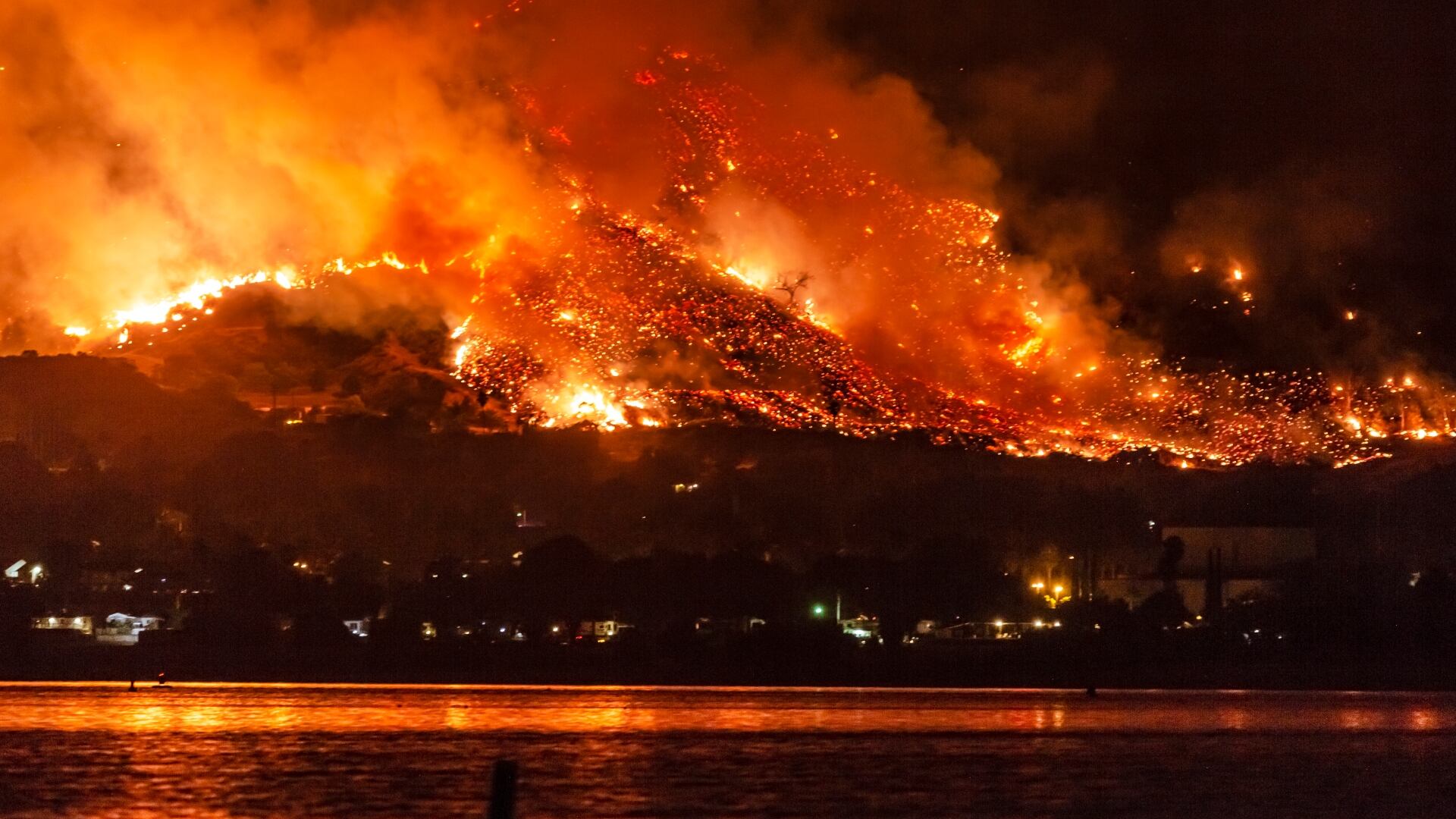
According to researchers, the state of California's cap-and-trade program is currently being undermined by forest fires caused primarily by climate change. Over the past few years, trees that were set aside for the program have been releasing carbon as they continue to burn in fires. Climate Researcher and Policy Director at CarbonPlan Danny Cullenward, joined Cheddar to discuss more.
The CDC's latest update to its COVID-19 quarantine guidelines reduces the isolation period from ten days to just five for people who test positive but are asymptomatic. Dr. Bayo Curry-Winchell, regional clinical director at Carbon Health, spoke to Cheddar's Baker Machado about the new guidance. She noted that while the reduced quarantine time "makes sense," the CDC should also require that a person test negative after their quarantine and before interacting with the public. "There is science behind it. We know that the majority of illness happens, or transmission, one to two days before the onset of symptoms and then two to three days as you have symptoms. So there is science behind the reducement of the actual five days," she said.
Prices at the pump this year reached a seven-year high, and a new forecast from GasBuddy shared with CNN predicts that gas prices will only continue to rise in 2022 and that the national average could even reach $4.00 a gallon; however, analysts at GasBuddy say anything could happen when it comes to gas prices in the future, as the pandemic has made it difficult to make any predictions about the economy. Consumer Energy Alliance federal policy advisor Michael Zehr joins Cheddar News' Closing Bell to discuss.
As the Omicron variant is fueling a surge in COVID-19 cases, parents and schools are faced with tough choices between absences and outbreaks. Matt Barnum, a national reporter at Chalkbeat, joins Cheddar News to discuss.
Ron Gutman, Co-CEO of Intrivo, joins Cheddar News to discuss how the company is creating a test and tech solution for Covid testing called 2Gather, and how it's using data-driven digital diagnostics to make these tests widely available and affordable.
As 2021 winds down, the number of positive COVID-19 cases has surged dramatically with numbers not seen since the heights of the pandemic. Dr. Laolu Fayanju, the regional medical director at primary care provider Oak Street Health, joined Cheddar to discuss the numbers, how the healthcare system is handling the surge this time around, and what it means that the CDC just cut the quarantine time guideline in half for those who are infected. "These are incredibly high numbers because they reflect the transmissibility of the omicron variant," Fayanju said.