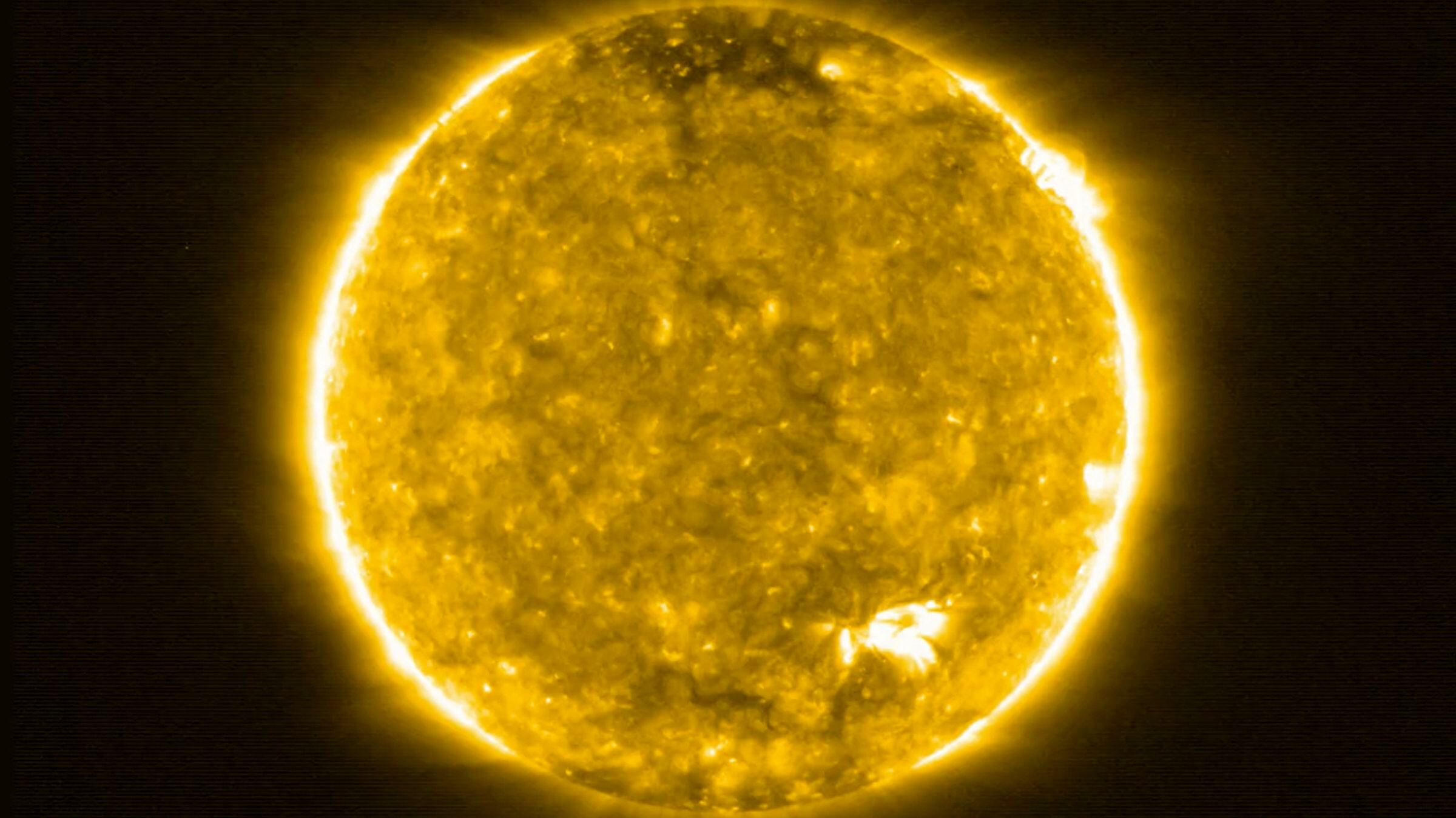
This image, provided by the European Space Agency (ESA) on Thursday, July 16, 2020, shows the Sun. The Extreme Ultraviolet Imager (EUI) on ESA's Solar Orbiter spacecraft took this image on 30 May 2020. It shows the Sun's appearance at a wavelength of 17 nanometers, which is in the extreme ultraviolet region of the electromagnetic spectrum. During an online press briefing with Solar Orbiter mission experts, the first images from ESA's new Sun-observing spacecraft were released on Thursday. (Solar Orbiter/EUI Team (ESA & NASA); CSL, IAS, MPS, PMOD/WRC, ROB, UCL/MSSL/ via AP)
By Marcia Dunn
A European and NASA spacecraft has snapped the closest pictures ever taken of the sun, revealing countless little "campfires" flaring everywhere.
Scientists on Thursday released the first images taken by Solar Orbiter, launched from Cape Canaveral in February.
The orbiter was about 48 million miles (77 million kilometers) from the sun — about halfway between Earth and the sun — when it took the stunning high-resolution pictures last month.
NASA's Parker Solar Probe is flying much closer to the sun than Solar Orbiter — too close for cameras to safely photograph the sun. Its lone camera faces away from the sun to observe the solar wind.
That's why Solar Orbiter's new pictures showing vibrant swirls of yellow and dark smoky gray — the first images from so close and at such small scale — are so precious. The team had to create a new vocabulary to name these tiny flare-ups, said European Space Agency project scientist Daniel Muller.
Muller described the observed multitude of "campfires" shooting into the corona, or sun's crown-like outer atmosphere, as quite possibly "the tiny cousins of the solar flares that we already know." Millions if not billions of times smaller, these tiny flares may be heating the corona, he said, long known to be hundreds of times hotter than the actual solar surface for unknown reasons.
The Royal Observatory of Belgium's David Berghmans, principal scientist of the instrument that captured the images, said he was blown away. He said his first response was: "This is not possible. It cannot be that good."
"It was really much better than we expected, but what we dared to hope for," Berghmans said.
These so-called campfires, Berghmans noted, are "literally everywhere we look." Not yet well understood, they could be mini explosions, or nanoflares. More measurements are planned.
The $1.5 billion spacecraft will tilt its orbit as the mission goes on, providing unprecedented views of the sun's poles. This vantage point will allow it to capture the first pictures of the solar poles.
Solar Orbiter will get even closer to the sun in two years.
"This is just the beginning of the long epic journey of Solar Orbiter," Muller said.
The pandemic has forced Solar Orbiter's scientists to work from home for months. Only a few engineers are allowed at any one time inside the control center in Darmstadt, Germany.
___
The Associated Press Health and Science Department receives support from the Howard Hughes Medical Institute's Department of Science Education. The AP is solely responsible for all content.
Experts say that at some point next year, the pandemic will officially drop its pandemic status, becoming endemic. While this is a milestone to acknowledge, it does not mean we're free of infections, illnesses, and deaths. Dr. Rajeev Fernando, infectious disease specialist, Beth Israel Hospital and fellow, joins Cheddar News' Closing Bell to discuss.
Chicago-based Internist Dr. Vivek Cherian joined Wake Up With Cheddar to break down the unprecedented surge in U.S. COVID-19 as many prepare to celebrate the new year.
Dr. Soumi Eachempati, co-founder and CEO of Cleared4 and former professor of surgery and public health at Weill Cornell Medical College, joined Cheddar to breakdown what people should know about the recently FDA-approved emergency use of Merck and Pfizer's COVID-19 treatment pills. He noted that not only do people need to be aware of other medications they are taking that could cause adverse effects if coupled with COVID-19 pill treatments, he also talked about the intense in-take regiment. "The Merck pills are actually about 40 pills over five days. The Pfizer ones are three pills over five days, so people have to be prepared for that because it is a lot of pills you'll have to take to get full value from these drugs," Eachempati told Cheddar.
Twitter is exploding with a new meme after the CDC revised its Covid-19 guidelines, shortening the recommended isolation period to five days instead of 10 for when you test positive and are asymptomatic. The change came amid a skyrocketing surge of new cases is the U.S. due to the Omicron variant, drawing criticism from experts and Twitter --with users claiming the government agency is giving funny advise on a variety of issues. But what does the meme say about the public’s trust in the agency? Cheddar News speaks with political strategist Hastie Afkhami.
The list of questions should be getting shorter as we enter the pandemic's third year, but that isn't the case. There's another question to add to that list: is the U.S. doing enough to track the virus and its variants? Lawrence Gostin, faculty director of the O'Neill Institute for national and global health law at Georgetown University, joins Cheddar News.
As we prepare to ring in the new year, COVID cases are hitting an all-time high. Dr. Anthony Fauci has said the safest way to celebrate would be a small gathering with vaccinated family members only... far from the large, flashy parties from a few years ago. Dr. Christina Johns, senior medical advisor at PM Pediatrics, joins Cheddar News to discuss how to celebrate safely.