This image, provided by the European Space Agency (ESA) on Thursday, July 16, 2020, shows the Sun. The Extreme Ultraviolet Imager (EUI) on ESA's Solar Orbiter spacecraft took this image on 30 May 2020. It shows the Sun's appearance at a wavelength of 17 nanometers, which is in the extreme ultraviolet region of the electromagnetic spectrum. During an online press briefing with Solar Orbiter mission experts, the first images from ESA's new Sun-observing spacecraft were released on Thursday. (Solar Orbiter/EUI Team (ESA & NASA); CSL, IAS, MPS, PMOD/WRC, ROB, UCL/MSSL/ via AP)
By Marcia Dunn
A European and NASA spacecraft has snapped the closest pictures ever taken of the sun, revealing countless little "campfires" flaring everywhere.
Scientists on Thursday released the first images taken by Solar Orbiter, launched from Cape Canaveral in February.
The orbiter was about 48 million miles (77 million kilometers) from the sun — about halfway between Earth and the sun — when it took the stunning high-resolution pictures last month.
NASA's Parker Solar Probe is flying much closer to the sun than Solar Orbiter — too close for cameras to safely photograph the sun. Its lone camera faces away from the sun to observe the solar wind.
That's why Solar Orbiter's new pictures showing vibrant swirls of yellow and dark smoky gray — the first images from so close and at such small scale — are so precious. The team had to create a new vocabulary to name these tiny flare-ups, said European Space Agency project scientist Daniel Muller.
Muller described the observed multitude of "campfires" shooting into the corona, or sun's crown-like outer atmosphere, as quite possibly "the tiny cousins of the solar flares that we already know." Millions if not billions of times smaller, these tiny flares may be heating the corona, he said, long known to be hundreds of times hotter than the actual solar surface for unknown reasons.
The Royal Observatory of Belgium's David Berghmans, principal scientist of the instrument that captured the images, said he was blown away. He said his first response was: "This is not possible. It cannot be that good."
"It was really much better than we expected, but what we dared to hope for," Berghmans said.
These so-called campfires, Berghmans noted, are "literally everywhere we look." Not yet well understood, they could be mini explosions, or nanoflares. More measurements are planned.
The $1.5 billion spacecraft will tilt its orbit as the mission goes on, providing unprecedented views of the sun's poles. This vantage point will allow it to capture the first pictures of the solar poles.
Solar Orbiter will get even closer to the sun in two years.
"This is just the beginning of the long epic journey of Solar Orbiter," Muller said.
The pandemic has forced Solar Orbiter's scientists to work from home for months. Only a few engineers are allowed at any one time inside the control center in Darmstadt, Germany.
___
The Associated Press Health and Science Department receives support from the Howard Hughes Medical Institute's Department of Science Education. The AP is solely responsible for all content.
Neil Young has come up with an ultimatum for Spotify: his music or Joe Rogan’s podcast. This comes over concerns that the podcast is spreading COVID-19 vaccine misinformation to its listeners. "The Joe Rogan Experience," which is exclusive to Spotify, is currently the number one streamed podcast on the platform.
Commercial and residential buildings account for 13% of carbon emissions in the U.S., according to the EPA, and one company says it has a solution. Runwise says it has updated the boiler and heating systems of thousands of buildings, and that its technology not only lowers carbon output but also saves landlords money. Lee Hoffman, Co-Founder and COO of Runwise, joined Cheddar Climate to discuss.
Jo Ruxton, Founder of Ocean Generation, joins Cheddar Climate, where she explains the threat that plastic pollution poses to marine life, but elaborates on why we shouldn't be looking to ban plastic entirely. Ruxton also discusses her biggest takeaways while producing the film ‘A Plastic Ocean.'
President Joe Biden's Build Back Better deal seems all but finished after months of Democratic infighting and the Senate's deadlock over certain provisions. But Biden mentioned during a press conference marking his first year in office that 'chunks' of the bill could be passed. Is that enough motivation to force Democrats to rally around certain parts of the bill - especially those that focus on climate and green energy? Andrew Freedman, Energy and Climate Reporter at Axios, joins Cheddar Climate to discuss whether Senate Democrats will be able to rally around climate provisions, if the idea of passing Build Back Better in 'chunks' is doable, and more.
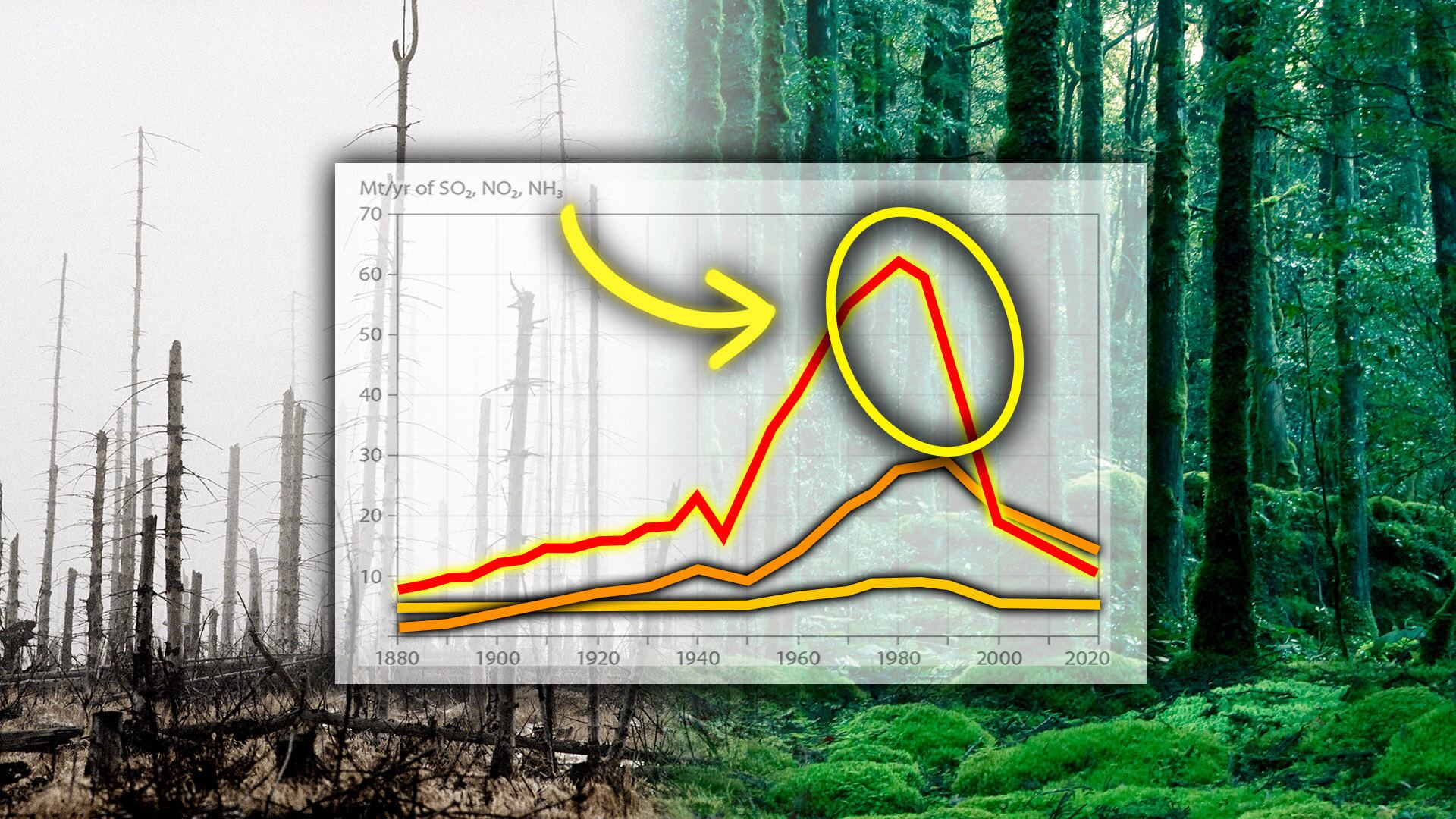
Anyone who remembers the 70s and 80s will probably remember acid rain. Industrial emissions acidified precipitation around the globe, which killed forests and crops, rendered lakes inhospitable, corroded buildings, and exacerbated human health problems.
But anyone who follows environmental news will be surprised to learn this: we solved it! Countries came together to limit acid rain-causing emissions, eliminating the problem altogether.
…kind of. Acidic precipitation may not be a thing of the past after all.
Natalie Ginsberg, Global Impact Officer, MAPS, joins Cheddar Reveals to discuss MAPS organization and its current initiatives and their work to get FDA approval for MDMA to treat PTSD.
Kelsey Ramsden, Co-Founder, President & CEO, Mind Cure Health, joins Cheddar Reveals to break down what 'psychedelic therapy' could look like once it's legalized and how Mind Cure Health is using AI to help treat everything from addiction to depression.
On this episode of Cheddar Reveals, Natalie Ginsberg, Global Impact Officer, MAPS, discusses the MAPS organization and its current initiatives and their work to get FDA approval for MDMA to treat PTSD; Kelsey Ramsden, Co-Founder, President & CEO, Mind Cure Health, breaks down what 'psychedelic therapy' could look like once it's legalized and how Mind Cure Health is using AI to help treat everything from addiction to depression; Cheddar gets a look at Curiosity Stream's 'Pain, Pus and Poison.'