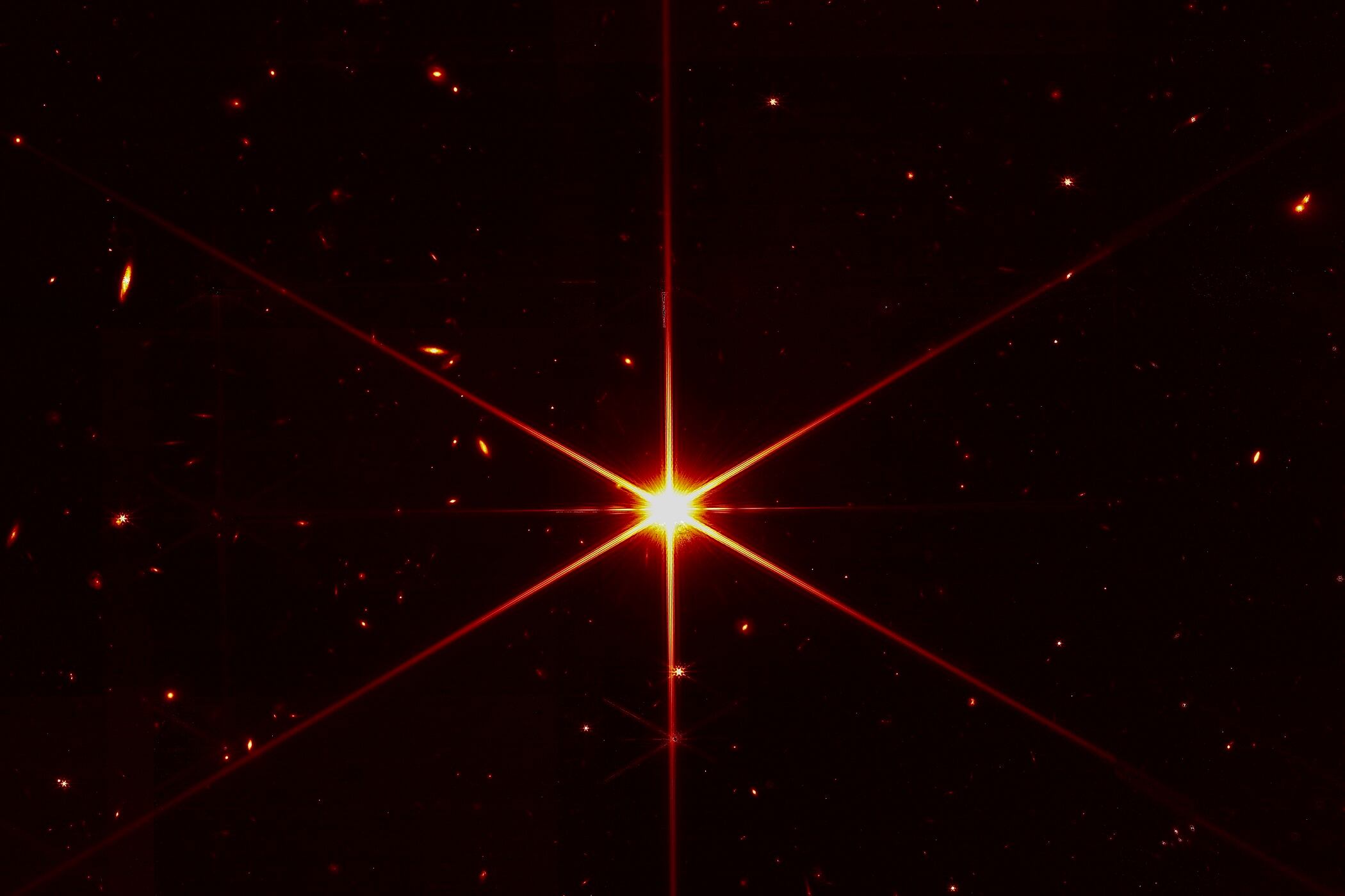
This image made available by NASA on Wednesday, March 16, 2022 shows star 2MASS J17554042+6551277 used to align the mirrors of the James Webb Space Telescope, with galaxies and stars surrounding it. The hexagonal shape of Webb’s mirrors and its filters made the shimmering star look more red and spiky. The first science images aren't expected until late June or early July. (NASA/STScI via AP)
By Seth Borenstein
NASA’s new space telescope has gazed into the distant universe and shown perfect vision: a spiky image of a faraway star photobombed by thousands of ancient galaxies.
The image released Wednesday from the James Webb Space Telescope is a test shot — not an official science observation — to see how its 18 hexagonal mirrors worked together for a single coordinated image taken 1 million miles (1.6 million kilometers) away from Earth. Officials said it worked better than expected.
Scientists said they were giddy as they watched the latest test photos arrive. NASA’s test image was aimed at a star 100 times fainter than the human eye can see — 2,000 light-years away. A light-year is nearly 6 trillion miles (9.7 trillion kilometers).
The shape of Webb’s mirrors and its filters made the shimmering star look more red and spiky but the background really stole the show.
“You can’t help but see those thousands of galaxies behind it, really gorgeous,” said Jane Rigby, Webb operations project scientist.
Those galaxies are several billions of years old. Eventually, scientists hope Webb will see so faraway and back in time that it will only be “a couple hundred million years after the Big Bang,” she said.
The first science images won’t come until late June or early July.
The $10 billion Webb — successor to the nearly 32-year-old Hubble Space Telescope — blasted off from South America in December and reached its designated perch in January.
___
The Associated Press Health and Science Department receives support from the Howard Hughes Medical Institute’s Department of Science Education. The AP is solely responsible for all content.
On Monday, football fans were stunned when Buffalo Bills safety Damar Hamlin collapsed and suffered cardiac arrest. Cheddar News explains the condition and the steps to take if you witness an incident.
What's being called an unprecedented breakthrough in cancer treatment recently completed a small trial at New York City's Memorial Sloan Kettering in 14 rectal cancer patients. The experimental trial with the drug dostarlimab resulted in 100 percent remission in all candidates, precluding the need for chemotherapy or surgery. Cheddar News anchor Hena Doba dives into this hopeful story.
Join Cheddar News as we break down the top headlines this morning including updates on the Jan. 6 hears, the PGA suspension of 17 of the world's best golfers, and NASA's plans to study UFOs.
Rick Pauls, President & CEO OF DiaMedica Therapeutics, joins Cheddar Innovates to discuss a new ischemic stroke treatment option that expands the window for effective therapy for stroke patients.
John Bencich, CEO of Achieve Life Sciences, joins Cheddar Innovates to discuss a new plant-based compound that's being used to fight nicotine addiction.
On this episode of Cheddar Innovates: CEO of Achieve Life Sciences discusses a new plant-based compound that's being used to fight nicotine addiction; President & CEO OF DiaMedica Therapeutics explains a new ischemic stroke treatment option that expands the window for effective therapy for stroke patients; Cheddar gets a look at Curiosity Stream's 'Asteroid Rush.'