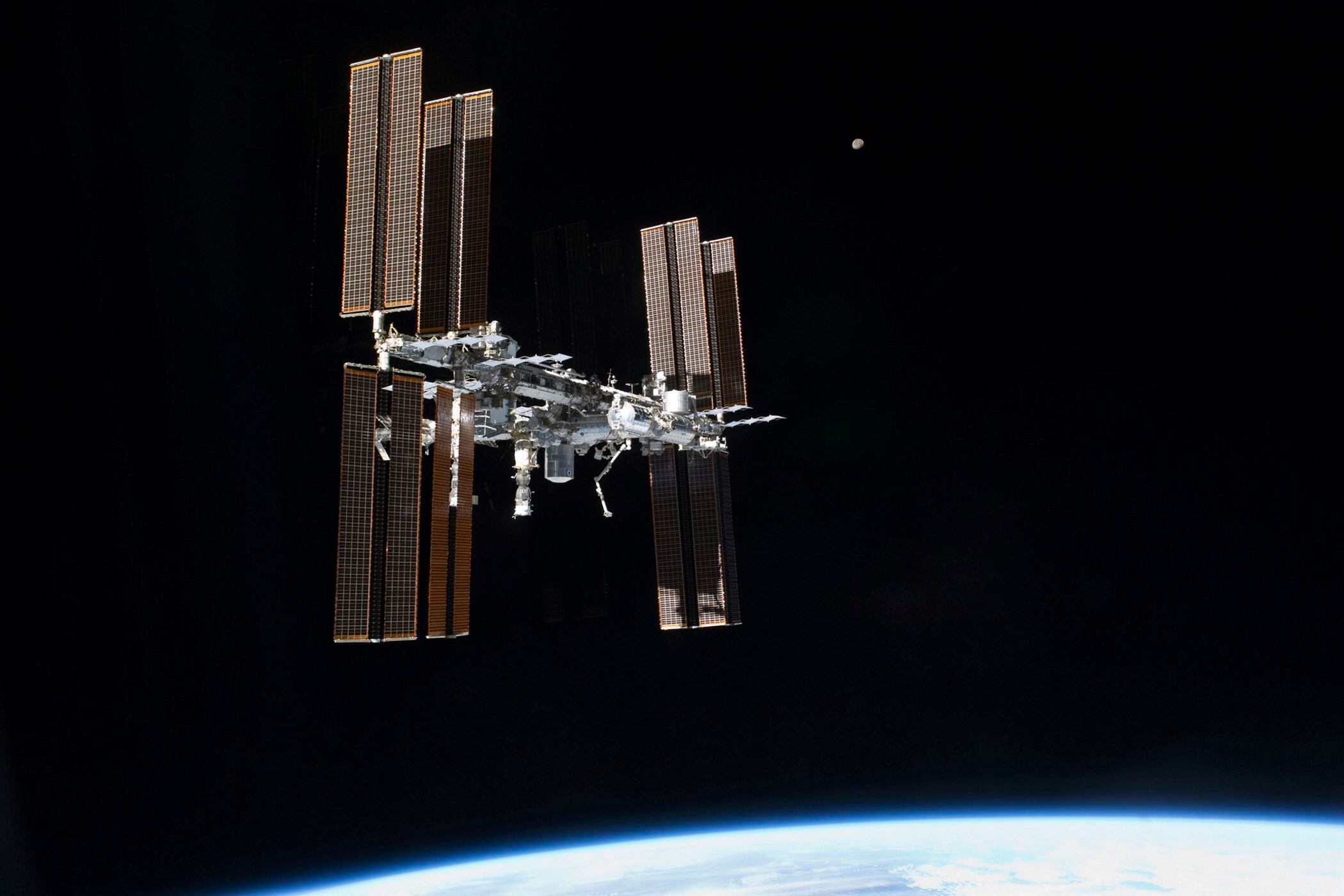
This July 19, 2011 photo of the International Space Station was taken from the space shuttle Atlantis. On Tuesday, Sept. 29, 2020, NASA said that the two Russians and one American on board were awakened late Monday to hurriedly seal hatches between compartments and search for the ongoing leak, which appeared to be getting worse. It was the third time in just over a month that the crew had to isolate themselves on the Russian side, in an attempt to find the growing leak. (NASA via AP)
By Marcia Dunn
A small air leak at the International Space Station finally has been traced to the Russian side, following a middle-of-the-night search by astronauts.
NASA said Tuesday that the two Russians and one American on board were awakened late Monday to hurriedly seal hatches between compartments and search for the ongoing leak, which appeared to be getting worse. It was the third time in just over a month that the crew had to isolate themselves on the Russian side, in an attempt to find the growing leak.
It turns out instead of the leak getting bigger this time, a temporary temperature change caused the erroneous cabin air pressure reading, according to NASA. The leak was first spotted a year ago.
NASA officials stress that the leak remains small and poses no danger. The astronauts will now use leak detectors to try to pinpoint the leak in Russia’s main living and working compartment called Zvezda, Russian for Star.
Space station deputy program manager Kenny Todd said the good news is that “instead of a bunch of haystacks, we're down to maybe one haystack." But he added: “It's still a needle we're looking for.”
NASA is sending up extra air supply tanks on its next space station delivery, scheduled for a Thursday departure from Virginia. As long as the leak does not worsen, Todd said, the space station should be fine through next spring.
In two weeks, two Russians and an American are scheduled to arrive at the space station, followed by a crew of three Americans and a Japanese on SpaceX's second launch of astronauts, now targeted for Oct. 31.
During a news conference Tuesday from Houston, NASA astronaut Mike Hopkins, the commander, announced that the SpaceX capsule would be called Resilience — to reflect how the world is coping with this year's challenges.
“We hope that it brings a smile to your face and we hope that it provides something positive in your lives. Quite frankly, we hope that it’s an inspiration,” Hopkins said of the name and the mission.
___
The Associated Press Health and Science Department receives support from the Howard Hughes Medical Institute’s Department of Science Education. The AP is solely responsible for all content.
Experts say that at some point next year, the pandemic will officially drop its pandemic status, becoming endemic. While this is a milestone to acknowledge, it does not mean we're free of infections, illnesses, and deaths. Dr. Rajeev Fernando, infectious disease specialist, Beth Israel Hospital and fellow, joins Cheddar News' Closing Bell to discuss.
Chicago-based Internist Dr. Vivek Cherian joined Wake Up With Cheddar to break down the unprecedented surge in U.S. COVID-19 as many prepare to celebrate the new year.
Dr. Soumi Eachempati, co-founder and CEO of Cleared4 and former professor of surgery and public health at Weill Cornell Medical College, joined Cheddar to breakdown what people should know about the recently FDA-approved emergency use of Merck and Pfizer's COVID-19 treatment pills. He noted that not only do people need to be aware of other medications they are taking that could cause adverse effects if coupled with COVID-19 pill treatments, he also talked about the intense in-take regiment. "The Merck pills are actually about 40 pills over five days. The Pfizer ones are three pills over five days, so people have to be prepared for that because it is a lot of pills you'll have to take to get full value from these drugs," Eachempati told Cheddar.
Twitter is exploding with a new meme after the CDC revised its Covid-19 guidelines, shortening the recommended isolation period to five days instead of 10 for when you test positive and are asymptomatic. The change came amid a skyrocketing surge of new cases is the U.S. due to the Omicron variant, drawing criticism from experts and Twitter --with users claiming the government agency is giving funny advise on a variety of issues. But what does the meme say about the public’s trust in the agency? Cheddar News speaks with political strategist Hastie Afkhami.
The list of questions should be getting shorter as we enter the pandemic's third year, but that isn't the case. There's another question to add to that list: is the U.S. doing enough to track the virus and its variants? Lawrence Gostin, faculty director of the O'Neill Institute for national and global health law at Georgetown University, joins Cheddar News.
As we prepare to ring in the new year, COVID cases are hitting an all-time high. Dr. Anthony Fauci has said the safest way to celebrate would be a small gathering with vaccinated family members only... far from the large, flashy parties from a few years ago. Dr. Christina Johns, senior medical advisor at PM Pediatrics, joins Cheddar News to discuss how to celebrate safely.