By Christopher Weber and Jonathan J. Cooper
Thick smoke that held down winds and temperatures in the zone of the largest single wildfire in California history cleared Monday from scenic Northern California forestlands, allowing firefighting aircraft to rejoin the battle to contain the massive Dixie Fire.
The newly clear skies will allow more than two dozen helicopters and two air tankers that have been grounded to fly again and make it safer for ground crews to maneuver.
“With this kind of weather, fire activity will pick up. But the good thing is we can get aircraft up,” said fire spokesman Ryan Bain.
Winds were not expected to reach the ferocious speeds that helped the blaze explode in size last week. But they were still a concern for firefighters working in unprecedented conditions to protect thousands of threatened homes.
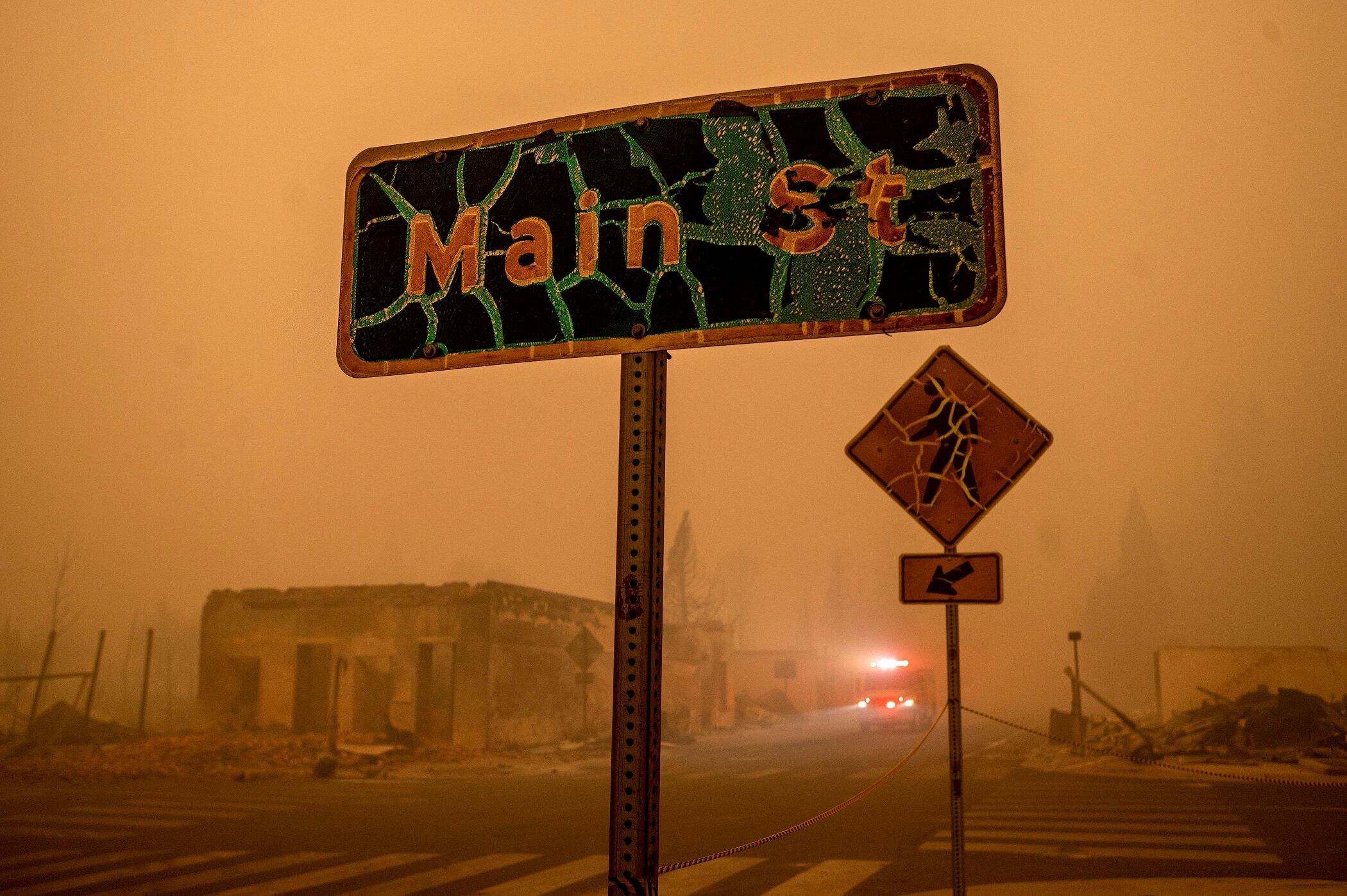
Fueled by powerful gusts and bone-dry vegetation, the fire incinerated much of the small community of Greenville last Wednesday and Thursday. At least 627 homes and other structures had been destroyed by Monday and another 14,000 buildings were still threatened in the northern Sierra Nevada.
Damage reports are preliminary because assessment teams can’t get into many areas, officials said.
The Dixie Fire, named for the road where it started nearly four weeks ago, grew to an area of 765 square miles (1,980 square kilometers) by Sunday evening and was just 21% contained, according to the California Department of Forestry and Fire Protection. It had scorched an area more than twice the size of New York City.
With smoke clearing out above eastern portions of the fire, crews that had been directly attacking the front lines would be forced to retreat and build containment lines farther back, said Dan McKeague, a fire information officer from the U.S. Forest Service.
The blaze became the largest single fire in California's recorded history, surpassing last year's Creek Fire in the the state's central valley agricultural region.
The Dixie Fire is about half the size of the August Complex, a series of lightning-caused 2020 fires across seven counties that were fought together and that state officials consider California's largest wildfire overall.
The fire’s cause was under investigation. The Pacific Gas & Electric utility has said it may have been sparked when a tree fell on one of its power lines. A federal judge ordered PG&E on Friday to give details by Aug. 16 about the equipment and vegetation where the fire started.
Gov. Gavin Newsom surveyed the damage in Greenville over the weekend, writing on Twitter that “our hearts ache for this town.”
“These are climate-induced wildfires and we have to acknowledge that we have the capacity in not just the state but in this country to solve this,” Newsom said on CNN.
Heat waves and historic drought tied to climate change have made wildfires harder to fight in the American West. Scientists have said climate change has made the region much warmer and drier in the past 30 years and will continue to make the weather more extreme and wildfires more frequent and destructive.
Northwest of the Dixie Fire in the Shasta-Trinity National Forest, hundreds of homes remained threatened by the McFarland and Monument fires. About a quarter of the McFarland Fire was contained and about 3% of the Monument Fire was contained.
South of the Dixie Fire, firefighters prevented further growth of the River Fire, which broke out Wednesday near the community of Colfax and destroyed 68 homes.
Smoke from wildfires burning in the U.S. West continues to flow into parts of Colorado and Utah, where the air quality in many areas was rated as unhealthy. Denver's air quality improved on Sunday, but the smoke wafting into Colorado and Utah has made the air there and in Salt Lake City among the worst in the world.
California's fire season is on track to surpass last year's season, which was the worst in recent recorded state history.
Since the start of the year, more than 6,000 blazes have destroyed more than 1,260 square miles (3,260 square kilometers) of land — more than triple the losses for the same period in 2020, according to state fire figures.
California’s raging wildfires were among 107 large fires burning across 14 states, mostly in the West, where historic drought conditions have left lands parched and ripe for ignition.