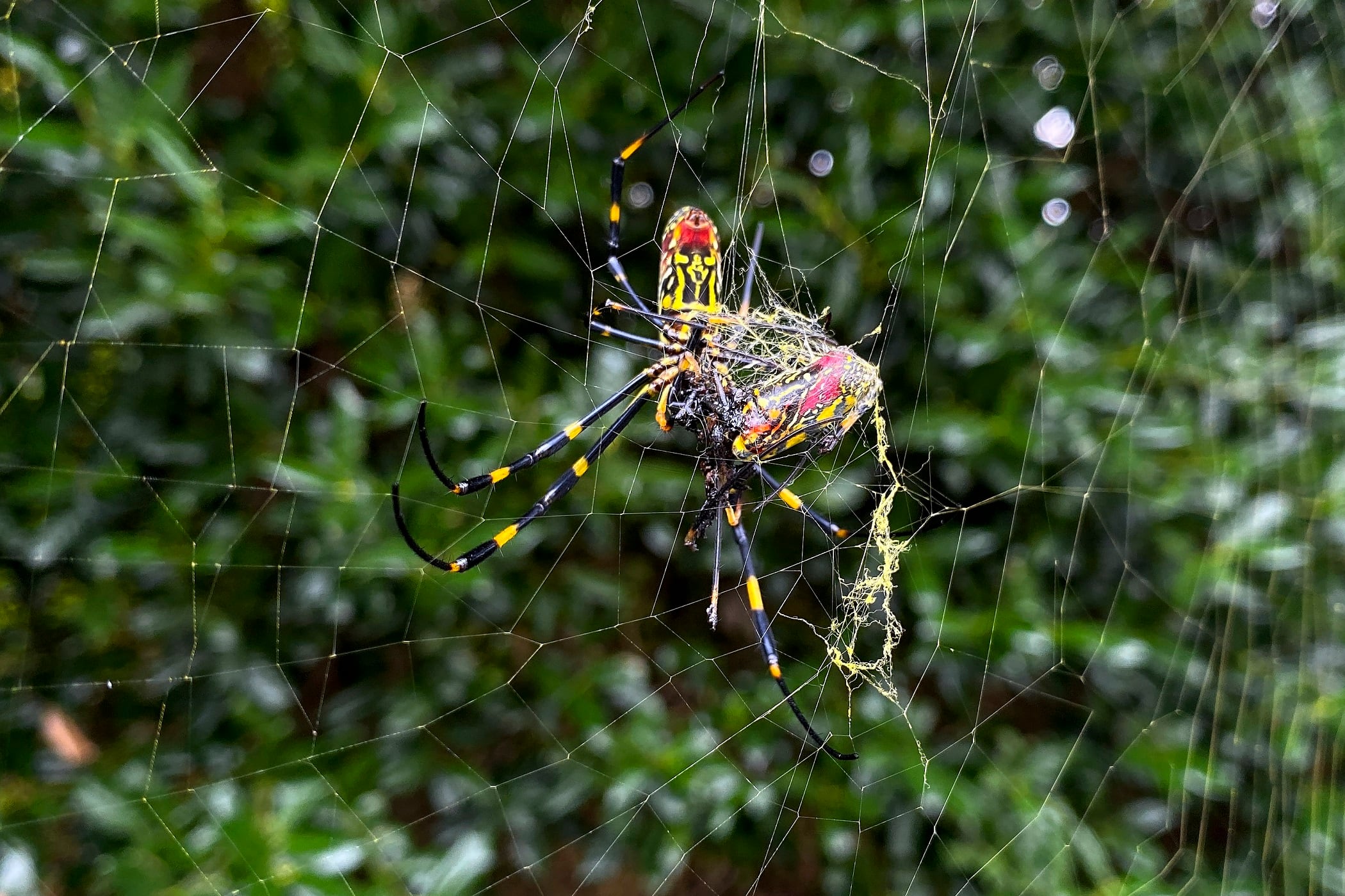
The Joro spider, a large spider native to East Asia, is seen in Johns Creek, Ga., on Sunday, Oct. 24, 2021. Researchers say the large spider that proliferated in Georgia in 2021 could spread to much of the East Coast. (AP Photo/Alex Sanz, File)
Researchers say a large spider native to East Asia that proliferated in Georgia last year could spread to much of the East Coast.
The Joro spider's golden web took over yards all over north Georgia in 2021, unnerving some residents. The spider was also spotted in South Carolina, and entomologists expected it to spread throughout the Southeast.
A new study suggests it could spread even farther than that. The Joro appears better suited to colder temperatures than a related species, researchers at the University of Georgia said in a paper published last month.
It has about double the metabolism, a 77% higher heart rate and can survive a brief freeze that kills off its relatives, the study found.
The researchers also noted that Joros are found in much of Japan, which has a similar climate to the U.S.
“Just by looking at that, it looks like the Joros could probably survive throughout most of the Eastern seaboard here, which is pretty sobering,” study co-author Andy Davis said in a statement.
The Joro — Trichonephila clavata — is part of a group of spiders known as orb weavers for their highly organized, wheel-shaped webs. Joro females have colorful yellow, blue and red markings on their bodies and can measure three inches (8 cm) across when their legs are fully extended.
It’s not clear exactly how and when the first Joro spider arrived in the U.S. or why they were so abundant in Georgia last year.
Their impact on native species and the environment is also not clear, though some researchers believe they are benign.
Five-time Olympic gold medal swimmer Missy Franklin was at the top of her sport when a shoulder injury forced her to retire. After that, her father was diagnosed with a rare kidney disease that forced her family to come together to support him. Now Franklin is working with Otsuka Pharmaceutical to raise awareness of genetic diseases and ADPKD, the disease that affected her father.
Federal health officials are expanding an investigation into potentially lead-tainted pouches of apple cinnamon fruit puree marketed for children amid reports of more illnesses and additional product recalls.
Kamili Bell Hill, author of "Happy Plants, Happy You: A Plant-Care & Self-Care Guide for the Modern Houseplant Parent," explains what you can do to make your houseplants thrive.
Marci Hopkins, recovery expert and author of "Chaos to Clarity: Seeing The Signs and Breaking The Cycles," talks about her own intergenerational experience with addiction that drove her to make changes and help others.
The Centers for Disease Control and Prevention announced that it will expand its infectious disease surveillance programs at major airports around the country.
Astronaut Thomas Kenneth Mattingly, who helped bring the crew of Apollo 13 back to earth after an explosion threatened their lunar mission, has died at 87.