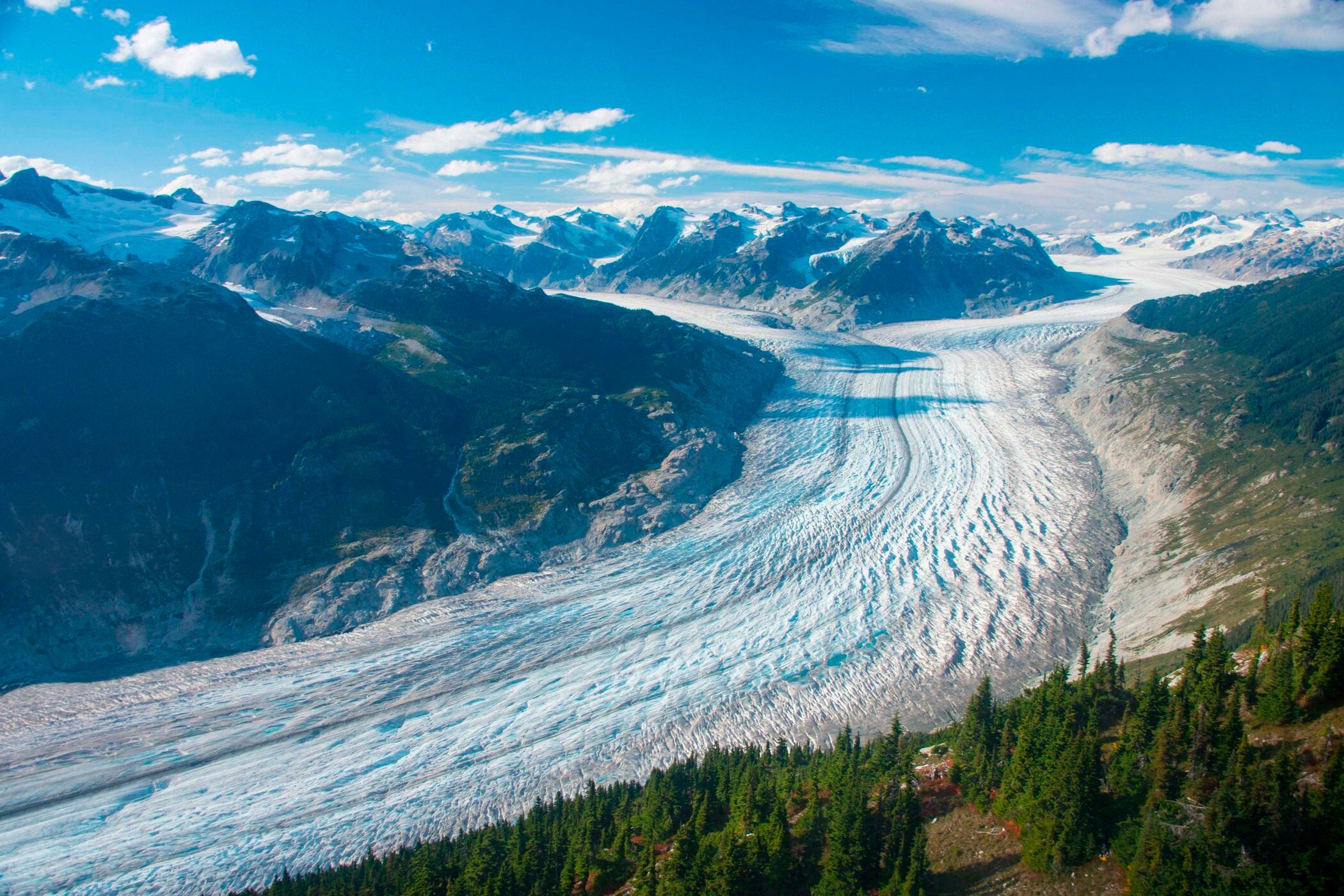
This September 2017 photo provided by researcher Brian Menounos shows the Klinaklini glacier in British Columbia, Canada. The glacier and the adjacent icefield has lost nearly 16 billion tons (14.5 billion metric tons) of snow and ice since 2000, with 10.7 billion tons of that (9.8 billion metric tons) of that since 2010, Menounos says. And the rate of loss accelerated over the last five years of the study. (Brian Menounos via AP)
By Seth Borenstein
Glaciers are melting faster, losing 31% more snow and ice per year than they did 15 years earlier, according to three-dimensional satellite measurements of all the world’s mountain glaciers.
Scientists blame human-caused climate change.
Using 20 years of recently declassified satellite data, scientists calculated that the world’s 220,000 mountain glaciers are losing more than 328 billion tons (298 billion metric tons) of ice and snow per year since 2015, according to a study in Wednesday’s journal Nature. That’s enough melt flowing into the world’s rising oceans to put Switzerland under almost 24 feet (7.2 meters) of water each year.
The annual melt rate from 2015 to 2019 is 78 billion more tons (71 billion metric tons) a year than it was from 2000 to 2004. Global thinning rates, different than volume of water lost, doubled in the last 20 years and “that’s enormous,” said Romain Hugonnet, a glaciologist at ETH Zurich and the University of Toulouse in France who led the study.
Half the world’s glacial loss is coming from the United States and Canada.
Alaska’s melt rates are “among the highest on the planet," with the Columbia glacier retreating about 115 feet (35 meters) a year, Hugonnet said.
Almost all the world’s glaciers are melting, even ones in Tibet that used to be stable, the study found. Except for a few in Iceland and Scandinavia that are fed by increased precipitation, the melt rates are accelerating around the world.
The near-uniform melting “mirrors the global increase in temperature” and is from the burning of coal, oil and gas, Hugonnet said. Some smaller glaciers are disappearing entirely. Two years ago, scientists, activists and government officials in Iceland held a funeral for a small glacier.
“Ten years ago, we were saying that the glaciers are the indicator of climate change, but now actually they’ve become a memorial of the climate crisis,” said World Glacier Monitoring Service Director Michael Zemp, who wasn’t part of the study.
The study is the first to use this 3D satellite imagery to examine all of Earth’s glaciers not connected to ice sheets in Greenland and Antarctic. Past studies either only used a fraction of the glaciers or estimated the loss of Earth’s glaciers using gravity measurements from orbit. Those gravity readings have large margins of error and aren't as useful, Zemp said.
Ohio State University’s Lonnie Thompson said the new study painted an “alarming picture."
Shrinking glaciers are a problem for millions of people who rely on seasonal glacial melt for daily water and rapid melting can cause deadly outbursts from glacial lakes in places like India, Hugonnet said.
But the largest threat is sea level rise. The world’s oceans are already rising because warm water expands and because of melting ice sheets in Greenland and Antarctica, but glaciers are responsible for 21% of sea level rise, more than the ice sheets, the study said. The ice sheets are larger longer term threats for sea level rise.
“It’s becoming increasingly clear that sea level rise is going to be a bigger and bigger problem as we move through the 21st century,” said National Snow and Ice Data Center Director Mark Serreze.
The Associated Press Health and Science Department receives support from the Howard Hughes Medical Institute’s Department of Science Education. The AP is solely responsible for all content.
A subvariant of the omicron COVID-19 variant called BA.2 is causing an outbreak overseas. Now, some health experts worry it could also lead to an increase in COVID-19 cases in the U.S. Dr. Amesh Adalja, infectious disease specialist and senior scholar at Johns Hopkins Center for Health Security, joins Cheddar News to discuss.
Dr. Alan Kaplin, Chief Scientific Officer of MyMD, joins Cheddar Innovates to discuss how the MYMD-1 is on track to be the first FDA-approved drug to treat aging and age-related diseases.
Tyler Hayes, CEO of Atom Limbs, joins Cheddar Innovates to discuss how the Atom Touch prosthetic is different from other prosthetics on the market, and how the Atom Limbs team of former Apple and Tesla leaders are bringing innovation into this industry.
Nouveau Monde Graphite says it wants to power the sustainable energy revolution. The Canadian company is developing carbon-neutral battery materials to serve the growing EV and cleantech markets and is doing so via a mining and manufacturing operation in Quebec. Eric Desaulniers, founder, president & CEO of Nouveau Monde Graphite, joins Cheddar News' Closing Bell to discuss.
Health experts are warning an even more contagious subvariant of Omicron, known as BA.2, could soon lead to another surge in Covid cases here in the U.S. The variant has already driven cases to skyrocket in China and Europe, which has historically served as a preview to the pattern the U.S. has seen throughout the pandemic. This comes at a time when protection from booster shots is waning for most people who got them. Dr. Jen Caudle, Family Physician & Associate Professor at Rowan University, explains what we can do to protect ourselves against the new variant and how we should act as warnings of another surge rise.
Catching you up on what you need to know Mar 24, 2022, with NATO meeting updates, Ukraine retaking suburbs around Kyiv, the spread of omicron subvariant BA.2 in China, Google Pay launching a third-party billing option, and a 16-year-old is suspected of being the Lapsus$ mastermind behind hacks of Microsoft and others.
Cannabis producer Cresco Labs is acquiring rival Columbia Care in a $2 billion all-stock deal, creating the largest U.S. cannabis company by sales. The deal, which is expected to close in the fourth quarter of 2022, is one of the biggest in the industry's history and would make Cresco the dominant player in a market projected to reach $46 billion in revenue by 2026. Charlie Bachtell, CEO of Cresco Labs, joins Cheddar News' Closing Bell to discuss.
Moderna announced it's seeking emergency use approval for its COVID-19 vaccine from the FDA for children under 6 years old. A former FDA associate commissioner and the president and co-founder of the Center for Medicine in the Public Interest (CMPI) Peter Pitts joined Cheddar News to talk about the timeline, benefits, and risks that come with the approval of the vaccine. "We want to protect their parents and their grandparents and their caregivers and their daycare providers, so it's all about protecting not just the kids but all around the people that are surrounding those kids," he said.
Moderna says its COVID-19 vaccine works in babies, toddlers and preschoolers. The company announced early findings Wednesday from a study of children younger than 6.
Catching you up on what you Need to Know on Mar 23, 2022, as NATO meets in Brussels to discuss Ukraine, mortgage rates rise, Justin Trudeau is set to lead Canada until 2025, tornadoes sweep through Louisiana, California may do away with SATs, and a Starbucks in Seattle unionizes.