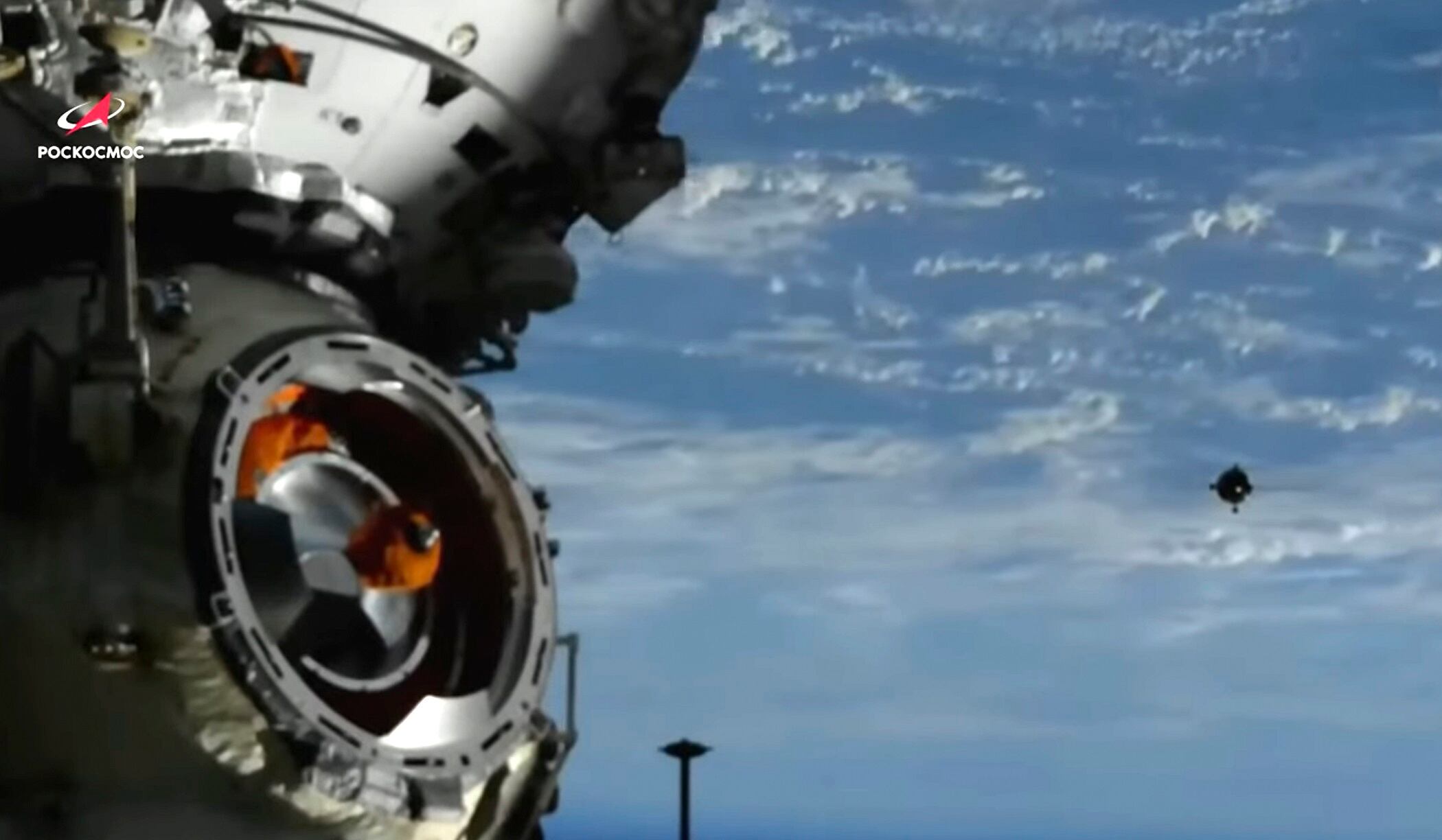
In this image taken from video footage released by the Roscosmos Space Agency, the Soyuz MS-21 space ship, right, approaches the International Space Station, ISS, during docking to the station, Friday, March 18, 2022. The head of Russia’s space program says the future of the International Space Station hangs in the balance after the United States, the European Union and Canadian space agencies missed a deadline to meet Russian demands for lifting sanctions on Russian enterprises and hardware. (Roscosmos Space Agency via AP, File)
The head of Russia's space program said Saturday that the future of the International Space Station hangs in the balance after the United States, the European Union, and Canadian space agencies missed a deadline to meet Russian demands for lifting sanctions on Russian enterprises and hardware.
Dmitry Rogozin, the head of Roscosmos, told reporters that the state agency is preparing a report on the prospects of international cooperation at the station, to be presented to federal authorities “after Roscosmos has completed its analysis.”
Rogozin implied on Russian state TV that the Western sanctions, some of which predate Russia’s current military operations in Ukraine, could disrupt the operation of Russian spacecraft servicing the ISS with cargo flights. Russia also sends manned missions to the space station.
He stressed that the Western partners need the space station and “cannot manage without Russia, because no one but us can deliver fuel to the station.”
Rogozin added that “only the engines of our cargo craft are able to correct the ISS’s orbit, keeping it safe from space debris.”
Rogozin later Saturday wrote on his Telegram channel that he received responses from his Western counterparts vowing to promote “further cooperation on the ISS and its operations.”
He reiterated his view that “the restoration of normal relations between partners in the ISS and other joint (space) projects is possible only with the complete and unconditional lifting” of sanctions, which he referred to as illegal.
The Canadian Space Agency declined to comment. NASA and the European Space Agency did not immediately return emailed requests for comment.
Space is one of the last remaining areas of cooperation between Moscow and Western nations. U.S.-Russian negotiations on the resumption of joint flights to the space station were underway when Russia launched its military operation in Ukraine last month, prompting unprecedented sanctions on Russian state-linked entities.
So far the U.S. and Russia are still cooperating in space. A NASA astronaut caught a Russian ride back to Earth on Wednesday after a U.S. record 355 days at the International Space Station, returning with two cosmonauts.
Mark Vande Hei landed in a Soyuz capsule in Kazakhstan alongside the Russian Space Agency’s Pyotr Dubrov, who also spent the past year in space, and Anton Shkaplerov. Wind blew the capsule onto its side following touchdown, and the trio emerged into the late afternoon sun one by one.
Vande Hei’s return followed customary procedures. A small NASA team of doctors and other staff was on hand for the touchdown and returned home immediately with the 55-year-old astronaut.
Russia resumed attacks on the Ukrainian capital for the first time in months after vowing to focus its resources on the eastern region known as 'the Donbas.' Cheddar News Speaks with national security and foreign policy analyst Ari Aramesh on the latest developments surrounding Ukraine.
U.S. stocks close Monday's session slight higher Monday as investors continue to monitor whether the economy will successfully avoid a recession. For many, fears over inflation and rising interest rates. Tommy Mancuso, president and co-founder of the Bad Investment Company, joins Cheddar News' Closing Bell to discuss.
Bill Nye the Science Guy is back but on an even smaller screen. America’s favorite science teacher has racked up more than eight million followers on TikTok, and he joined Cheddar News to talk about his success on the platform, having fun but also being serious about scientific topics like tackling climate change, and his newest hosting project "The End is Nye," a streaming show on Peacock that examines disasters — both natural and manmade. "There are six episodes. We have big disasters. Things go terribly wrong, and then we show you how things could have gone right," he explained.
Cheddar Politics takes a look at the Biden Administration's effort to center inflation concerns in the White House's economic policies. Reuters White House reporter Jeff Mason joins Cheddar News to discuss what the White House is doing and what more it can do to help fix economic issues.
In another round of sweeping sanctions against Russia for its war on Ukraine, European Union leaders have agreed to ban the vast majority of Russian oil by the end of the year. But, the embargo covers only Russian oil brought in by sea, allowing an exemption for fuel imported via pipeline. Christine McDaniel, a senior fellow with the Mercatus Center, discusses just how significant this deal is, and what impact it might have on the global energy sector.
Catching you up on what you need to know on Monday, June 6, 2022, a string of mass shootings across the country this weekend, UK Prime Minister Boris Johnson faces a no-confidence vote this morning, and Tropical Storm Alex floods Miami.
U.S. stocks closed Friday's session near session to cap off the week in the red. The disappointing end to the day and week follows a lukewarm May jobs report from the Labor Department and comes as investors continue to eye future rate hikes from the Federal Reserve. Callie Cox, U.S. Investment Analyst for eToro, joins Cheddar News' Closing Bell to discuss.