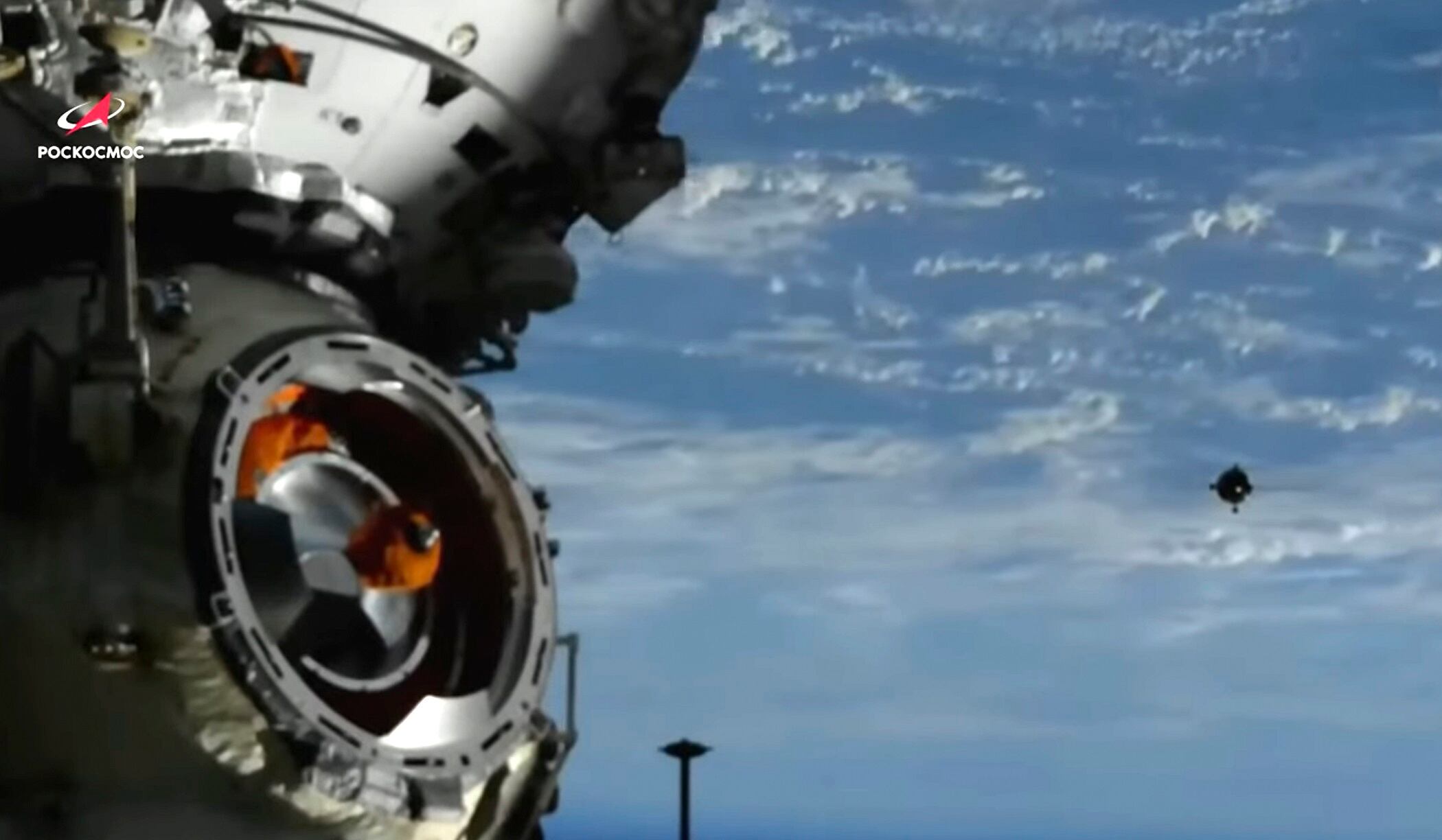
In this image taken from video footage released by the Roscosmos Space Agency, the Soyuz MS-21 space ship, right, approaches the International Space Station, ISS, during docking to the station, Friday, March 18, 2022. The head of Russia’s space program says the future of the International Space Station hangs in the balance after the United States, the European Union and Canadian space agencies missed a deadline to meet Russian demands for lifting sanctions on Russian enterprises and hardware. (Roscosmos Space Agency via AP, File)
The head of Russia's space program said Saturday that the future of the International Space Station hangs in the balance after the United States, the European Union, and Canadian space agencies missed a deadline to meet Russian demands for lifting sanctions on Russian enterprises and hardware.
Dmitry Rogozin, the head of Roscosmos, told reporters that the state agency is preparing a report on the prospects of international cooperation at the station, to be presented to federal authorities “after Roscosmos has completed its analysis.”
Rogozin implied on Russian state TV that the Western sanctions, some of which predate Russia’s current military operations in Ukraine, could disrupt the operation of Russian spacecraft servicing the ISS with cargo flights. Russia also sends manned missions to the space station.
He stressed that the Western partners need the space station and “cannot manage without Russia, because no one but us can deliver fuel to the station.”
Rogozin added that “only the engines of our cargo craft are able to correct the ISS’s orbit, keeping it safe from space debris.”
Rogozin later Saturday wrote on his Telegram channel that he received responses from his Western counterparts vowing to promote “further cooperation on the ISS and its operations.”
He reiterated his view that “the restoration of normal relations between partners in the ISS and other joint (space) projects is possible only with the complete and unconditional lifting” of sanctions, which he referred to as illegal.
The Canadian Space Agency declined to comment. NASA and the European Space Agency did not immediately return emailed requests for comment.
Space is one of the last remaining areas of cooperation between Moscow and Western nations. U.S.-Russian negotiations on the resumption of joint flights to the space station were underway when Russia launched its military operation in Ukraine last month, prompting unprecedented sanctions on Russian state-linked entities.
So far the U.S. and Russia are still cooperating in space. A NASA astronaut caught a Russian ride back to Earth on Wednesday after a U.S. record 355 days at the International Space Station, returning with two cosmonauts.
Mark Vande Hei landed in a Soyuz capsule in Kazakhstan alongside the Russian Space Agency’s Pyotr Dubrov, who also spent the past year in space, and Anton Shkaplerov. Wind blew the capsule onto its side following touchdown, and the trio emerged into the late afternoon sun one by one.
Vande Hei’s return followed customary procedures. A small NASA team of doctors and other staff was on hand for the touchdown and returned home immediately with the 55-year-old astronaut.
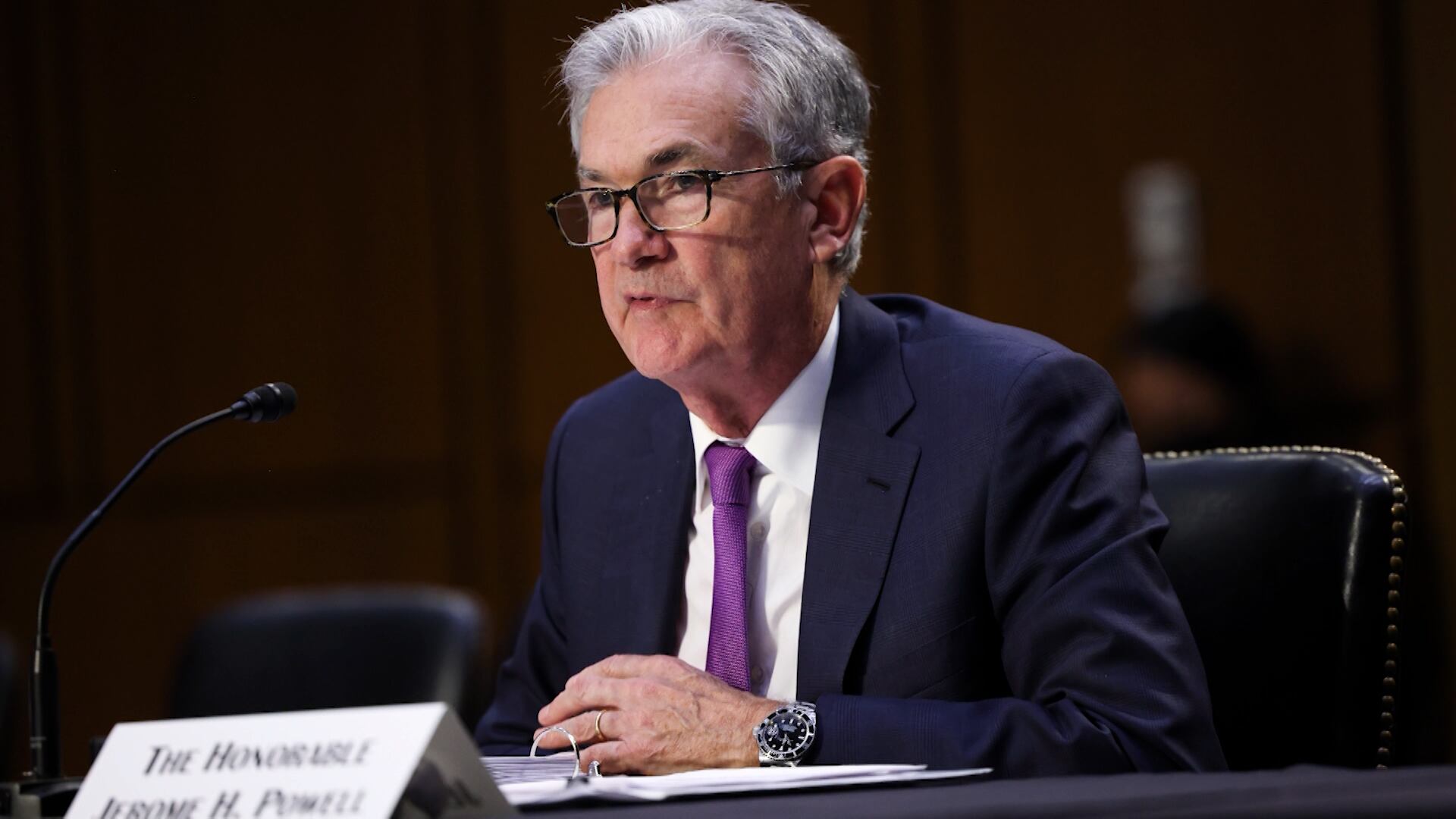
Stocks began the week closing at session lows on a day when bond yields rose and President Biden decided to stick with Jerome Powell as Fed Chair. Bryan Lee, Chief Investment Officer at Blue Zone Wealth Advisors, joins Cheddar News' Closing Bell, where he breaks down the day's activity and discusses what the Fed now needs to do going forward.
President Joe Biden announced Monday he is re-nominating Federal Reserve Chairman Jerome Powell after weeks of speculation that he would choose Democrat and Fed Governor Lael Brainard to fill the role. Biden could be looking for continuity as the U.S. continues to grapple with COVID-19 and high inflation, and investors could be on the same page: markets and treasuries ticked up after the White House made the announcement. MarketWatch Senior Reporter Greg Robb joins Cheddar News' Closing Bell to discuss Powell's re-nomination, what we can expect from the Fed's December meeting, whether it will speed up its taper timeline, and more.
President Joe Biden named Jerome Powell, initially appointed by President Trump, to keep his seat as the chair of the Federal Reserve on Monday amid the ongoing challenges of the pandemic, inflation, and unemployment. David Beckworth, a former international economist for the Treasury Department and a senior fellow with the Mercatus Center, joined Cheddar to discuss what he sees as the practicality of Biden's decision. "What Powell brings to the table is he's built up political capital with Republicans and Democrats," he said. "It's easy for him to get the job done. I think in one way he was the path of least resistance for the president."
In a surprise turn of events, Elizabeth Holmes took the stand in her own defense on Friday and is expected to continue her testimony later today. Holmes, who founded a blood testing start-up Theranos back in 2003, faces 11 counts of wire fraud as well as conspiracy to commit wire fraud. Aron Solomon, Chief Legal Analyst, Esquire Digital joined Cheddar's Opening Bell to discuss.
Jill and Carlo cover the developing story out of suburban Milwaukee, where a speeding SUV careened through a Christmas parade. Looters get more brazen in San Francisco, the missing Chinese tennis star resurfaces, and more.
Michael Tubbs, former Mayor of Stockton, California and author of 'The Deeper the Roots,' joined Cheddar Movers to talk all about his new memoir, and his ongoing fight to make meaningful change in his community.
The House narrowly passed President Biden's $1.7 trillion Build Back Better bill, the largest expansion of the social safety net in decades. The final vote was 220 to 213, with only one Democrat joining all Republicans in opposing the bill. It now heads to the Senate, where it faces an uncertain fate. Jennifer Haberkorn, congressional reporter for the Los Angeles Times, joins Cheddar News' Closing Bell, where she breaks down the current version of the bill, where it goes next, and what it could mean for the country if it eventually reaches the president's desk.