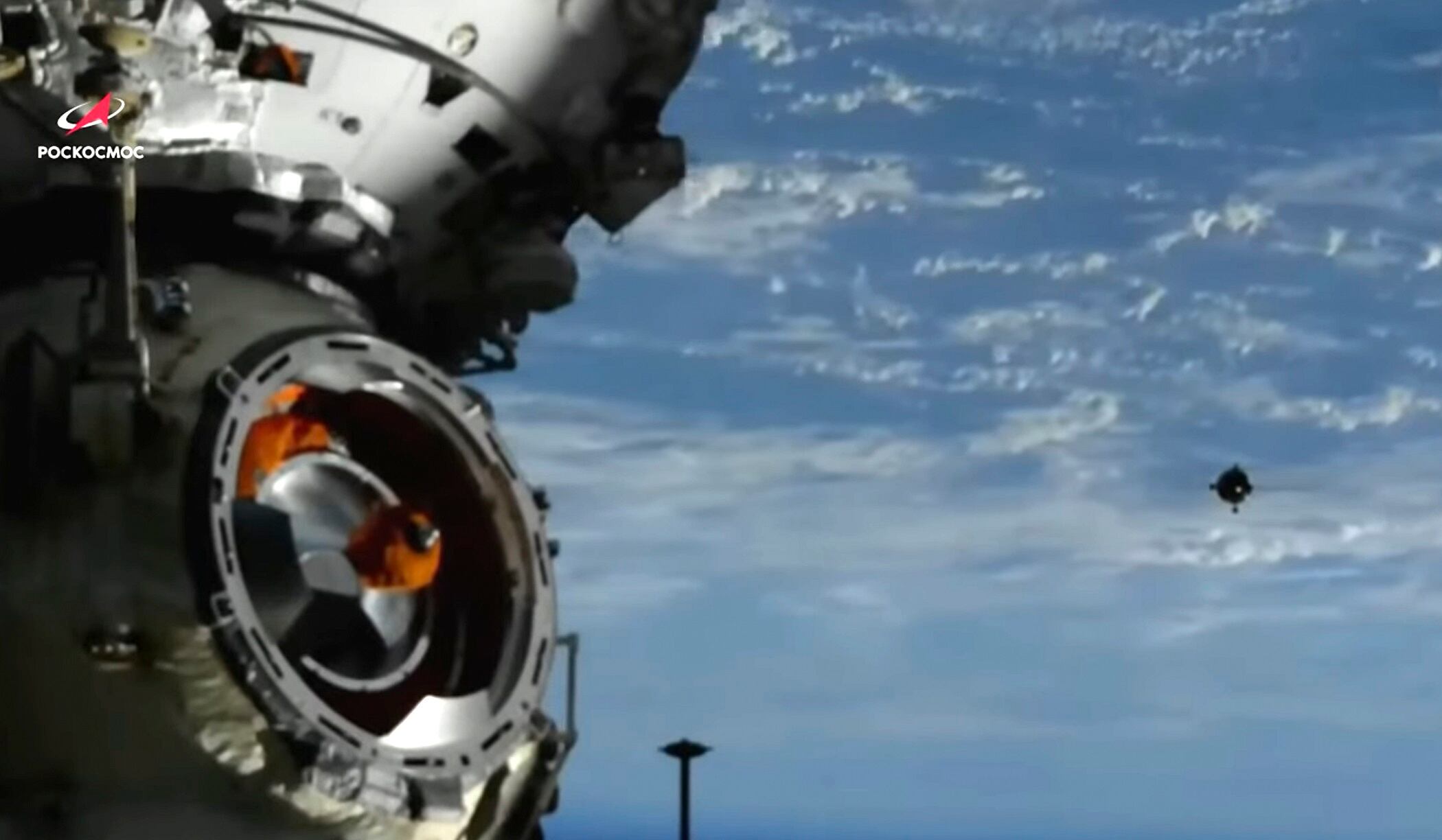
In this image taken from video footage released by the Roscosmos Space Agency, the Soyuz MS-21 space ship, right, approaches the International Space Station, ISS, during docking to the station, Friday, March 18, 2022. The head of Russia’s space program says the future of the International Space Station hangs in the balance after the United States, the European Union and Canadian space agencies missed a deadline to meet Russian demands for lifting sanctions on Russian enterprises and hardware. (Roscosmos Space Agency via AP, File)
The head of Russia's space program said Saturday that the future of the International Space Station hangs in the balance after the United States, the European Union, and Canadian space agencies missed a deadline to meet Russian demands for lifting sanctions on Russian enterprises and hardware.
Dmitry Rogozin, the head of Roscosmos, told reporters that the state agency is preparing a report on the prospects of international cooperation at the station, to be presented to federal authorities “after Roscosmos has completed its analysis.”
Rogozin implied on Russian state TV that the Western sanctions, some of which predate Russia’s current military operations in Ukraine, could disrupt the operation of Russian spacecraft servicing the ISS with cargo flights. Russia also sends manned missions to the space station.
He stressed that the Western partners need the space station and “cannot manage without Russia, because no one but us can deliver fuel to the station.”
Rogozin added that “only the engines of our cargo craft are able to correct the ISS’s orbit, keeping it safe from space debris.”
Rogozin later Saturday wrote on his Telegram channel that he received responses from his Western counterparts vowing to promote “further cooperation on the ISS and its operations.”
He reiterated his view that “the restoration of normal relations between partners in the ISS and other joint (space) projects is possible only with the complete and unconditional lifting” of sanctions, which he referred to as illegal.
The Canadian Space Agency declined to comment. NASA and the European Space Agency did not immediately return emailed requests for comment.
Space is one of the last remaining areas of cooperation between Moscow and Western nations. U.S.-Russian negotiations on the resumption of joint flights to the space station were underway when Russia launched its military operation in Ukraine last month, prompting unprecedented sanctions on Russian state-linked entities.
So far the U.S. and Russia are still cooperating in space. A NASA astronaut caught a Russian ride back to Earth on Wednesday after a U.S. record 355 days at the International Space Station, returning with two cosmonauts.
Mark Vande Hei landed in a Soyuz capsule in Kazakhstan alongside the Russian Space Agency’s Pyotr Dubrov, who also spent the past year in space, and Anton Shkaplerov. Wind blew the capsule onto its side following touchdown, and the trio emerged into the late afternoon sun one by one.
Vande Hei’s return followed customary procedures. A small NASA team of doctors and other staff was on hand for the touchdown and returned home immediately with the 55-year-old astronaut.
Carlo and Baker cover the heartening news on the Covid front ahead of the holiday, plus President Biden punting student loan repayments again, a new space telescope and Love, Hate, Ate: Christmas Eve Eve Edition!
This year's worldwide semiconductor shortage limited the supply of everything from new cars to smartphones; and now, many in the chip industry expect the shortage to continue deep into 2022, and maybe even 2023. Semiconductor senior research analyst for Robert W. Baird & Co., Tristan Gerra, joins Cheddar News' Closing Bell to discuss.
The airline industry says it is contending with staff shortages that threaten to hamper operations amid the COVID resurgence, andDelta Airlines CEO Ed Bastian called on the CDC to revise its guidance for vaccinated workers who test positive from a 10-day quarantine to just five. Chuck Liberman, chief investment officer and managing partner at Advisors Capital Management LLC, joined Cheddar to talk about the current guidance on isolation and why he believes the omicron variant calls for more relaxed guidance given its reportedly mild symptoms.
Schools are shutting down in droves as the highly contagious omicron variant surges across the country. Denisha Merriweather, director of public relations and content marketing at the American Federation for Children, an advocacy organization for vouchers and tax credits for school choice, joined Cheddar's "Opening Bell" to discuss the impact of remote learning on children. She argued that school districts have to be more proactive about the steps they are taking to engage students, and if they are unable to form better teaching methods, parents should be able to find alternative schools.
The boys discuss President Biden's plans to send out free rapid tests as the testing supply chain starts to buckle ahead of the holidays. Also, why aren't Americans having more babies, and The Matrix returns.
With the Build Back Better plan essentially out of the picture, economists are highlighting what the country might lose without the provisions designed to strengthen it. Among other things, this includes no more monthly payments for tens of millions of families, no universal Pre-K for 6 million children a year, and no billions of dollars in tax incentives for climate initiatives. Grace Segers, staff writer for The New Republic, joined Cheddar to discuss the various impacts on the economy without President Biden's spending bill.
Electric vehicle companies took a tumble Monday after Senator Joe Manchin killed Biden's 'Build Back Better' plan. Shares of Tesla, Lucid, and Rivian all fell rapidly as the plan had included significant incentives for the growing EV sector. Rich Steinberg, former executive at Nissan, BMW and Electrify America joined Cheddar's Opening Bell to discuss.
Michael Robinson, Chief Technology Strategist at Money Map Press, joins Cheddar News' Closing Bell, where he explains why small and mid-cap stocks heating up during Tuesday's session is a very good sign for a stock market that ended the day's session sharply higher.