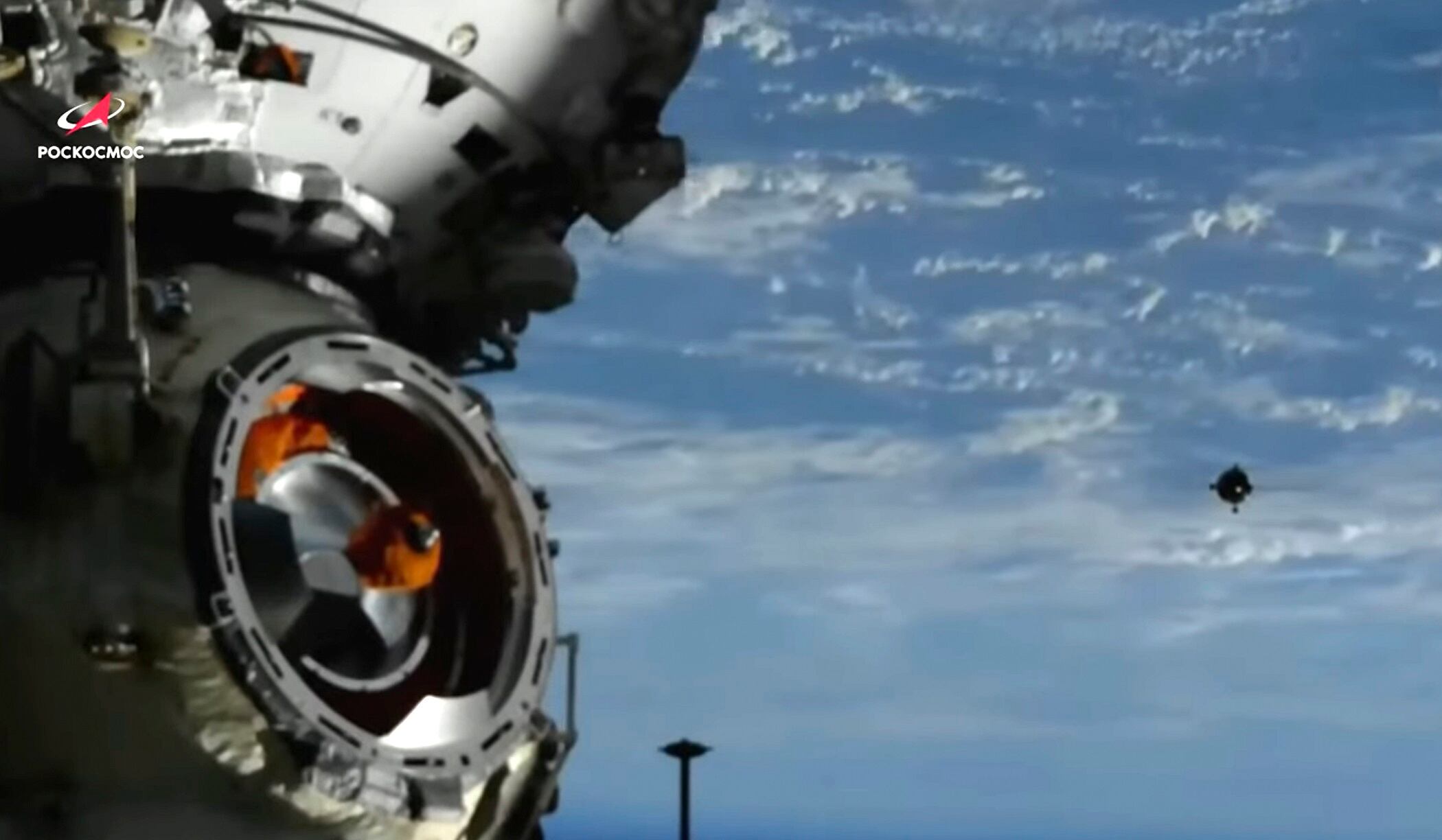
In this image taken from video footage released by the Roscosmos Space Agency, the Soyuz MS-21 space ship, right, approaches the International Space Station, ISS, during docking to the station, Friday, March 18, 2022. The head of Russia’s space program says the future of the International Space Station hangs in the balance after the United States, the European Union and Canadian space agencies missed a deadline to meet Russian demands for lifting sanctions on Russian enterprises and hardware. (Roscosmos Space Agency via AP, File)
The head of Russia's space program said Saturday that the future of the International Space Station hangs in the balance after the United States, the European Union, and Canadian space agencies missed a deadline to meet Russian demands for lifting sanctions on Russian enterprises and hardware.
Dmitry Rogozin, the head of Roscosmos, told reporters that the state agency is preparing a report on the prospects of international cooperation at the station, to be presented to federal authorities “after Roscosmos has completed its analysis.”
Rogozin implied on Russian state TV that the Western sanctions, some of which predate Russia’s current military operations in Ukraine, could disrupt the operation of Russian spacecraft servicing the ISS with cargo flights. Russia also sends manned missions to the space station.
He stressed that the Western partners need the space station and “cannot manage without Russia, because no one but us can deliver fuel to the station.”
Rogozin added that “only the engines of our cargo craft are able to correct the ISS’s orbit, keeping it safe from space debris.”
Rogozin later Saturday wrote on his Telegram channel that he received responses from his Western counterparts vowing to promote “further cooperation on the ISS and its operations.”
He reiterated his view that “the restoration of normal relations between partners in the ISS and other joint (space) projects is possible only with the complete and unconditional lifting” of sanctions, which he referred to as illegal.
The Canadian Space Agency declined to comment. NASA and the European Space Agency did not immediately return emailed requests for comment.
Space is one of the last remaining areas of cooperation between Moscow and Western nations. U.S.-Russian negotiations on the resumption of joint flights to the space station were underway when Russia launched its military operation in Ukraine last month, prompting unprecedented sanctions on Russian state-linked entities.
So far the U.S. and Russia are still cooperating in space. A NASA astronaut caught a Russian ride back to Earth on Wednesday after a U.S. record 355 days at the International Space Station, returning with two cosmonauts.
Mark Vande Hei landed in a Soyuz capsule in Kazakhstan alongside the Russian Space Agency’s Pyotr Dubrov, who also spent the past year in space, and Anton Shkaplerov. Wind blew the capsule onto its side following touchdown, and the trio emerged into the late afternoon sun one by one.
Vande Hei’s return followed customary procedures. A small NASA team of doctors and other staff was on hand for the touchdown and returned home immediately with the 55-year-old astronaut.
Tens of thousands of people have fled Ukraine in attempts to escape the Russian Invasion. According to the U.N. neighboring countries like Poland, Hungary, and even Romania have seen half a million refugees. While the hospitality is being welcomed by many, it also highlights the mistreatment of migrants and refugees from the Middle East and Africa. Professor of Philosophy and Director of Politics at Northeastern University Serena Parekh, joined Cheddar, to discuss more.
As Russia unleashed war in the country of Ukraine, global leaders have started inflicting punishment on Vladimir Putin's regime via commercial and financial penalties. According to President Joe Biden Putin's aggression is "a flagrant violation of international law and it demands a firm response from the international community".However, the main question is will these sanctions actually work. Partner at Jenner & Block LLP, Rachel Alpert, joined Cheddar to discuss more.
A Gallup poll finds that now 7.1% of American adults identify as LGBTQ, jumping from 3.5% in 2012. The increase is driven by Generation-Z – those born between 1997 and 2003 – of whom one out of five identify as LGBTQ. Cheddar News speaks with Washington Blade reporter Chris Johnson about the significant shift.
As the Biden administration continues to see the potential for an imminent invasion of Ukraine after contradictory reports of a Russian troop pullback or buildup, Rep. Ami Bera (D-Calif. 7th District), a member of the House Committee on Foreign Affairs, joined Cheddar News to give his insight into the tense situation. "When I was in Ukraine a couple of weeks ago and we were talking with the Ukrainian leadership with President Zelensky, they said we ought to approach Vladimir Putin as though he was a poker player," he said. "So this could be one of those head fakes where he's saying one thing and doing another thing."
The Biden Administration has now issued new guidelines when it comes to carbon capture. The new guidelines handed down this week encouraged the widespread use of climate attacks that traps and stores carbon emissions. The goal here is the process would help keep carbon out of the atmosphere without requiring a whole lot of change by big companies and manufacturing plants. Several scientists say that this method would be crucial to help us decrease the use of carbon emissions by the year 2050. Professor of Civil and Environmental Engineering at Stanford University, Mark Jacobson, joined Cheddar to discuss more.
Natalie Fertig, federal cannabis policy reporter for Politico Pro, joins Cheddar News to discuss the latest in marijuana legalization in the United States.
The Biden administration is launching a new task force to promote the use of 'cleaner' construction materials with lower life cycle emissions. This comes as the White House works to speed up government purchases of greener products. Sweta Chakraborty, climate change expert and U.S. president of "We Don't Have Time," joins Cheddar News to discuss.
Due to the staffing shortages of teachers in New Mexico, the state has been encouraging its National Guard members to fill in as licensed substitutes to keep schools open. Kurt Steinhaus, New Mexico secretary of education, joined Cheddar News to explain the state's stopgap measure amid its lack of teaching professionals. "The first thing they have to go through a fingerprint background check, just like any other substitute new Mexico. The second thing they have to do is go through some online training, and then we provided some in-person professional development about classroom management," Steinhaus explained about the qualifications process.