By Vladimir Isachenkov, Yuras Karmanau, and Aamer Madhani
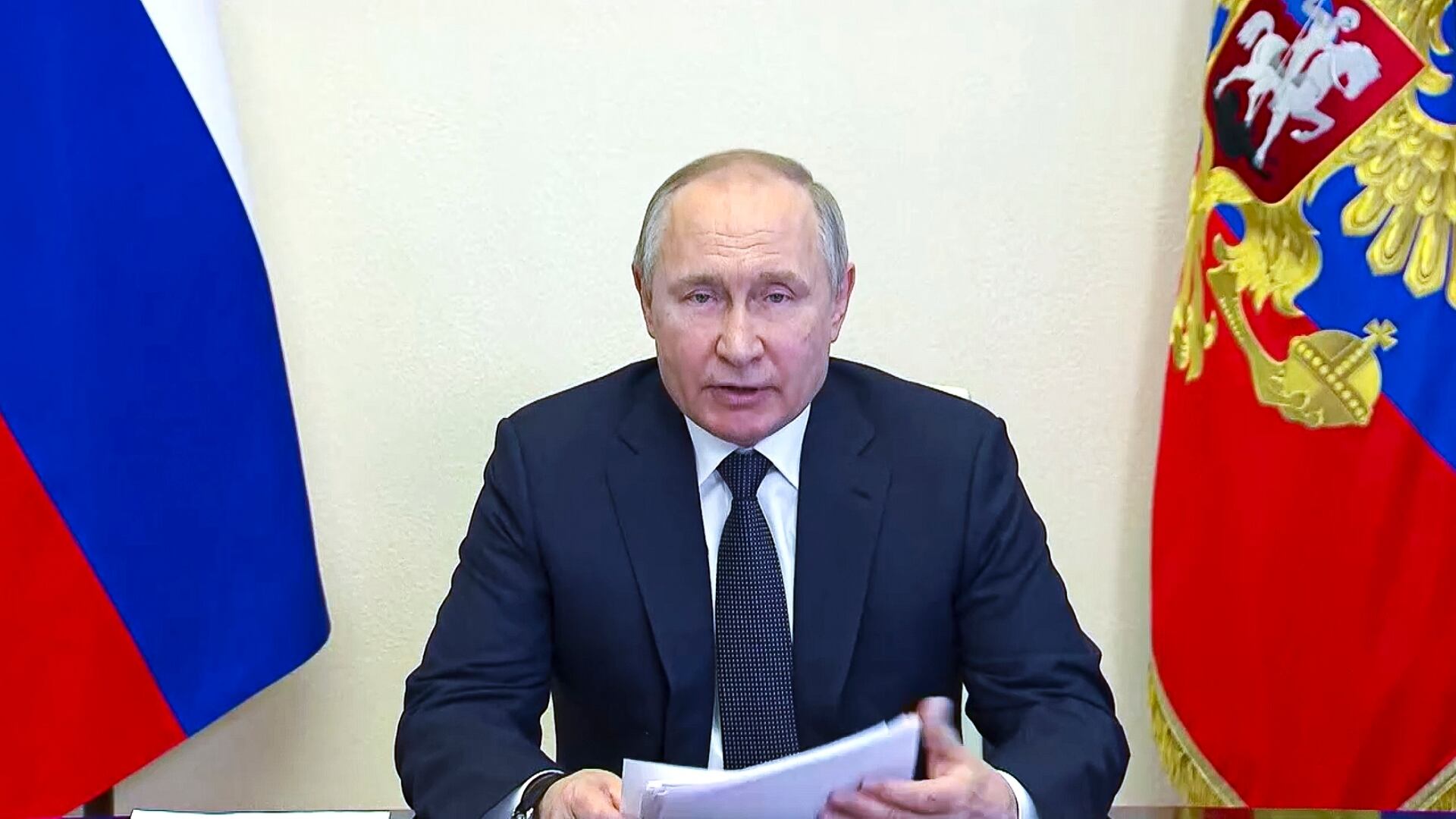
Russian President Vladimir Putin said Tuesday that he welcomed a security dialogue with the West as his military reported pulling back some of its troops near Ukraine. But U.S. President Joe Biden said the U.S. had not verified Russia’s claim and that an invasion was still a distinct possibility.
Putin said he does not want war and would rely on negotiations as he presses his demand for the West to halt Ukraine’s bid to join NATO. At the same time, he did not commit to a full pullback of troops, saying Russia’s next moves in the standoff will depend on how the situation evolves.
In remarks at the White House, Biden promised that the U.S. would continue to give diplomacy "every chance” to prevent a Russian invasion, but he struck a skeptical tone about Moscow's intentions. Biden also insisted that the U.S. and its allies would not to “sacrifice basic principles” respecting Ukraine sovereignty.
“Two paths are still open," Biden said. "But let there be no doubt: If Russia commits this breach by invading Ukraine, responsible nations around the world will not hesitate to respond. If we do not stand for freedom where it is at risk today, we’ll surely pay a steeper price tomorrow.”
Putin's overtures soothed global markets that have been on edge amid the worst East-West tensions in decades. Washington and its European allies remained cautious, saying they want to see evidence of a Russian pullback. Biden said 150,000 Russian forces are now massed near Ukraine, an increase from an earlier U.S. estimate of 130,000 troops.
The U.S. and NATO continue to warn that Russia could invade at any time as they sent troops and military supplies to shore up NATO members in Eastern Europe. Russia has denied having such plans. It wants the West to keep Ukraine and other ex-Soviet nations out of the alliance, halt weapons deployments near Russian borders and roll back forces from Eastern Europe.
The U.S. and its allies have roundly rejected those demands, but offered to engage in talks with Russia on ways to bolster security in Europe.
Speaking after meeting with German Chancellor Olaf Scholz, Putin said the West agreed to discuss a ban on missile deployment to Europe, restrictions on military drills and other confidence-building measures — issues that Moscow put on the table years ago.
He said Russia is open to discuss “some of those elements," but added that it would only do so in combination "with the main issues that are of primary importance for us.”
Asked if there could be a war in Europe, Putin said Russia doesn’t want it but that Ukraine’s bid to join NATO posed a major security threat to his country.
While Scholz reiterated that NATO's eastward expansion “is not on the agenda -- everyone knows that very well,” Putin retorted that Moscow will not be assuaged by such assurances.
“They are telling us it won't happen tomorrow,” Putin said. “Well, when will it happen? The day after tomorrow? What does it change for us in the historic perspective? Nothing.”
Putin went on to argue NATO expansion violates the principle of the indivisibility of security enshrined in international documents.
“We want to solve this issue now as part of negotiation process through peaceful means,” Putin said. “We very much hope that our partners hear our concerns and take them seriously.”
Scholz also said diplomatic options are “far from exhausted,” and praised the announcement of a troop withdrawal as a “good signal,” adding: "We hope that more will follow.”
The Russian Defense Ministry released images of tanks and howitzers rolling onto railway platforms and more tanks rolling across snowy fields. It did not disclose where or when the images were taken, or where the vehicles were headed, other than “to places of permanent deployment.”
Biden acknowledged the likelihood that U.S. and allied sanctions on Russia in retaliation for an invasion of Ukraine would have significant blowback on the American economy, including possible price hikes and disruption to the nation’s energy supply.
“The American people understand that defending democracy and liberty is never without cost,” Biden said. “I will not pretend this will be painless.”
He said the administration was trying to preempt supply issues by working with energy producers and shippers on contingency plans, and said he would work with Congress on unspecified “additional measures to protect consumers and address the impact of prices at the pump.”
Russian forces continue to threaten Ukraine along the eastern border and from the Black Sea Crimean peninsula that Moscow seized from Ukraine in 2014, the year when it also backed a separatist insurgency in the country's east. More Russian troops loom over Ukraine in Belarus, where they were deployed for sweeping joint drills.
Ukraine expressed skepticism about Russia's statements of a pullback.
“We won’t believe when we hear, we’ll believe when we see. When we see troops pulling out, we’ll believe in de-escalation," Ukrainian Foreign Minister Dmytro Kuleba said.
NATO Secretary-General Jens Stoltenberg said that "so far, we have not seen ... any signs of reduced Russian military presence on the borders of Ukraine,” adding that the alliance wants to see a “significant and enduring withdrawal of forces, troops, and not least the heavy equipment.”
British Foreign Secretary Liz Truss reiterated the invasion danger still exists. Norwegian Foreign Minister Anniken Huitfeldt issued a similar warning, and Estonia’s foreign intelligence agency said the Russian armed forces could launch an operation “from the second half of February.”
Few Russians expect a war, following the Kremlin's dismissal of Western warnings as “hysteria” and “absurdity.”
In a village in Russia’s Belgorod region about 30 kilometers (18 miles) from Ukraine’s border, residents carried on with life as usual, even as more military personnel have been passing through village streets.
“We are friends with Ukraine," said villager Lyudmila Nechvolod. "We are really on the border, we really have relatives here and there, everyone has somebody there (on the Ukrainian side). No one wants war.”
Diplomatic efforts continued Tuesday.
U.S. Secretary of State Antony Blinken held a call with Lavrov, according to a State Department official who spoke on condition of anonymity because the call had not been publicly announced. And Biden spoke with French President Emmanuel Macron on Tuesday about the evolving crisis.
European leaders have scrambled to head off a new war on the continent after several tense weeks that have left Europeans feeling caught between Moscow and Washington, and further pushed up household energy prices because of a dependence on Russian gas.
Meanwhile, Russian lawmakers urged Putin to recognize rebel-held areas in eastern Ukraine as independent states. The State Duma, Russia’s lower house, voted to submit an appeal to Putin to that effect.
Putin said the motion reflects the Russian public's sympathy for the suffering of people trapped in the conflict in eastern Ukraine that has killed over 14,000 since 2014. He noted, however, that Russia continues to believe a 2015 peace deal brokered by France and Germany should serve as the main vehicle for a settlement of the separatist conflict.
Putin's statement signaled that he wasn't inclined to back the parliament motion that would effectively invalidate the 2015 agreement, which marked a major diplomatic coup for Moscow, requesting Kyiv to offer a broad self-rule to the separatist territories. It has been resented by many in Ukraine and its implementation has stalled.
___
Karmanau reported from Kyiv, Ukraine and Madhani from Washington. Dasha Litvinova in Moscow, Angela Charlton in Paris, Lorne Cook in Brussels, Monika Scislowska in Warsaw, Geir Moulson in Berlin, Jill Lawless in London, Jan M. Olsen in Copenhagen, Denmark, and Robert Burns, Matthew Lee and Zeke Miller in Washington contributed.
Updated on February 15, 2022, at 4:47 p.m. ET with the latest details, photos.