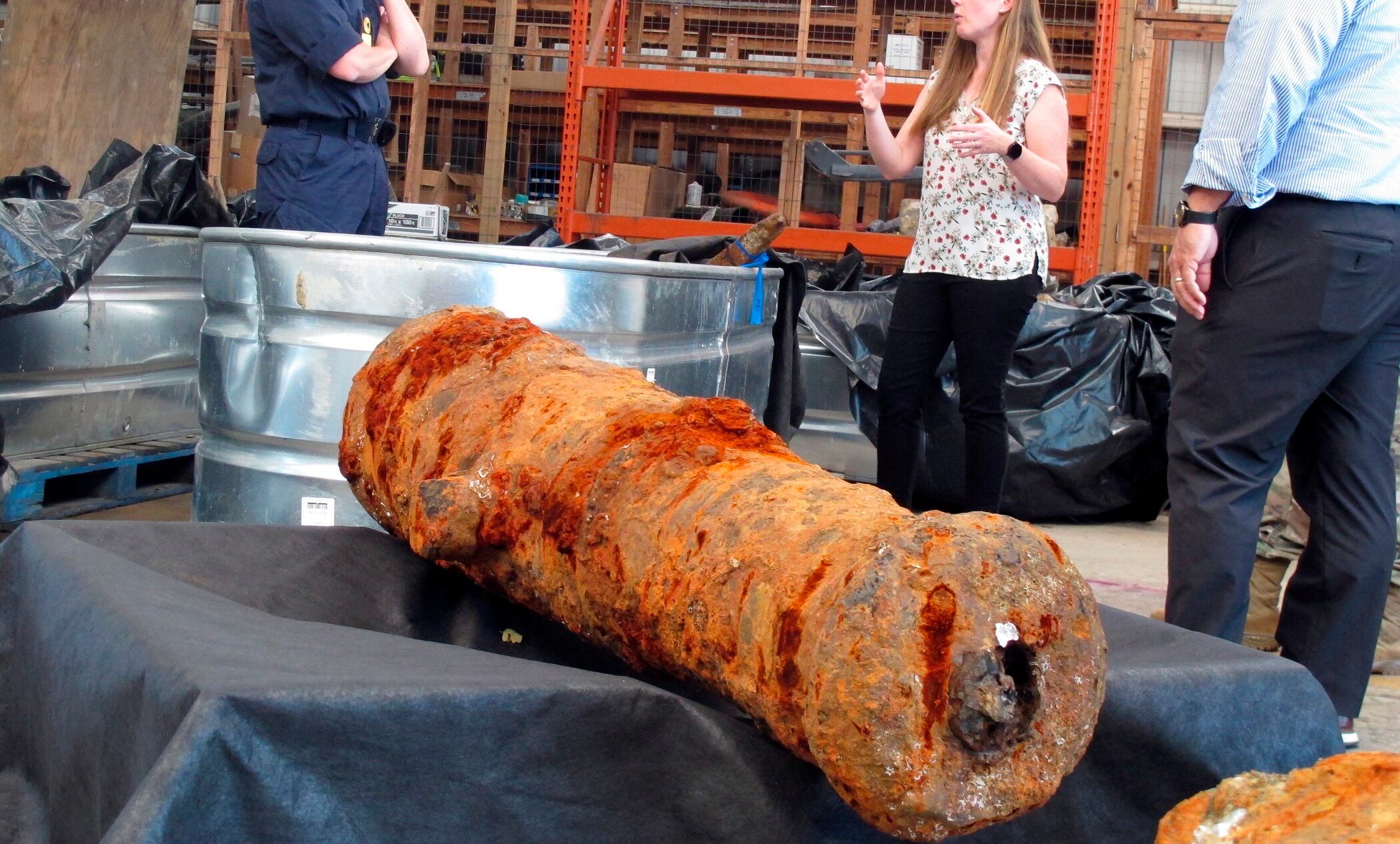
Commodore Philip Nash, left, of the British Royal Navy, gets a briefing from U.S. Army Corps of Engineers archaeologist Andrea Farmer on Thursday, April 28, 2022, in Savannah, Ga., about 19 cannons recovered from the Savannah River, that experts suspect came from one or more British ships scuttled in the river during the American Revolution in 1779. (AP Photo/Russ Bynum)
By Russ Bynum
A warehouse along the Savannah River is holding historical treasures that evidence suggests remained lost for more than 240 years — a cache of 19 cannons that researchers suspect came from British ships scuttled to the river bottom during the American Revolution.
The mud- and rust-encrusted guns were discovered by accident. A dredge scooping sediment from the riverbed last year as part of a $973 million deepening of Savannah's busy shipping channel surfaced with one the cannons clasped in its metal jaws. The crew soon dug up two more.
Archaeologists guessed they were possibly leftover relics from a sunken Confederate gunship excavated a few years earlier in the same area, said Andrea Farmer, an archaeologist for the Army Corps of Engineers. But experts for the U.S. Navy found they didn't match any known cannons used in the Civil War. Further research indicates they're likely almost a century older and sank during the buildup to the Revolutionary War's bloody siege of Savannah in 1779.
In a timeframe of just over a year, 19 cannons were hoisted from the same area of the river a few miles downstream from Savannah, where Georgia was founded as the last of Britain's 13 American colonies in 1733.
“They’re in remarkably good shape," Farmer said. “Many were buried in clay and covered by silt and debris that kind of protected them.”
Now officials with the U.S. and British governments, as well as the state of Georgia, are working together on an agreement to preserve the newly found guns before putting them on display. Commodore Philip Nash of the British Royal Navy, a military attache based in Washington, viewed the artifacts submerged in metal tubs of water during a visit Thursday.
“Some of these pieces are in amazing condition and I’m sure could tell some stories,” Nash said.
The cannons are being kept in water to prevent further deterioration until experts can carefully clean them. Meanwhile, researchers are looking for more definitive proof linking the cannons to British ships from the American Revolution.
Farmer said researchers are very confident of the connection. Savannah had been under British occupation for about a year by the fall of 1779, when colonists planned an attack to retake the city with help from French and Haitian allies.
When French ships carrying troops were spotted off the Georgia coast, the British hurried to scuttle at least six ships in the Savannah River downstream from the city to block the French vessels. The land battle that followed was one of the bloodiest of the war. British forces killed nearly 300 colonial fighters and their allies, while wounding hundreds more.
Farmer said researchers suspect the cannons found in the river came from the British ship HMS Savannah and possibly a second ship scuttled at the same time, the HMS Venus. The longer guns appear to match cannons manufactured in France during the mid-1700s, she said. Researchers are looking for ship logs and manifests in hopes of confirming the armaments aboard those ships.
It's also possible the cannons themselves and other artifacts found at the site — pieces of anchors and a portion of a ship's bell — once cleaned might bear markings or other clues to which ship they belonged to. The wood from those ships, Farmer said, decayed long ago or got destroyed by prior dredging projects over a series of decades.
The question of who owns the artifacts gets a little murky. They were found in state waters of Georgia during a dredging project headed by the Army Corps, a U.S. government agency. The British government could make an ownership claim if there's strong evidence the artifacts came from British ships.
Farmer said all of those parties are working on an agreement to preserve the cannons and ultimately have them displayed at the Savannah History Museum, which incorporates the battlefield where the bloodiest fighting occurred during the 1779 siege.
“Everybody wants to keep the artifacts in Savannah," Farmer said, "because that makes the most sense.”
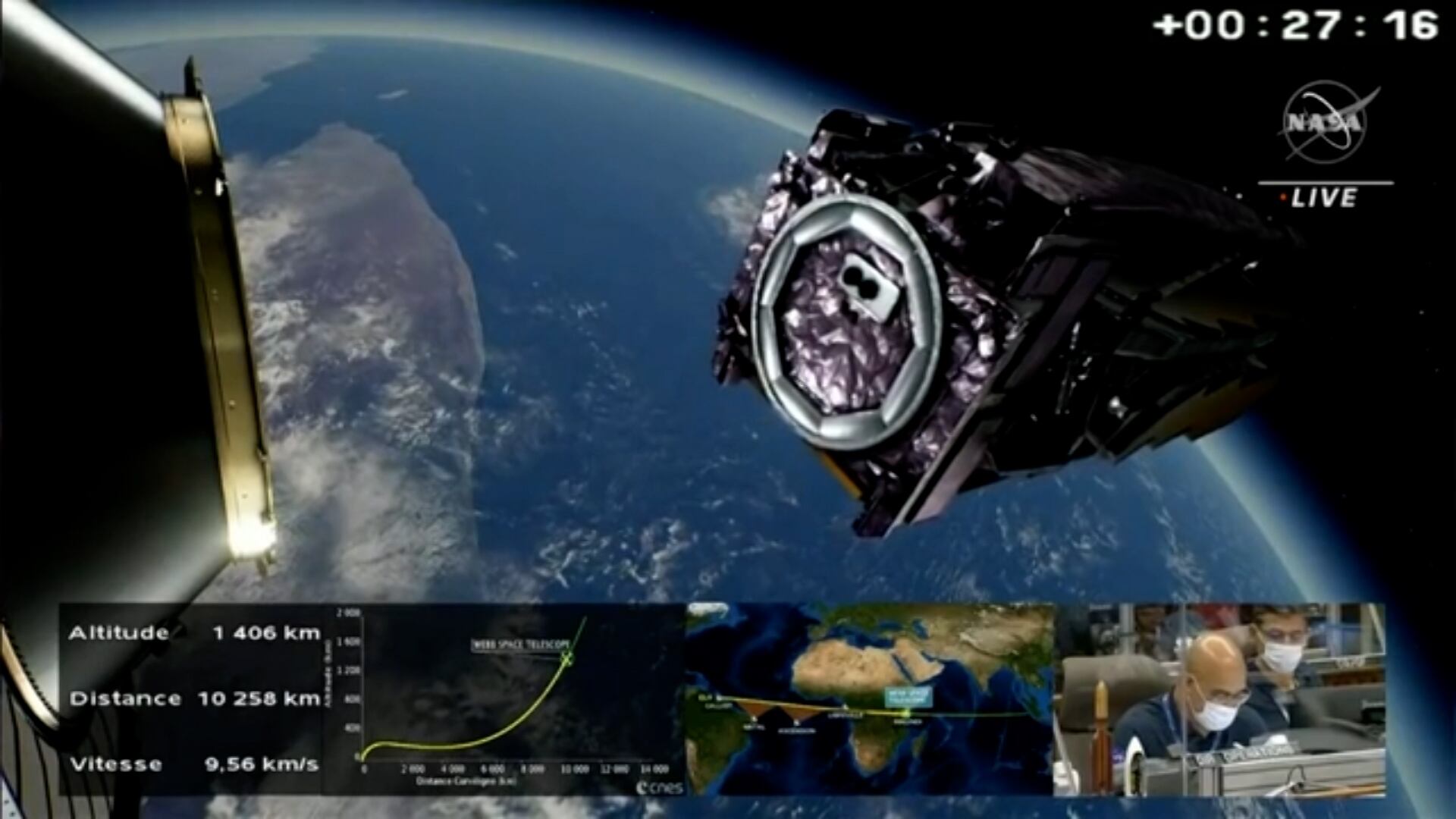
2021 was an exciting year for space innovations, but 2022 could hold even more in store. Cheddar took a deep dive into the space mission on tap for the year ahead.
The United States purchased over 600,000 doses of a monoclonal antibody treatment from Glaxosmithkline and Vir Biotechnology, bringing the total worldwide doses purchased to 1.7 million. This comes as the country attempts to ramp up treatment options as cases of the omicron variant continue to surge. Dr. Asha Shah, Director of Infectious Diseases at Stamford Health joined Cheddar's Opening Bell to discuss.
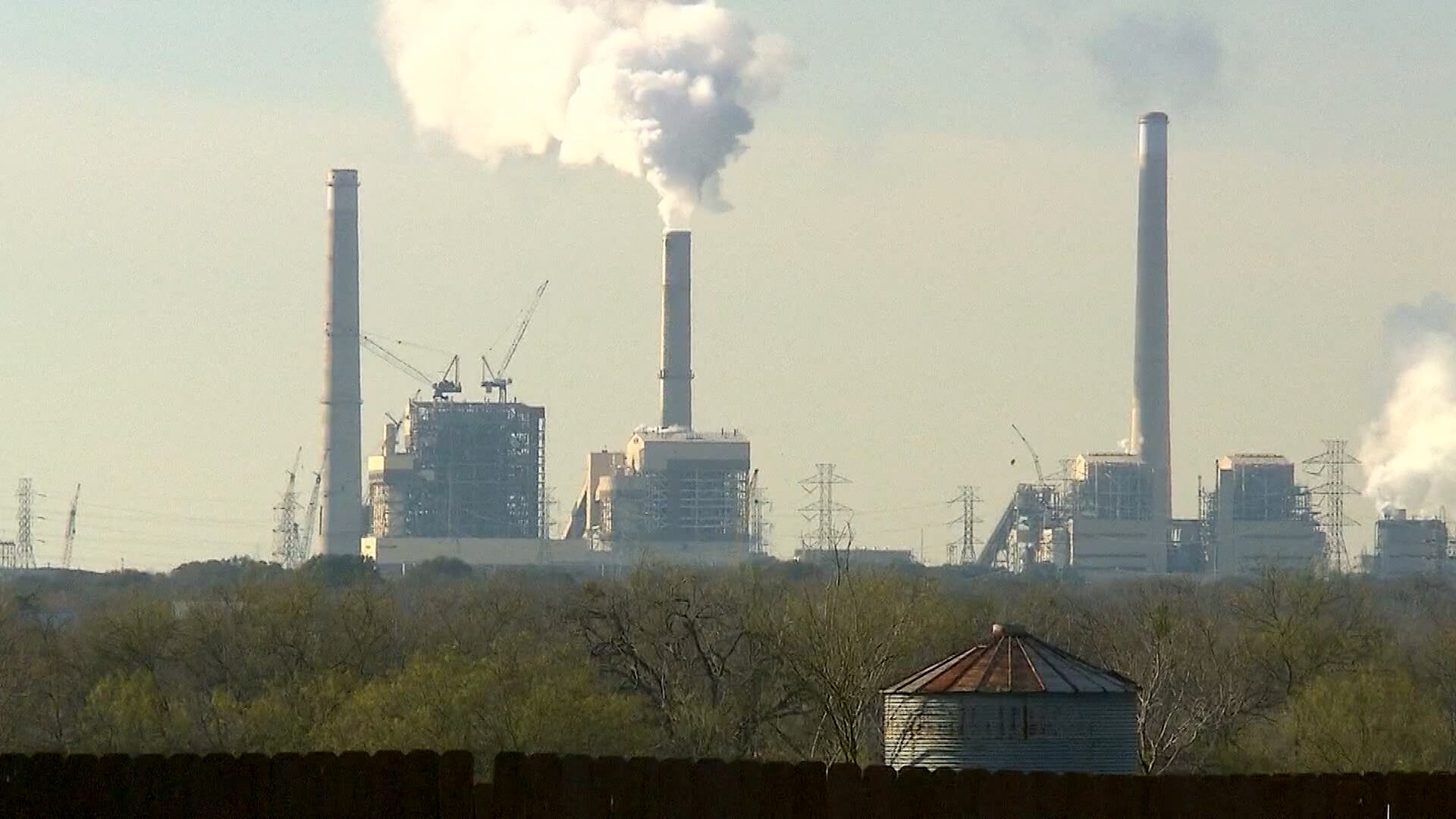
As the pandemic slammed the brakes on the nation's economy in 2020, America's greenhouse gas emissions reached their lowest levels in at least three decades. However, as the world, and the economy re-opened, 2021 told a much different story as emissions surged. Biden's flagship 'Build Back Better' act involves billions in spending on electric cars and renewables, in an effort to cut U.S. emissions, experts are still skeptical that the nation will meet the current 2030 target. Andrew Dessler, professor of atmospheric sciences at Texas A&M University, joins Cheddar News.
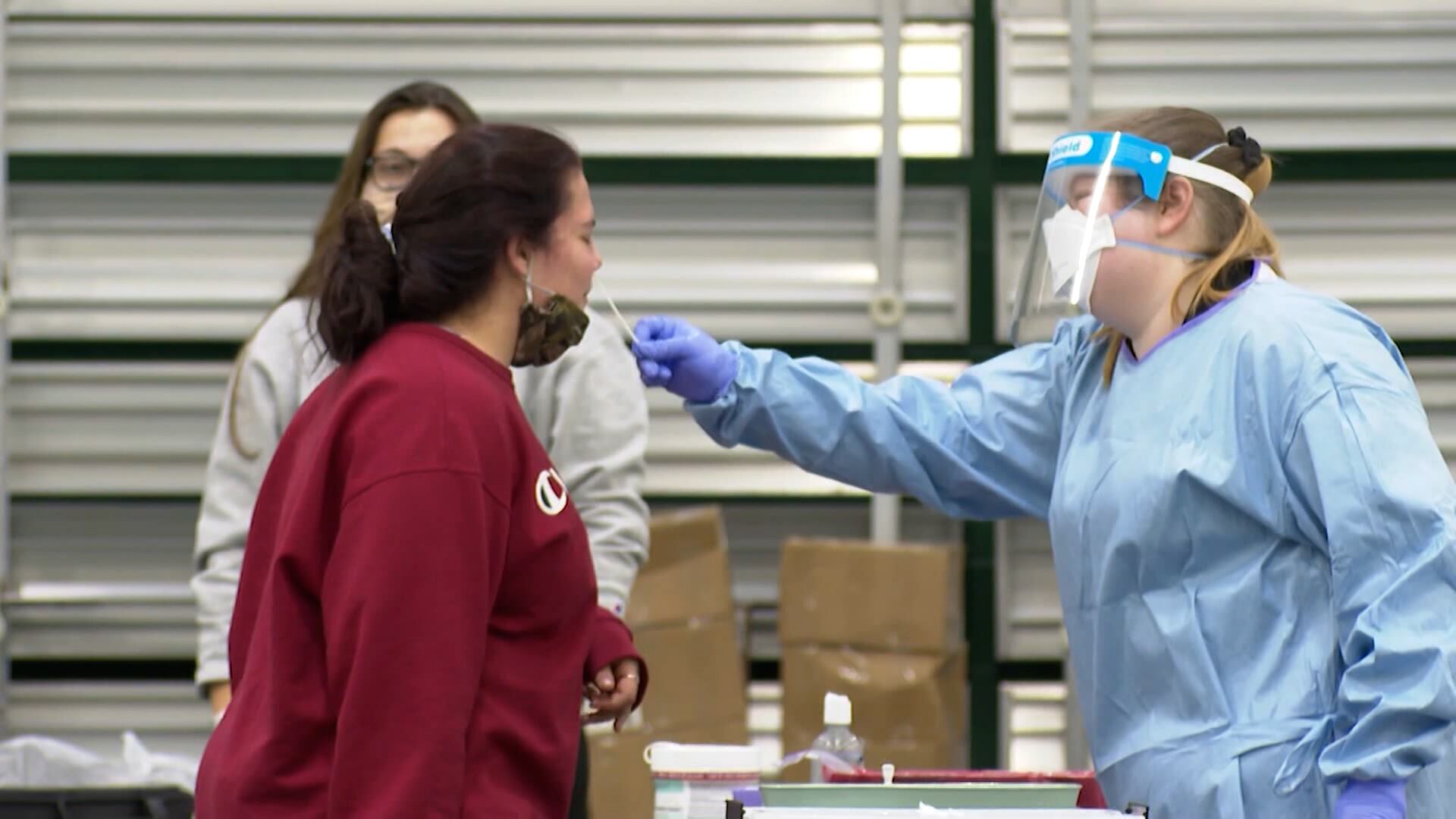
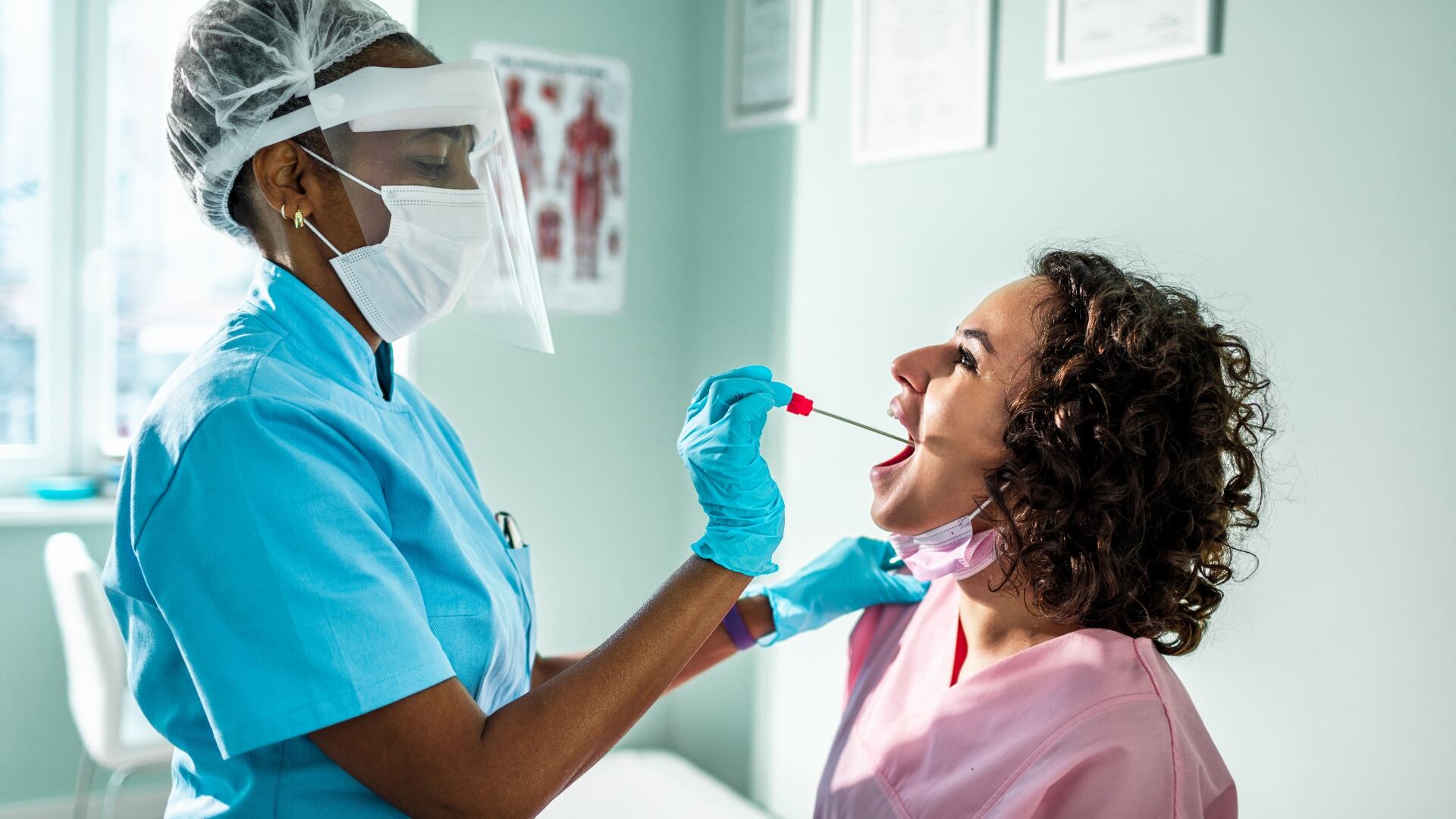
Amid the omicron surge, a new debate has emerged about whether or not throat swabs are more effective than nasal swabs for COVID testing. Dr. William Schaffner, MD, professor of infectious diseases, Vanderbilt Medical Center, sat down with Cheddar's News Wrap to weigh in on the dispute. "Should there be a change? You've got to do the studies, show that in the field [a throat swab] works as well or better than the nasal specimen," he said. "Let's not do it off our hips, as we say."
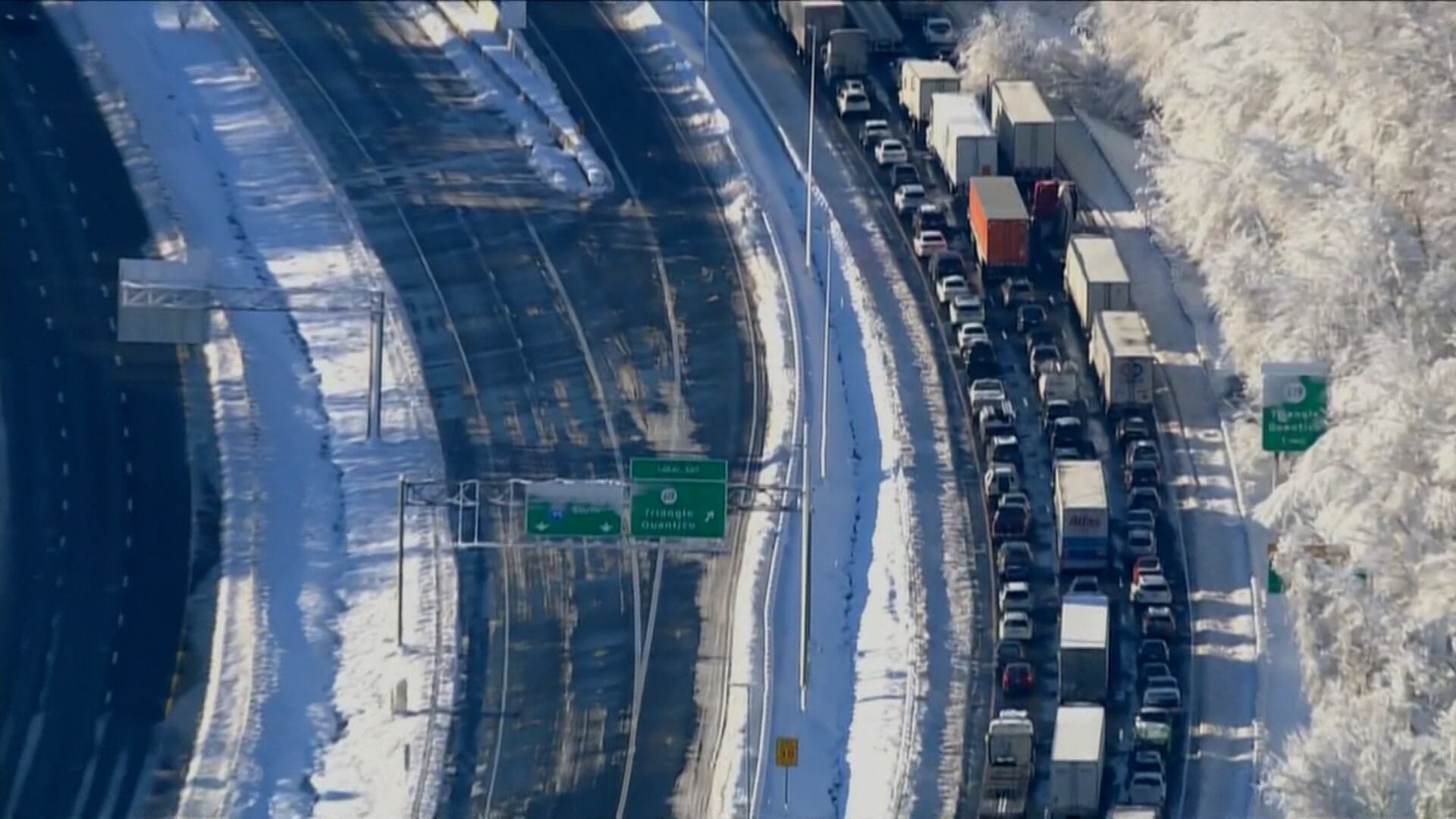
Virginia Governor Ralph Northam is declaring a state of emergency after Monday's winter storm left hundreds of drivers stranded on the interstate for more than 24 hours.
The snow also knocked out power for many residents, with more than 100,000 outages remaining days later.
Michael Wehner, a climate scientist at Lawrence Berkeley national laboratory, discusses recent weather disasters.
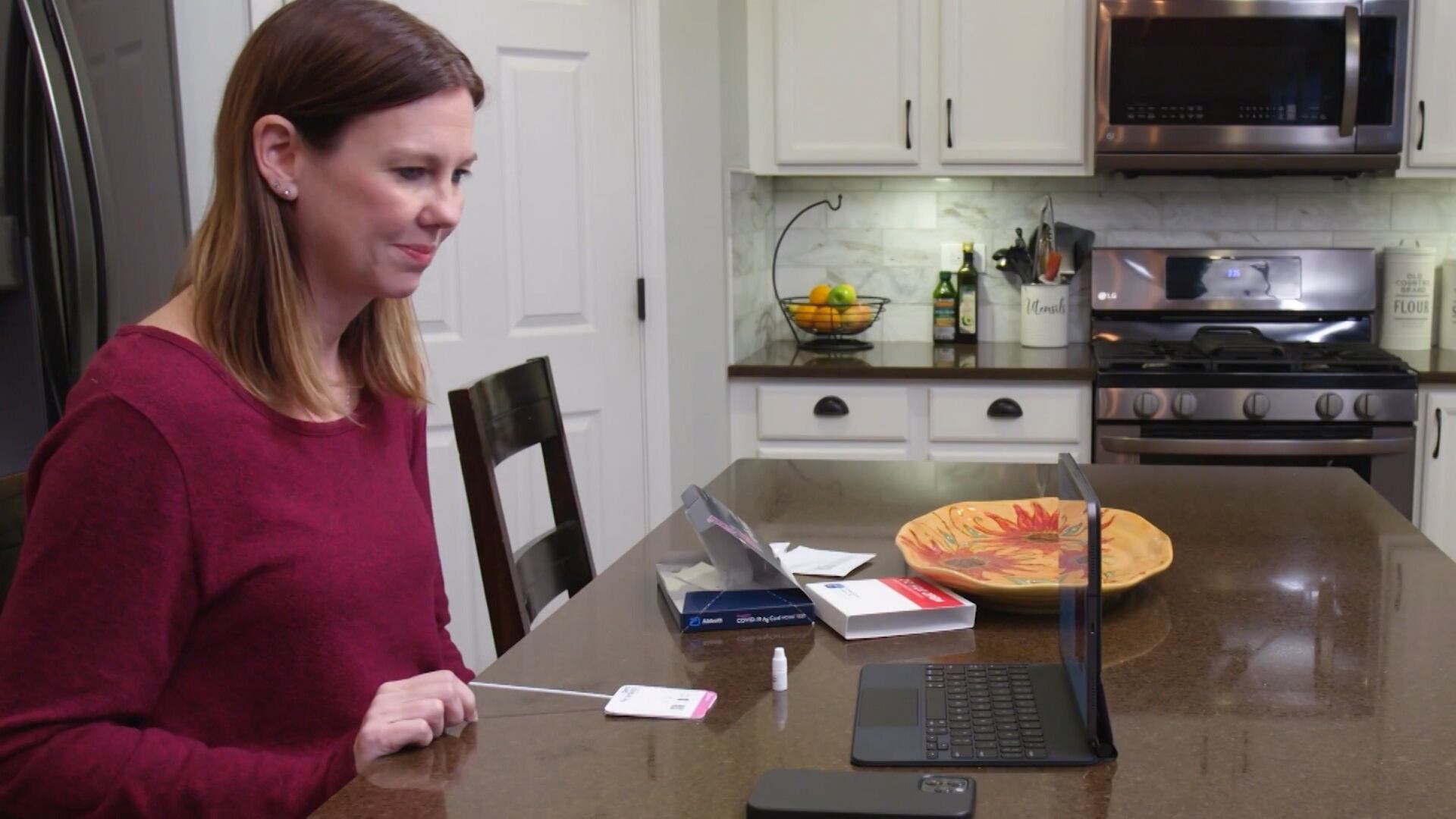
As the need for COVID-19 testing increases, so does the price of the tests themselves. An agreement with The White House and several major companies to sell the tests at a lower cost has now expired, sending prices up as retailers struggle to keep kits on shelves. Dr. Thomas McGinn, executive VP of physician enterprise at Common Spirit Health, joins Cheddar News to discuss.
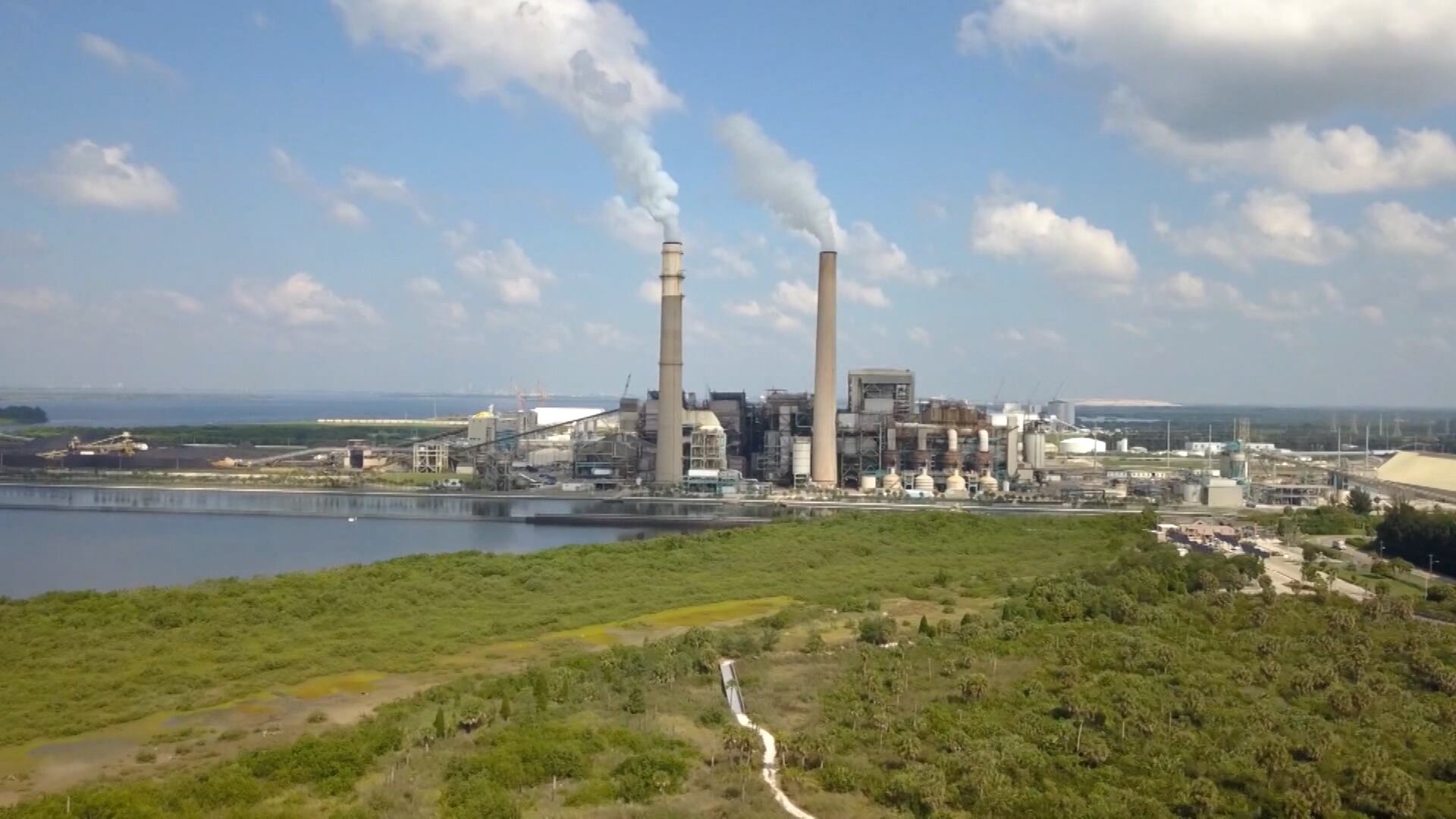
A new report shows 2021 saw a surge in U.S. greenhouse gas emissions, indicating that the country remains far off track from meeting President Biden's climate change targets. Biden previously pledged to cut the nation's emissions in half by 2030, and now experts warn that immediate action must be taken in order to get the nation back on track. Zeke Hausfather, director of climate and energy at The Breakthrough Institute on U.S. Emissions and Global Temperatures, joins Cheddar News to discuss.
Electric vehicles are quickly becoming an accessible way for consumers to slash emissions as legacy automakers begin to electrify their fleets and world leaders including President Joe Biden push for broad EV adoption. But consumers have concerns about EV range, the availability of charging stations, and more. What if it were both helpful to consumers — and feasible from a climate change standpoint — to keep hybrid models that run on gas on the market? Gill Pratt, CEO of the Toyota Research Institute & Toyota Motor Corporation's Chief Scientist joins Cheddar Climate to discuss his team's research about 'carbon return on investment,' how Toyota is electrifying its fleet, and more.
According to a recent analysis compiled by The Washington Post, more than four in 10 Americans lived in areas hit by climate-related disasters in 2021. Jonathan Porter, Chief Meteorologist at AccuWeather, joined Cheddar Climate to discuss what this means and what can be done to prevent severe weather events from becoming even worse.
It's a painfully cold week across a large portion of the U.S. with more than 185 million Americans experiencing below-freezing temperatures on Monday and 10 million of them dealing with dangerous sub-zero temps.