By Russ Bynum

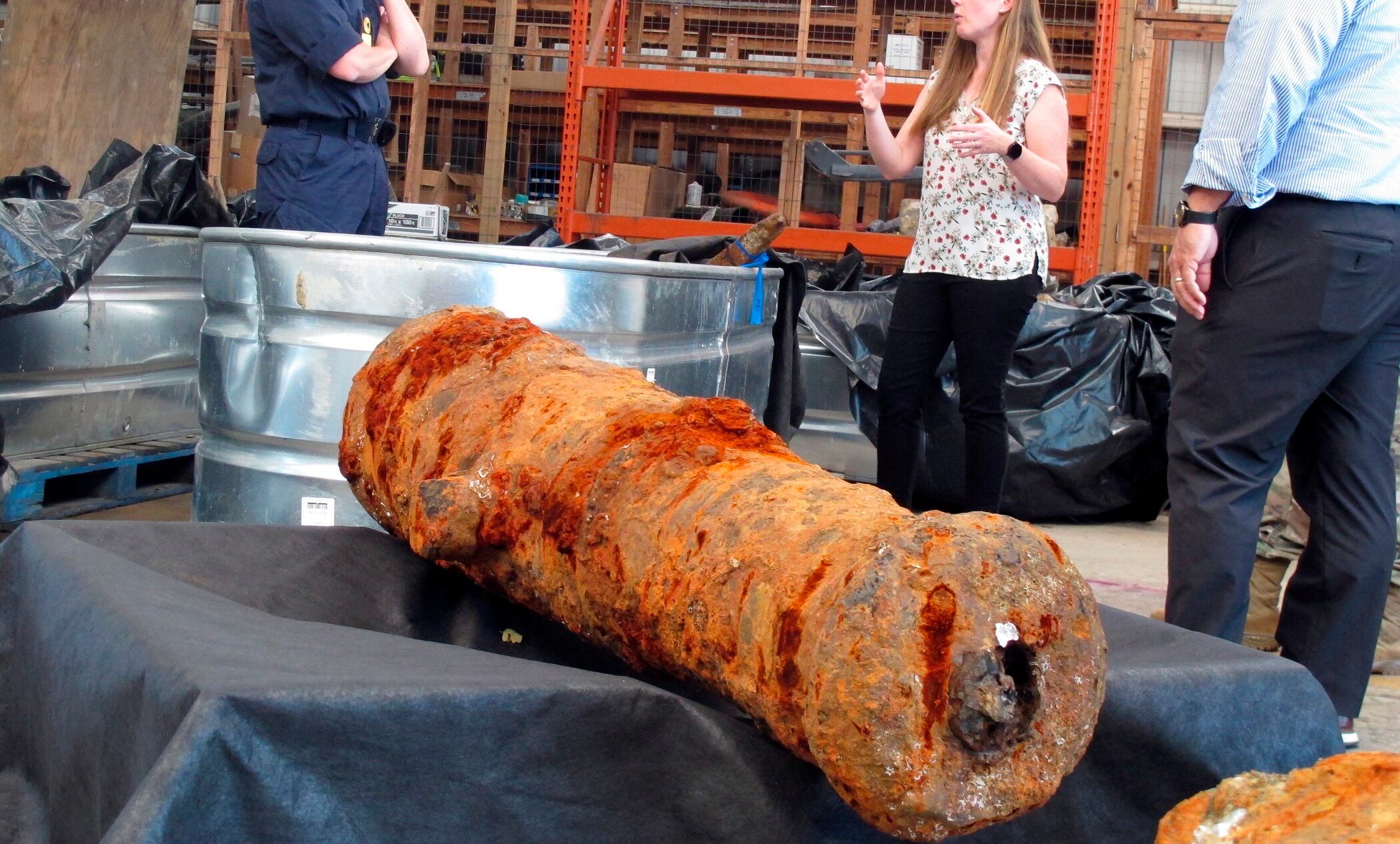
A warehouse along the Savannah River is holding historical treasures that evidence suggests remained lost for more than 240 years — a cache of 19 cannons that researchers suspect came from British ships scuttled to the river bottom during the American Revolution.

The mud- and rust-encrusted guns were discovered by accident. A dredge scooping sediment from the riverbed last year as part of a $973 million deepening of Savannah's busy shipping channel surfaced with one the cannons clasped in its metal jaws. The crew soon dug up two more.

Archaeologists guessed they were possibly leftover relics from a sunken Confederate gunship excavated a few years earlier in the same area, said Andrea Farmer, an archaeologist for the Army Corps of Engineers. But experts for the U.S. Navy found they didn't match any known cannons used in the Civil War. Further research indicates they're likely almost a century older and sank during the buildup to the Revolutionary War's bloody siege of Savannah in 1779.

In a timeframe of just over a year, 19 cannons were hoisted from the same area of the river a few miles downstream from Savannah, where Georgia was founded as the last of Britain's 13 American colonies in 1733.

“They’re in remarkably good shape," Farmer said. “Many were buried in clay and covered by silt and debris that kind of protected them.”

Now officials with the U.S. and British governments, as well as the state of Georgia, are working together on an agreement to preserve the newly found guns before putting them on display. Commodore Philip Nash of the British Royal Navy, a military attache based in Washington, viewed the artifacts submerged in metal tubs of water during a visit Thursday.

“Some of these pieces are in amazing condition and I’m sure could tell some stories,” Nash said.

The cannons are being kept in water to prevent further deterioration until experts can carefully clean them. Meanwhile, researchers are looking for more definitive proof linking the cannons to British ships from the American Revolution.

Farmer said researchers are very confident of the connection. Savannah had been under British occupation for about a year by the fall of 1779, when colonists planned an attack to retake the city with help from French and Haitian allies.

When French ships carrying troops were spotted off the Georgia coast, the British hurried to scuttle at least six ships in the Savannah River downstream from the city to block the French vessels. The land battle that followed was one of the bloodiest of the war. British forces killed nearly 300 colonial fighters and their allies, while wounding hundreds more.

Farmer said researchers suspect the cannons found in the river came from the British ship HMS Savannah and possibly a second ship scuttled at the same time, the HMS Venus. The longer guns appear to match cannons manufactured in France during the mid-1700s, she said. Researchers are looking for ship logs and manifests in hopes of confirming the armaments aboard those ships.

It's also possible the cannons themselves and other artifacts found at the site — pieces of anchors and a portion of a ship's bell — once cleaned might bear markings or other clues to which ship they belonged to. The wood from those ships, Farmer said, decayed long ago or got destroyed by prior dredging projects over a series of decades.

The question of who owns the artifacts gets a little murky. They were found in state waters of Georgia during a dredging project headed by the Army Corps, a U.S. government agency. The British government could make an ownership claim if there's strong evidence the artifacts came from British ships.

Farmer said all of those parties are working on an agreement to preserve the cannons and ultimately have them displayed at the Savannah History Museum, which incorporates the battlefield where the bloodiest fighting occurred during the 1779 siege.

“Everybody wants to keep the artifacts in Savannah," Farmer said, "because that makes the most sense.”


Share:
More In Science
Pillow Customization to Improve Sleep; Bringing Green Hydrogen to Scale
On this episode of Cheddar Innovates: President of The Pillow Bar breaks down how everyone can benefit from a pillow customized to their unique way of sleeping; CEO of H2Pro explains how to bring environmentally friendly hydrogen to scale; Cheddar gets a look at Curiosity Stream's 'Suppressed Science.'
Gardening to Improve Wellbeing; Future of A.I. in Healthcare
On this episode of Cheddar Innovates: Gardenuity CEO breaks down how gardening can improve your wellbeing; Augmedix CEO discusses how this technology is helping doctors fight burnout; Cheddar gets a look at Curiosity Stream's 'Suppressed Science.'
Innovation in Prosthetics; New Drug for Anti-Aging
On this episode of Cheddar Innovates: Atom Limbs CEO breaks down how the Atom Touch prosthetic is different from other prosthetics on the market; CEO & Chief Scientific Officer of MyMD explains how the MYMD-1 is on track to be the first FDA-approved drug to treat aging and age-related diseases; A look at Curiosity Stream's 'The Future of Warfare.'
VR to Train Frontline Workers; Digital Marketplace to End Waste
On this episode of Cheddar Innovates: SkilsVR CEO explains how virtual reality is being used to train frontline workers to handle difficult customers; Rubicon CEO breaks down how technology and sustainability will go hand in hand in the future; Cheddar gets a look at 'Our Infinite Universe.'
UN Report Warns Seawalls Alone Will Not Save Coastal Cities
A UN report is warning that relying on seawalls and other engineering fixes will not be enough to keep communities safe from rising sea levels and climate change consequences. Dr. Steve Rose, a senior research economist at the Electric Power Research Institute, joins Cheddar News to discuss.
Oil Price Crisis Could Lead to Speedier Push Toward Clean Energy Transition
As gas prices surge amid the Russian invasion of Ukraine, other nations could potentially transition faster to using clean energy than previously expected. Philip K. Verleger, a senior fellow at the Niskanen Center, joined Cheddar News to explain how this could be a possibility in the near future. "Part of the reason I think we have this invasion and the tantrum that's being thrown by Russia, terrible tantrum, is because the Russians were trying to slow down the transition," he said. "Ironically they speeded it up."
What Biden's Ban on Russian Oil Imports Could Mean for Growing Energy Costs
As Russia intensifies its war on Ukraine, President Biden announced a ban on oil imported from the aggressor nation. Critics of Russia have said this would be the best way to force Putin to pull back, but curbs on Russian oil exports are expected to send already skyrocketing oil and gas prices even higher, further impacting consumers, businesses, financial markets, and the global economy. Leslie Beyer, CEO of the Energy Workforce and Technology Council, joined Cheddar News' Closing Bell to discuss. "It's certainly going to increase pricing, but it is the right thing to do," she said. "The industry itself has already pulled out of the significant portion of its operations in Russia."
Future of the E-Boating Industry; Making Smart Socks a Reality
On this episode of Cheddar Innovates: Vision Marine Technologies CEO discusses how e-boats will play a role in the fight against the climate crisis; Lasso CEO breaks down how the design behind these compression socks can prevent injuries and improve performance; Cheddar gets a look at Curiosity Stream's 'The Tombs Of Egypt.'
How Omicron Derailed Pfizer Vaccine for Children Under the Age of 5
Vaccine maker Pfizer delayed its COVID shot for kids allegedly due to a lack of data on how it would perform against the omnicron variant, according to the Wall Street Journa. Peter Pitts, professor and founder of the Center for Medicine in the Public Interest and a former FDA associate commissioner, joined Cheddar News Wrap to break down why the authorization can't be rushed. "Going forward, the FDA wants to look at data specifically against omicron, and it looks like that's going to be a three-shot regimen versus two, which was efficient against delta but not omicron because obviously omicron is more infectious," said Pitts.
Load More