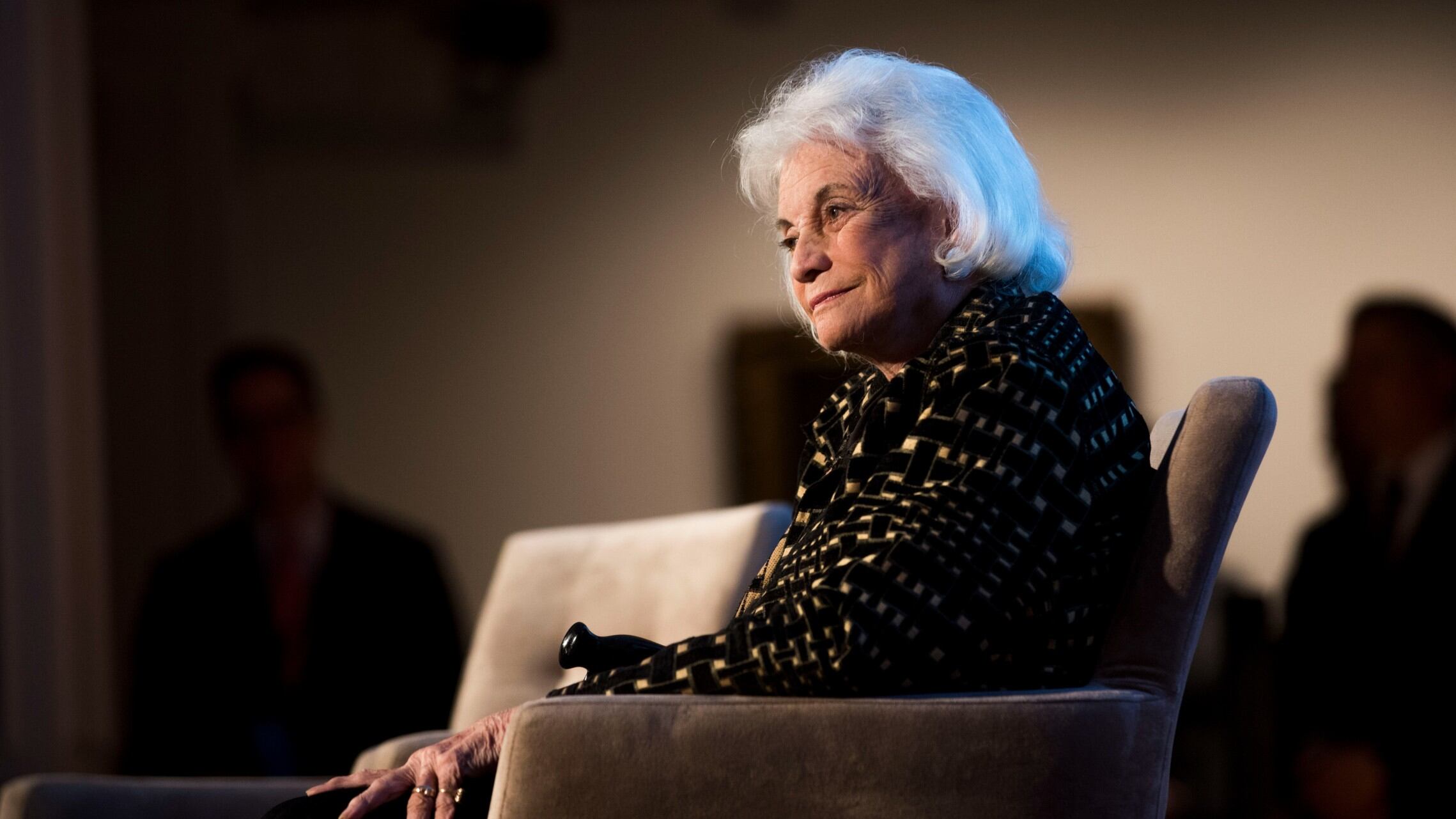
Justice Sandra Day O'Connor listens Justice Ruth Bader Ginsburg pays tribute to O'Connor's advocacy work on behalf of civic education, impact on female judges and justice for women and girls worldwide at the Seneca Women Global Leadership Forum at the National Museum of Women in the Arts, on Wednesday, April 15, 2015 in Washington. (Photo by Kevin Wolf/Invision for Seneca Women/AP Images)
By Mark Sherman
Former Supreme Court Justice Sandra Day O’Connor, an unwavering voice of moderate conservatism and the first woman to serve on the nation’s highest court, has died. She was 93.
The court says she died in Phoenix on Friday, of complications related to advanced dementia and a respiratory illness.
In 2018, she announced that she had been diagnosed with “the beginning stages of dementia, probably Alzheimer’s disease.” Her husband, John O’Connor, died of complications of Alzheimer’s in 2009.
O’Connor’s nomination in 1981 by President Ronald Reagan and subsequent confirmation by the Senate ended 191 years of male exclusivity on the high court. A native of Arizona who grew up on her family’s sprawling ranch, O’Connor wasted little time building a reputation as a hard worker who wielded considerable political clout on the nine-member court.
The granddaughter of a pioneer who traveled west from Vermont and founded the family ranch some three decades before Arizona became a state, O’Connor had a tenacious, independent spirit that came naturally. As a child growing up in the remote outback, she learned early to ride horses, round up cattle and drive trucks and tractors.
“I didn’t do all the things the boys did,” she said in a 1981 Time magazine interview, “but I fixed windmills and repaired fences.”
On the bench, her influence could best be seen, and her legal thinking most closely scrutinized, in the court’s rulings on abortion, perhaps the most contentious and divisive issue the justices faced. O’Connor balked at letting states outlaw most abortions, refusing in 1989 to join four other justices who were ready to reverse the landmark 1973 Roe v. Wade decision that said women have a constitutional right to abortion.
Then, in 1992, she helped forge and lead a five-justice majority that reaffirmed the core holding of the 1973 ruling. “Some of us as individuals find abortion offensive to our most basic principles of morality, but that can’t control our decision," O’Connor said in court, reading a summary of the decision in Planned Parenthood v. Casey. “Our obligation is to define the liberty of all, not to mandate our own moral code.”
Thirty years after that decision, a more conservative court did overturn Roe and Casey, and the opinion was written by the man who took her high court seat, Justice Samuel Alito. He joined the court upon O’Connor’s retirement in 2006, chosen by President George W. Bush.
In 2000, O’Connor was part of the 5-4 majority that effectively resolved the disputed 2000 presidential election in favor of Bush, over Democrat Al Gore.
O’Connor was regarded with great fondness by many of her colleagues. When she retired, Justice Clarence Thomas, a consistent conservative, called her “an outstanding colleague, civil in dissent and gracious when in the majority.”
She could, nonetheless, express her views tartly. In one of her final actions as a justice, a dissent to a 5-4 ruling to allow local governments to condemn and seize personal property to allow private developers to build shopping plazas, office buildings and other facilities, she warned the majority had unwisely ceded yet more power to the powerful. “The specter of condemnation hangs over all property,” O’Connor wrote. “Nothing is to prevent the state from replacing ... any home with a shopping mall, or any farm with a factory.”
O’Connor, whom commentators had once called the nation’s most powerful woman, remained the court’s only woman until 1993, when, much to O’Connor’s delight and relief, President Bill Clinton nominated Justice Ruth Bader Ginsburg. The current court includes a record four women.
Updated December 1, 2023 at 10:17 a.m. ET with full story.
Almost a decade after facing a parent's worst nightmare, the families of the young students killed in the Sandy Hook School shooting reached a settlement with gun manufacturer Remington, makers of the Bushmaster AR-15 used in the crime. David Pucino, deputy chief counsel, Giffords Law Center to Prevent Gun Violence joined Cheddar News to discuss the families' case and how its strategy brought about the legal settlement. "They built a really great case showing the way that Bushmaster developed its advertising to drive sales using those toxic messages.
A new analysis reveals that for more than two decades, the West has been the driest it has ever been since 800 A.D. The drought which began in 2000 has brought more devastating wildfires and draining water reserves well below healthy levels. Climate Scientists and Adjunct Associate Research Scientist at Lamont Doherty Earth Observatory at Columbia University,Benjamin Cook, joined Cheddar to discuss more.
Inflation remains hot as the January PPI has increased by 1 percent, twice what analysts had been expecting with a jump of 9.7 over the year. Beth Ann Bovino, the U.S. chief economist, for S&P Global Ratings, joined Cheddar News to discuss the rapid pace of inflation alongside higher wages, predicting the Federal Reserve will act quickly and forcefully this year. "They haven't changed their forecast, yet, that's gonna come out soon. But we expect that a March rate hike is basically pretty much baked in the cake," she said. "We think six rate hikes in total for 2022."
For black history month, Cheddar is highlighting black business leaders who are driving the need for representation forward. On February 10, the U.S. Chamber of Commerce hosted an event called 'Developing the Black-Owned Business Ecosystem.' The virtual event was organized under the lobbying group's two initiatives -- the Equality of Opportunity Initiative, and the Coalition to Back Black Businesses. The event highlighted the developments needed to develop more black-owned businesses in the U.S. Dr. Anthony Wilbon, Dean of the School of Business at Howard University, joined Cheddar News' Closing Bell to discuss his experience as a speaker at the event.
A newly declassified letter by senators Ron Wyden and Martin Heinrich claimed the CIA. has been conducting a Secret Surveillance Program which has been collecting a bulk of data from American citizens. The letter which was written in April of 2021 urges the CIA to come clean about the kind of data it collects and how many Americans have been impacted. According to these two senators, the program did not have the safeguards of congressional oversight.
Art Hogan, Chief Market Strategist at National Securities, joined Cheddar News' Closing Bell, where he says investors are taking a wait-and-see approach when it comes to the situation between Russia and the Ukraine and elaborates on the impact higher oil prices stemming from the conflict would have on the market.
Last week, Senators Ron Wyden of Oregon and Martin Heinrich of New Mexico, Democrats on the Senate Intelligence Committee, wrote a a letter airing concerns that the CIA is collecting the data of American citizens without their consent. The lawmakers fear that the program might be exploiting private data. Morgan Wright, the chief security advisor at cybersecurity firm SentinelOne, joined Cheddar News to discuss the ramifications of the letter. "We don't have all the dots in one place to connect them," said Wright, cautioning against jumping to conclusions.
Russian President Vladimir Putin and his Foreign Minister Sergey Lavrov said that diplomacy is still possible, while U.S. officials warn that an attack on Ukraine is imminent. Cheddar News speaks with James Astill, Washington bureau chief of The Economist on the latest developments in Eastern Europe.