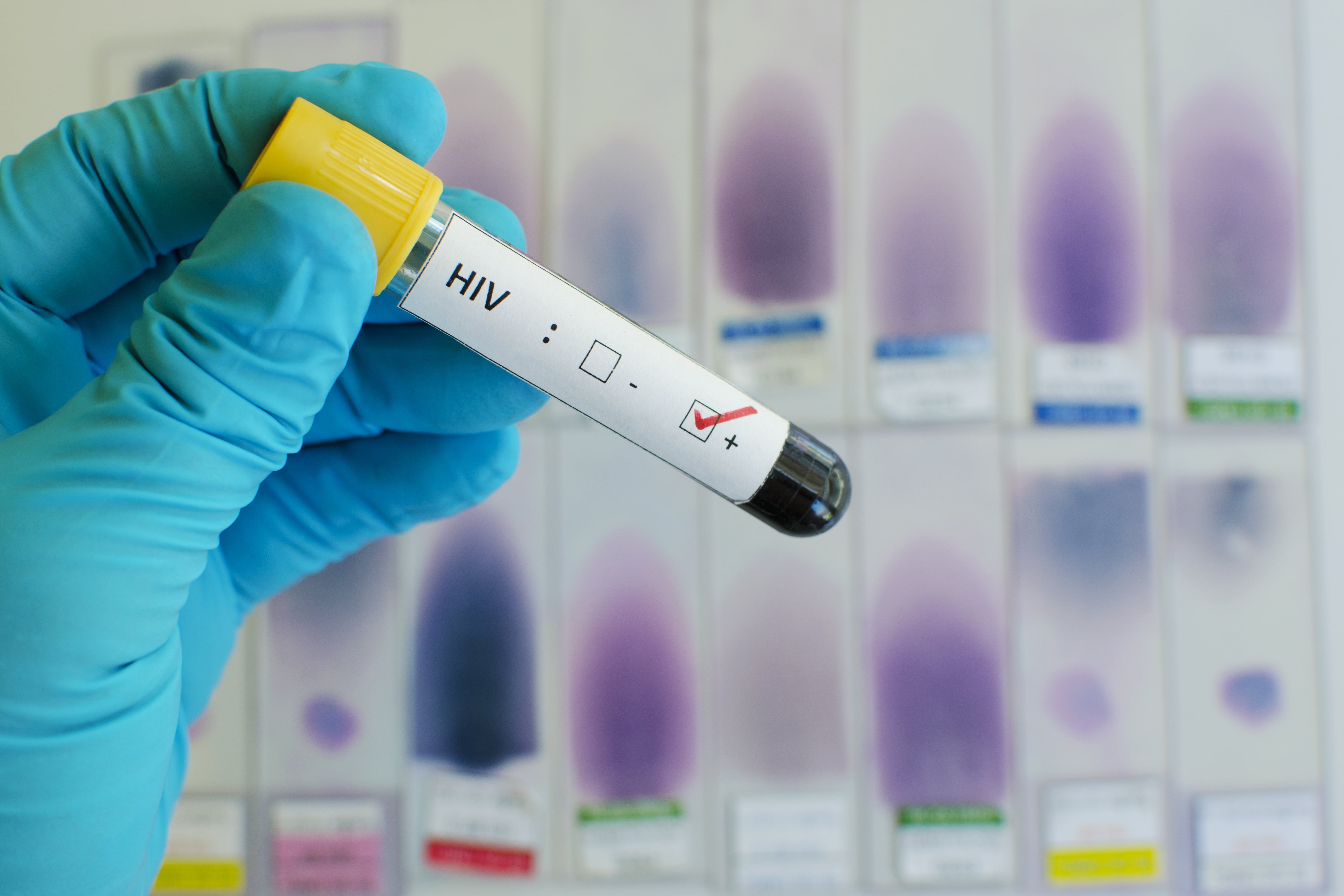
A groundbreaking new study reports that researchers were able to use gene therapy to eradicate HIV in mice. Now the team is considering how to turn that into a life-saving cure for humans.
"We actually have the tools now to go into the genome of a live animal — and inevitably into a person — and clip out, or excise out, the infectious HIV, in a means, or a pathway, towards a cure," said Howard Gendelman, a professor of internal medicine and infectious diseases at the University of Nebraska Medical Center, during an interview with Cheddar on Friday.
The treatment, which was discovered by teams at the University of Nebraska Medical Center and Temple University, works by "dampening down" the HIV virus through an antiretroviral therapy called LASER ART, and then using the gene-editing tool CRISPR-Cas9 — essentially a genetic "scissor" — to remove genes impacted by the virus.
The method led to a "total elimination" of the virus in nine of 23 animals, Gendelman said. It is the first time the virus has been completely eradicated from an animal, according to a UNMC press release.
But Gendelman cautions that applying the technique to humans requires both improving the technology for locating DNA impacted by the virus, and ensuring that the treatment doesn't damage other vital portions of the human genome.
"Every single HIV DNA that's integrated into the genome of a live host has to be excised. So we must develop even better technologies than we've developed in mice to discover where that latent virus is," explained Gendelman. "That's a major part of the research efforts ongoing now."
"We're manipulating the human genome. We're treating an HIV infection as if it was a genetic disorder. We're going into the genome and changing the structure, essentially using the HIV as a bad gene and cutting it out," he added. "So if we do that, we have to understand that there's a possibility that other genes can be affected."
More than 70 million people are reported to have been infected with HIV, according to the World Health Organization. The U.N. agency estimated that in 2017, more than 35 million people were living with the virus.
Esper Bionics CEO Dima Gazda breaks down how they're creating a mind-controlled bionic hand that guest smarter the more you use it, and what this innovation means for the future of the prosthetics industry.
Brightseed Co-Founder Sofia Elizondo breaks down what plant bioactives are, and how they're using the latest technology to study human's biological connections with plants.
On this episode of Cheddar Innovates: Brightseed Co-Founder breaks down what plant bioactives are, and how they're using the latest technology to study human's biological connections with plants; Esper Bionics CEO breaks down how they re creating a mind-controlled bionic hand that guest smarter the more you use it; Cheddar gets a look at Curiosity Stream's 'Capturing A Black Hole In Our Milky Way.'
Hilary Kearney, Founder of Girl Next Door Honey, joined Closing Bell to discuss her partnership with Comvita to save the important pollinators, as bee colonies are on the decline across the United States.
Hurricane climatologist Jill Trepanier joined Cheddar News to discuss NOAA's announced prediction for an above-normal hurricane season and what it might mean for people in the United States. "I think it's important that people who maybe haven't been used to having extreme weather events related to say tropical cycles and tropical systems, like thinking New Jersey, Northeastern seaboard, that area may get more action than they're used to in the past," she said.
Dr. Jarrad Aguirre, Co-Founder and CEO of Miga Health, joins Cheddar News' Closing Bell, where he says his company is looking to establish the future of heart health and points to how 80% of premature heart attacks and strokes are preventable.
On this episode of Cheddar Reveals, David Keith, Professor of Applied Physics at the Harvard School of Engineering and Applied Sciences and Professor of Public Policy at the Harvard Kennedy School, and founder of Carbon Engineering outlines the viability of solar geoengineering as a solution to help reverse the effects of global warming; Lena Geraghty, Sustainability & Urban Innovation Director at National League of Cities, discusses which U.S. cities are safest from global warming and how the real estate market will be impacted from the effects of climate change; Cheddar gets a look at Curiosity Stream's 'Changing Ocean Asia.'
David Keith, Professor of Applied Physics at the Harvard School of Engineering and Applied Sciences and Professor of Public Policy at the Harvard Kennedy School, and founder of Carbon Engineering joins Cheddar Reveals to outline the viability of solar geoengineering as a solution to help reverse the effects of global warming.
Lena Geraghty, Sustainability & Urban Innovation Director at National League of Cities, joins Cheddar News to discuss which U.S. cities are safest from global warming and how the real estate market will be impacted from the effects of climate change.
Peggy Whitson, Director of Human Space Flight, Axiom Space, joins Cheddar Innovates to discuss Axiom's involvement in the first fully-private mission to the ISS, and her experience spending 665 days in space.