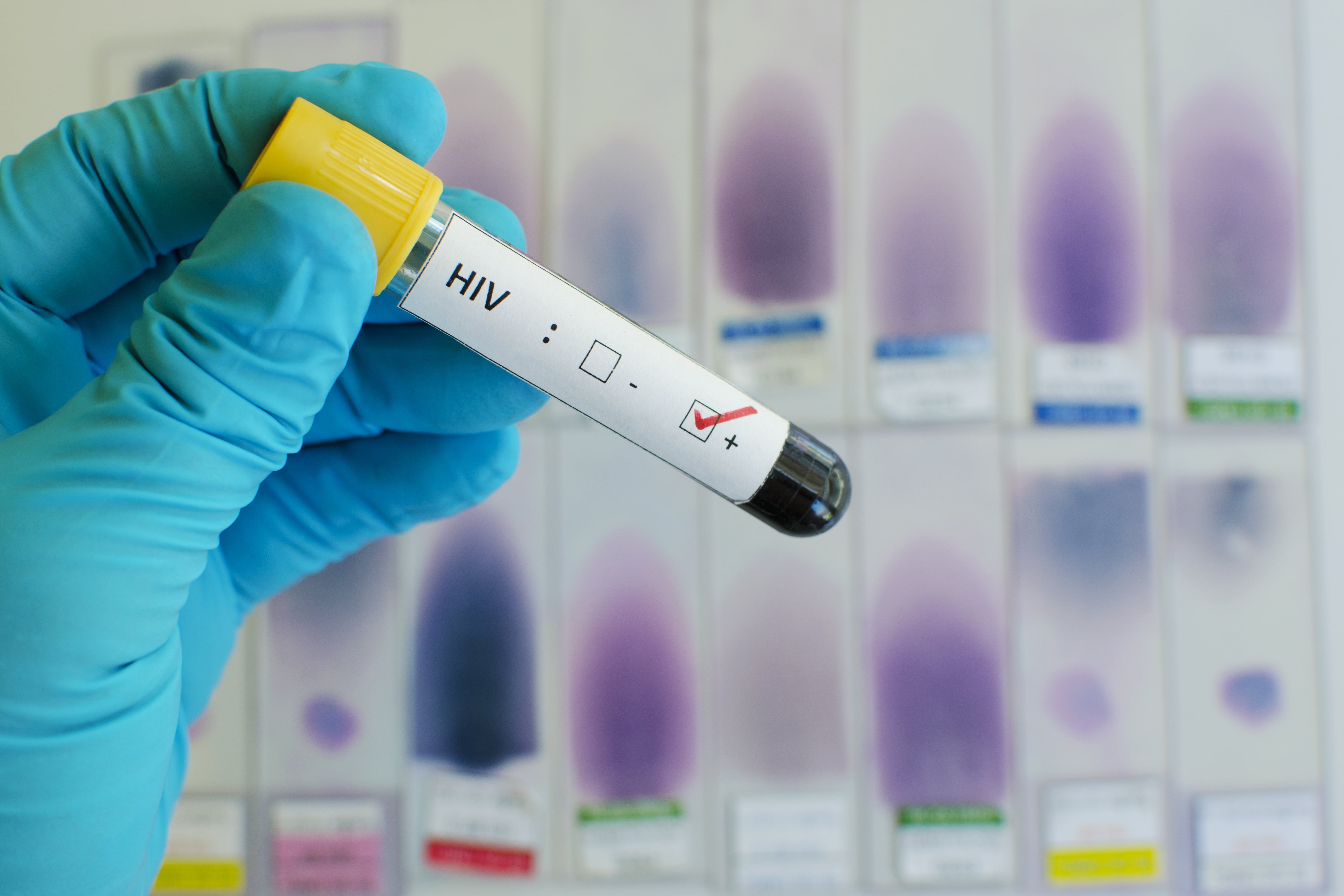
A groundbreaking new study reports that researchers were able to use gene therapy to eradicate HIV in mice. Now the team is considering how to turn that into a life-saving cure for humans.
"We actually have the tools now to go into the genome of a live animal — and inevitably into a person — and clip out, or excise out, the infectious HIV, in a means, or a pathway, towards a cure," said Howard Gendelman, a professor of internal medicine and infectious diseases at the University of Nebraska Medical Center, during an interview with Cheddar on Friday.
The treatment, which was discovered by teams at the University of Nebraska Medical Center and Temple University, works by "dampening down" the HIV virus through an antiretroviral therapy called LASER ART, and then using the gene-editing tool CRISPR-Cas9 — essentially a genetic "scissor" — to remove genes impacted by the virus.
The method led to a "total elimination" of the virus in nine of 23 animals, Gendelman said. It is the first time the virus has been completely eradicated from an animal, according to a UNMC press release.
But Gendelman cautions that applying the technique to humans requires both improving the technology for locating DNA impacted by the virus, and ensuring that the treatment doesn't damage other vital portions of the human genome.
"Every single HIV DNA that's integrated into the genome of a live host has to be excised. So we must develop even better technologies than we've developed in mice to discover where that latent virus is," explained Gendelman. "That's a major part of the research efforts ongoing now."
"We're manipulating the human genome. We're treating an HIV infection as if it was a genetic disorder. We're going into the genome and changing the structure, essentially using the HIV as a bad gene and cutting it out," he added. "So if we do that, we have to understand that there's a possibility that other genes can be affected."
More than 70 million people are reported to have been infected with HIV, according to the World Health Organization. The U.N. agency estimated that in 2017, more than 35 million people were living with the virus.
On this episode of Cheddar Innovates: CEO of Achieve Life Sciences discusses a new plant-based compound that's being used to fight nicotine addiction; President & CEO OF DiaMedica Therapeutics explains a new ischemic stroke treatment option that expands the window for effective therapy for stroke patients; Cheddar gets a look at Curiosity Stream's 'Asteroid Rush.'
Catching you up on the stories you need to know this morning, mass shooting victims testify on Capitol Hill, the White House outlines its plan to vaccinate kids younger than five years old, and we break down how to protect yourself from monkeypox.
The pharmaceutical giant Moderna says its updated 'bivalent' booster shot provides a stronger immune response against the Omicron variant of COVID-19 specifically. This week, Moderna plans to submit preliminary data to U.S. health officials in the hopes that its new booster will be available later this summer. Dr. Sampson Davis, emergency medicine physician, joins Cheddar News to discuss.
NASA has announced that the first official full-color images will be beamed back to Earth from the James Webb Telescope on July 12. Gregory L. Robinson, the director of the James Webb Space Telescope Program in the NASA Science Mission Directorate, joined Cheddar News to discuss the anticipated image drop. “We expect to see the universe different," he said. "Webb will allow us to see much, much clearer and deeper into the universe."
On this episode of Cheddar Reveals, Professor Laurence Hurst, Director of The Milner Centre for Evolution, discusses the mystery of human evolution that's still baffling scientists: why are humans still evolving, and why has the process sped up? Neville Sanjana, faculty member at NY Genome and New York University, breaks down the latest innovations in CRISPR genetic engineering and its applications from 'designer babies' to curing genetic conditions and diseases; Cheddar gets a look at Curiosity Stream's 'The Butterfly Effect.'
Neville Sanjana, faculty member at NY Genome and New York University, joins Cheddar Reveals to break down the latest innovations in CRISPR genetic engineering and its applications from 'designer babies' to curing genetic conditions and diseases.
Professor Laurence Hurst, Director of The Milner Centre for Evolution, joins Cheddar Reveals to discuss the mystery of human evolution that's still baffling scientists: why are humans still evolving, and why has the process sped up?
It can be tough to make sustainable choices, and even harder when sustainable materials don't hold up. Loliware has a solution to the plastic straw problem: its seaweed-based straws are stronger than paper alternatives and once used, can be composted and return to the earth or sea without causing harm. Sea Briganti, CEO of Loliware, joins Closing Bell to discuss the tech behind the straws, new product launches, and more.
Umbilical cord blood banking platform Anja Health raised $4.5 million dollars in a seed round led by Seven Seven Six, a venture capital firm founded by Reddit co-founder Alexis Ohanian. Anja Health offers a personalized, doctor-backed cord blood bank, which lets new parents freeze stem cells from their child's umbilical cord so they can be used to treat diseases in the future. It's a process Anja has called 'Hollywood's best-kept secret,' as celebrities like Kylie Jenner, Serena Williams, and more have all banked their umbilical cord blood. Kathryn Cross, the founder of Anja Health, joins Cheddar News' Closing Bell to discuss.
After learning that the suspect in the Uvalde school shooting posted about his intentions on Facebook, activists are urging social networks to make changes. Lena Derhally, a licensed psychotherapist and author of "The Facebook Narcissist," joined Cheddar News to discuss the role social media plays in school shootings. "They're not really invested in taking down hateful content," she said about social platforms."In regards to the shooting, it was 15 minutes before that actual threat. It would be pretty hard for a social media company to trace that threat that quickly. But what they can do better is take down threats and hateful content much faster and more than they're doing now."