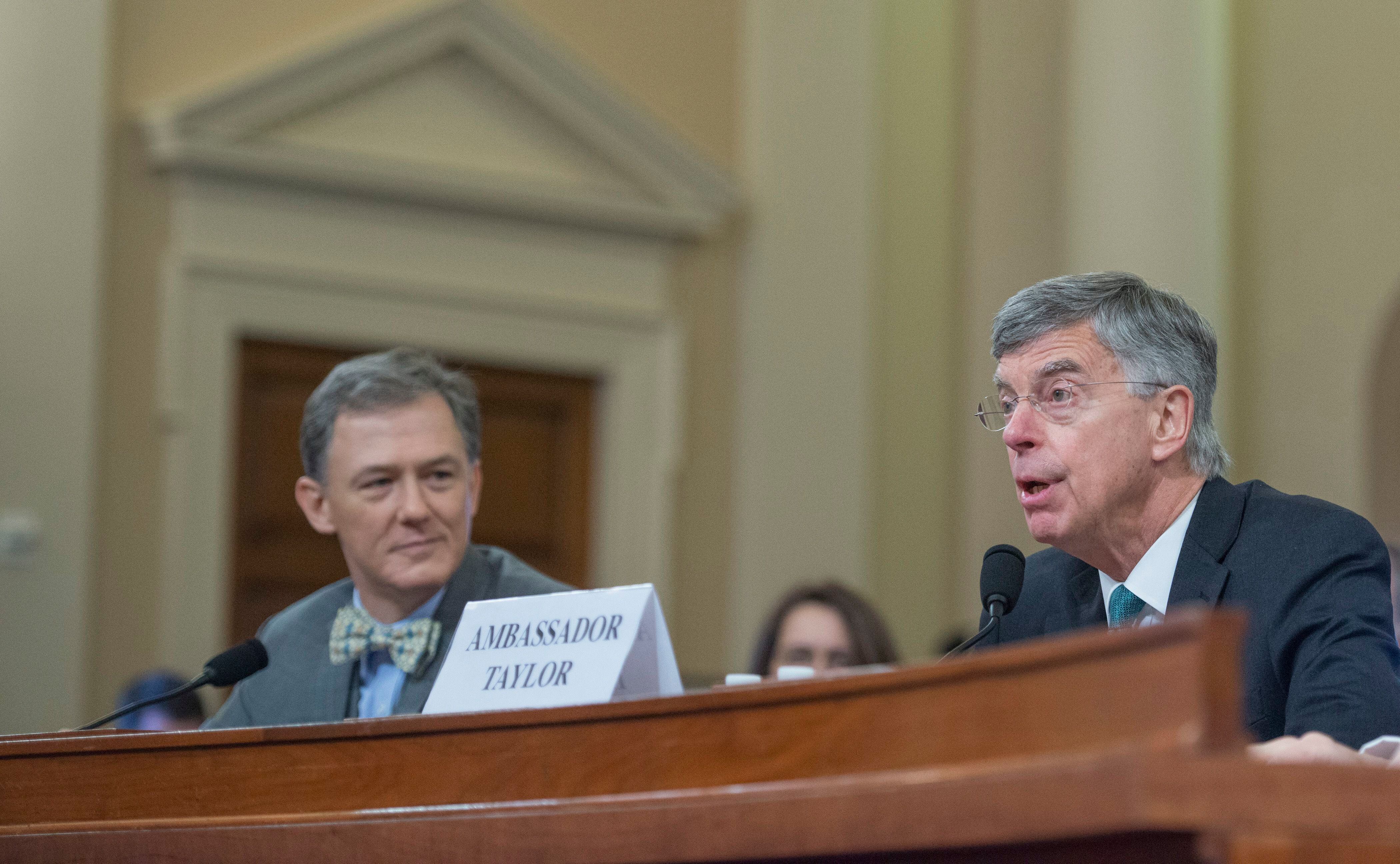
The first two witnesses to publically testify in the impeachment inquiry into President Trump began to bring the Ukraine story to life, not only answering questions about the withholding of aid, but offering context best known to officials like themselves.
Ambassador Bill Taylor, the top U.S. diplomat in Ukraine, and George Kent, deputy assistant secretary of state for Europe and Eastern Europe both focused on the geopolitical issues at play, namely Russia's aggression against Ukraine and the importance of U.S. aid there.
Whereas Kent's opening statement largely focused on historical context, Taylor cut straight to the point by saying American aid — and its freezing of that aid — has real impact in the region. He also described months of events beyond the infamous phone call, relaying a vividly-told story of months of tension, "highly irregular" channels of decision-making, and new testimony that would indicate Ambassador Sondland believed the president was more concerned with investigating the Bidens than U.S. relations with Ukraine.
Under questioning from party counsels, Taylor offered scathing answers describing pressure on the Ukrainians and his disapproval with the actions he witnessed. When asked by the Democrats' attorney Dan Goldman if he had ever seen "another example of foreign aid conditioned on the personal or political interests of the president of the United States," Taylor responded "No, Mr. Goldman, I have not."
Taylor also described "two channels" for diplomatic processes — a regular and an "irregular channel"
He testified that by August of 2019 the irregular channel, described as including Kurt Volker, Rick Perry, Mick Mulvaney, and Giuliani, began to diverge with the regular channel. "As this occurred, I became increasingly concerned," he said.
"I began to sense that the two decision making channels — the regular and irregular—were separate and at odds," he said.
During questioning, Taylor said "it's one thing to leverage a meeting in the White House. It's a wholly different thing to leverage security assistance to a country at war." The latter was "much more alarming," he said.
Near the end of his prepared testimony, Taylor offered a newsworthy admission that he was told President Trump was concerned more with the investigations of Biden than Ukraine. Taylor said last Friday a member of his staff told him about a conversation he had been privy to on July 26, the day after President Trump called President Zelensky.
Taylor’s staffer had accompanied the U.S. ambassador to the European Union Gordon Sondland to a meeting with Ukrainian presidential aide Andriy Yermak. Following the meeting, the staff member accompanied Sondland to a restaurant, where the ambassador called the president. The staffer heard Trump ask Sondland about “the investigations.” The staffer asked Sondland about Trump’s thoughts on Ukraine.
“Ambassador Sondland responded that President Trump cares more about the investigations of Biden, which Giuliani was pressing for,” Taylor testified, noting that he learned about this after his previous closed-door testimony and has already submitted it to the committee for investigation.
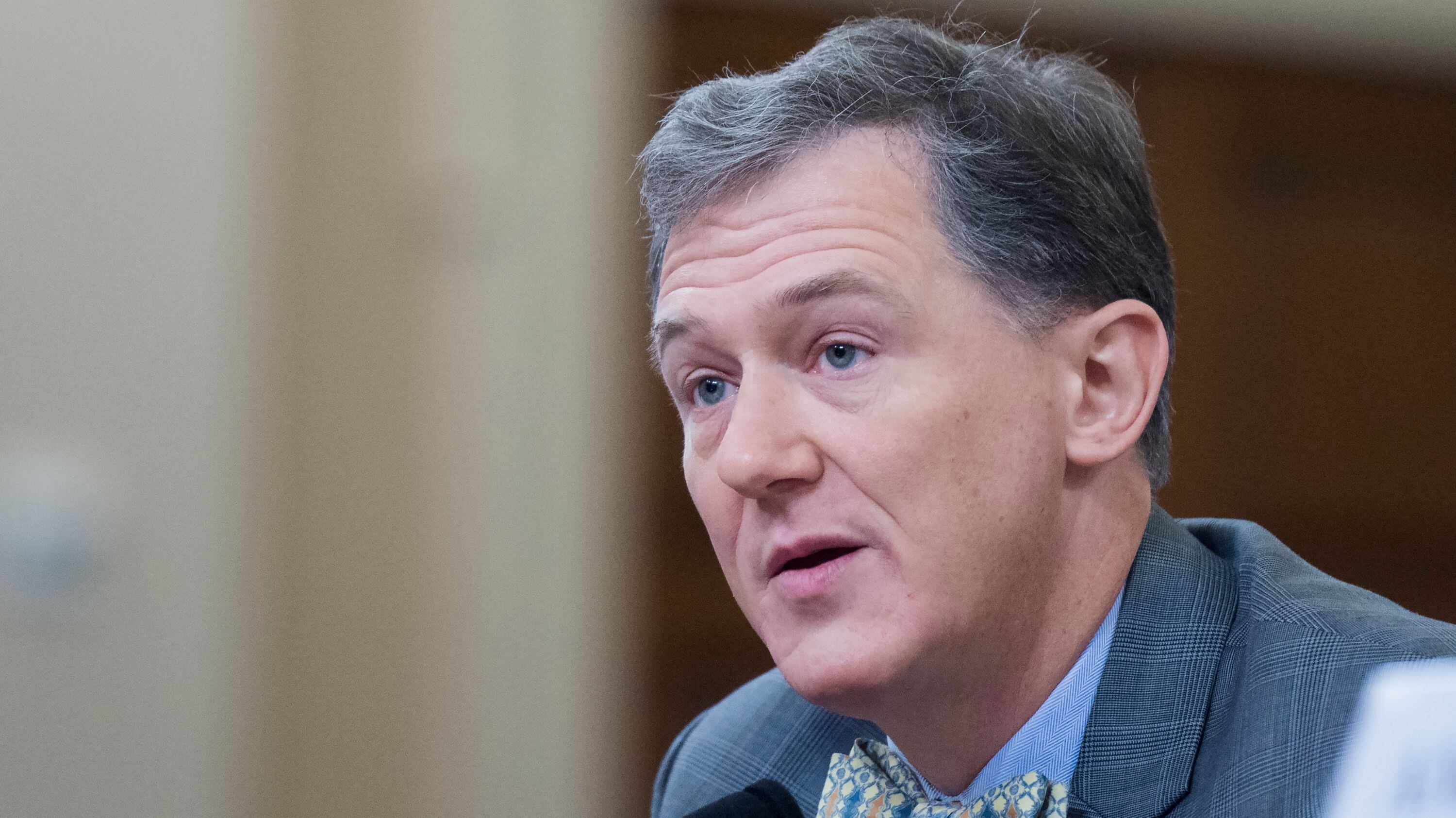
Meanwhile, Kent described the historical context in Ukraine before getting to the crux of his testimony, in which he emphasized the importance of the billions of dollars for U.S. aid to Ukraine and noted "the United States should not push other countries to engage in selective, politically motivated prosecutions against opponents of those in power because that undermines the rule of law."
The House investigation, launched by Speaker Nancy Pelosi in September, focuses on the president's conduct with Ukraine. A yet unidentified whistleblower alleges that he or she was informed that the president threatened to pull aid to Ukraine if it refused to investigate Hunter Biden, who served on the board of Ukraine natural gas company Burisma Holdings.
Today's hearings with Ambassador Bill Taylor and George Kent marks the public's first invitation into the room where it happens.
In September, the White House released a memo on a July phone call between Trump and Zelensky in which he asked his Ukrainian counterpart to "do us a favor" and investigate the president's rivals.
Committee Chairman Adam Schiff and Ranking Member Devin Nunes began the hearing by laying out the competing narratives of the impeachment inquiry.
Schiff's opening statement provided a digestible framework of the inquiry, beginning in 2014, and said the facts are not seriously contested, likely a reference to the fact that Republicans are expected to attack the inquiry, but that the facts themselves have not faced significant pushback.
"The matter is simple and as terrible as that," Schiff said, however, he acknowledged there are "still missing pieces." Schiff did not focus on the president's personal lawyer Rudy Giuliani, upon whom the Republicans are expected to lay some blame on.
Schiff contended that requests made of Ukrainian President Volodymyr Zelensky to look into Hunter Biden, the son of former Vice President and Democratic presidential nominee Joe Biden, were in Trump's "personal interest."
"If this is not impeachable conduct, what is?" Schiff asked.
The House investigation focuses on the president's conduct with Ukraine. A yet unidentified whistleblower alleges that he or she was informed that the president threatened to pull aid to Ukraine if it refused to investigate Hunter Biden, who served on the board of Ukraine natural gas company Burisma Holdings.
In September, the White House released a memo on a July phone call between Trump and Zelensky in which he asked his Ukrainian counterpart to "do us a favor" and investigate the president's rivals.
During his opening statement on Wednesday, Nunes set the tone for what the public can expect from Republicans in today's hearing. He described a "carefully orchestrated media smear campaign" against the president
Much of Nunes's statement focused on the processes through which the Democrats have investigated the president, perhaps explaining why Schiff issued a reminder that "the facts in the present inquiry are not seriously contested."
While the president remained unusually and largely quiet on Twitter during the hearings, he did tweet a video of himself with the message "They're trying to stop me, because I'm fighting for you. And I'll never let that happen."
On a lighter note, Walter Cronkite was trending on Twitter during Taylor's testimony, as users compared the ambassador to the late, legendary broadcaster who presided over the airwaves during the impeachment of President Nixon.
Eight more witness interviews are scheduled over the next week. Democrats have also requested testimony from additional witnesses who have so far have refused. Chief among those requested are John Bolton, former national security advisor, and Mick Mulvaney, the president's acting chief of staff.
Democrats will use the inquiry to advance the narrative that the president abused his power and that he would act similarly again were he not held responsible for his actions with Ukraine.
Republicans will likely try to distance the president from Ukraine quid pro quo and may lay the blame on his personal lawyer, Rudy Giuliani.
This is just the fourth impeachment inquiry in American history. Only two of those inquiries led to impeachment and both presidents were acquitted in the U.S. Senate.
This story will be updated as the hearing continues.