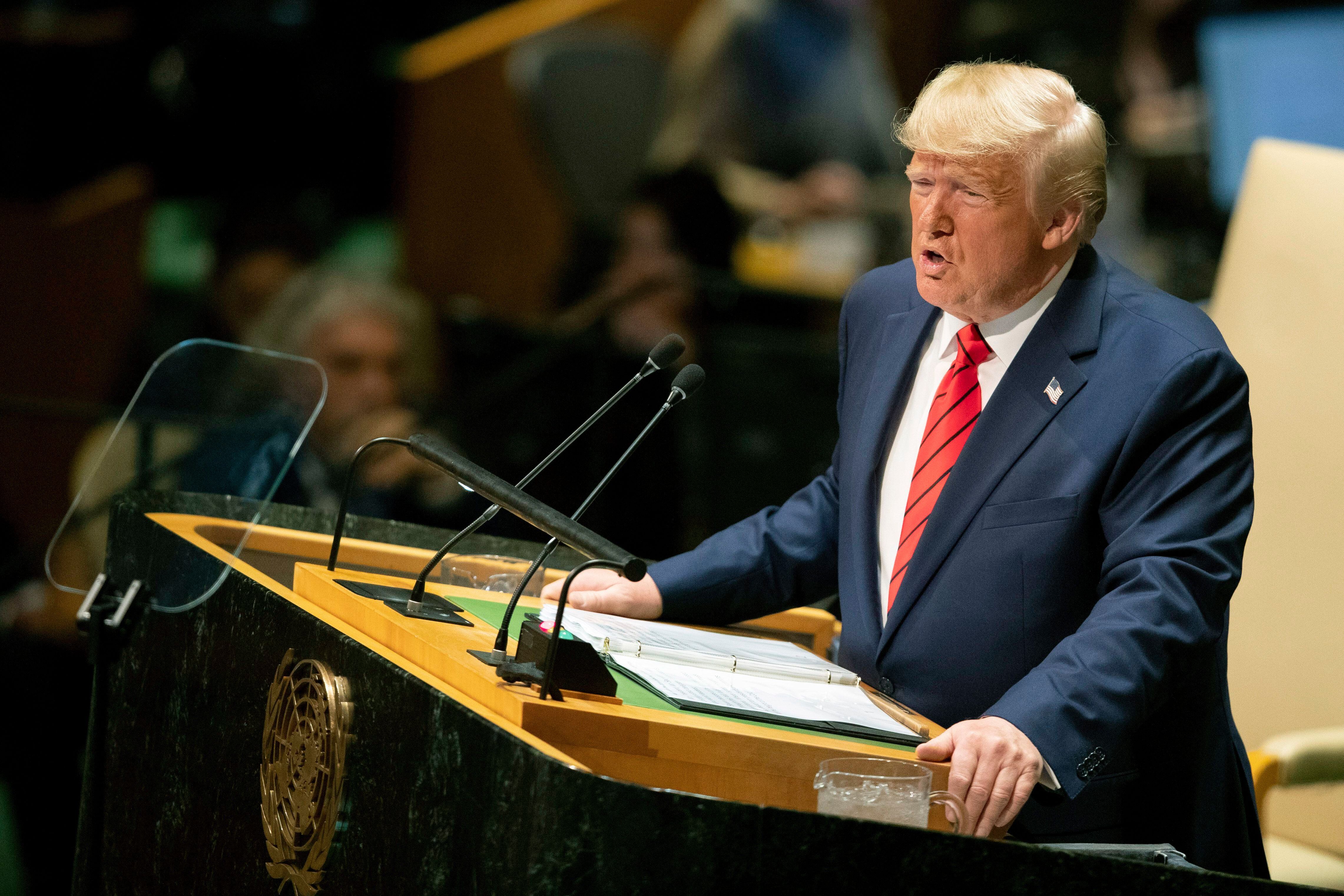
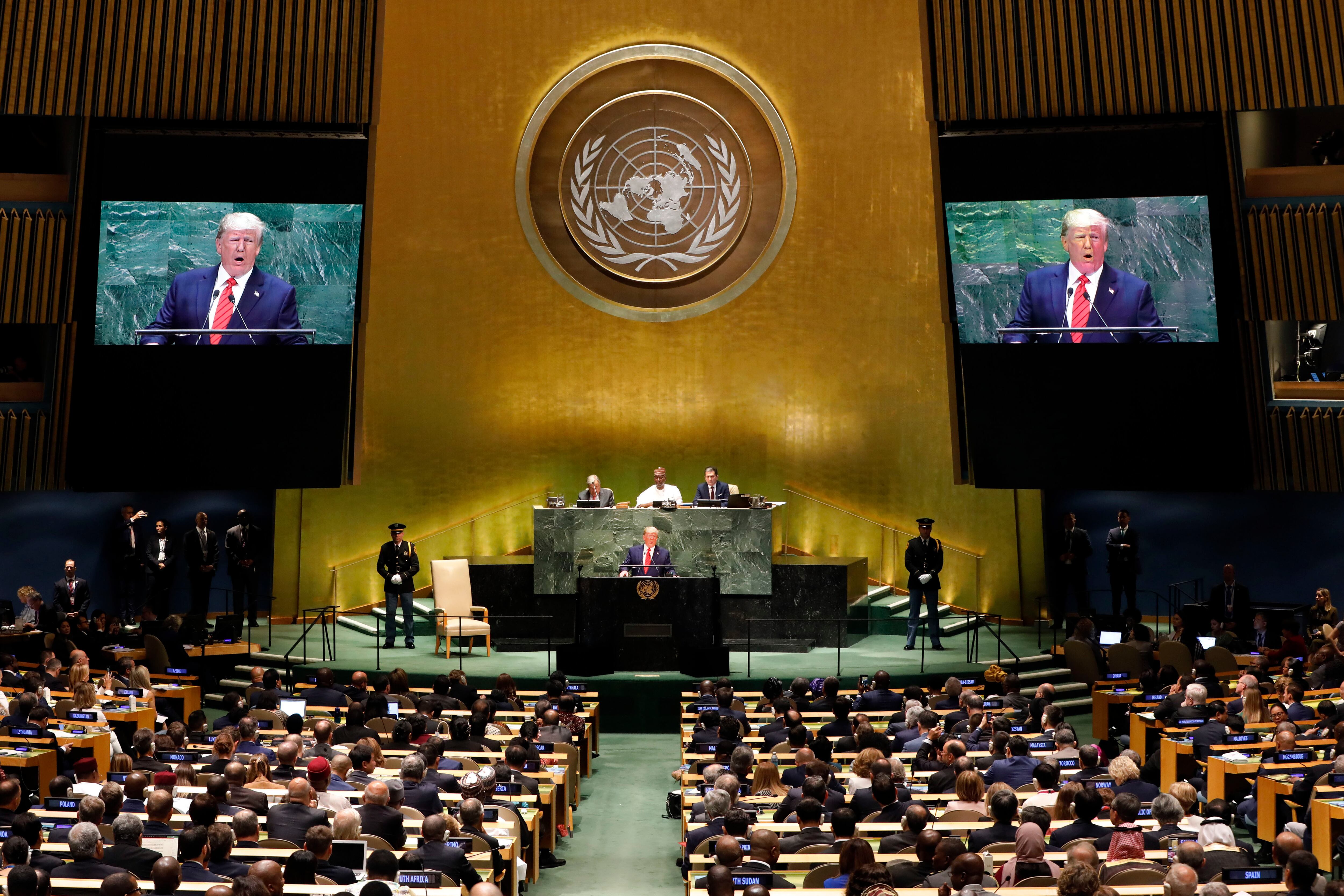
President Trump reiterated his "America first" worldview and policy agenda on Tuesday in a speech at the United Nations that bemoaned globalism and instead urged mutual support among sovereign nations.
"Wise leaders put the good of their own people and their own country first," Trump said in his third address as president to the UN General Assembly. "The free world must embrace its national foundations. It must not attempt to erase them or replace them."
However, he called for countries to work together toward common goals. "America is ready to embrace friendship with all who genuinely seek peace and respect," he said. "Many of America's closest friends today were once our greatest foes. America has never believed in permanent foes."
As with his past speeches at the UN, Trump used the platform to critique international institutions.
The president doubled down on his maximum pressure approach to Iran, a government he characterized as "one of the greatest security threats" to international peace. Trump, who pulled the U.S. out of the Iran nuclear deal last year despite global objections, threatened greater sanctions if "menacing behavior continues" and added that "no responsible government should subsidize Iran's blood lust."
Trump also called on North Korea to denuclearize and slammed Venezuelan President Nicolas Maduro, calling the embattled leader a "dictator" and "a Cuban puppet protected by Cuban bodyguards." In a not-so subtle shunning, the Venezuelan delegation in the audience visibly read a book about Simón Bolívar, the military and political leader that lead Venezuela's fight for independence.
On China, Trump reiterated that he will "not accept a bad deal for the American people" in order to resolve the enduring trade dispute between the two countries. He also called on Chinese President Xi Jinping to tread carefully in responding to the ongoing unrest in Hong Kong, saying that China must adhere to the governing system that protects "Hong Kong's freedom, legal system, and democractic ways of life."
He bragged of America's strong economy and lowest level of unemployment in half a century, "thanks to our pro-growth economic policies" and noted plans to meet with Japan's Prime Minister Shinzō Abe to work on a new trade agreement.
While touting the might of the U.S. military, the president said the U.S. "does not seek conflict" and desires "peace, cooperation, and mutual gain with all," although his administration will "never fail to defend America's interests." He also called on member nations to increase their contributions to global security and "pay their fair share of the tremendous defense burden" that has largely fallen on the U.S.
On migration, Trump fired back against international criticim of his illegal immigration policies, saying, "Each of you has the absolute right to protect your borders and so, of course, does our country." He also criticized "open border activists" who he said pursue a "cruel and evil" agenda that is "empowering criminal organizations that prey on innocent men, women and children."
The president also derided socialism — the "wrecker of nations and destroyer of societies" — and declared that the U.S. will never be a socialist country.
Above all, however, Trump stressed that governments lead by "patriots" are the future of the world's nation-state system.
"The true good of a nation can only be pursued by those who love it, by citizens who are rooted in its history, who are nourished in its culture, committed to its values, attached to its people, and who know that its future is theirs to build," Trump said at the end of his speech.