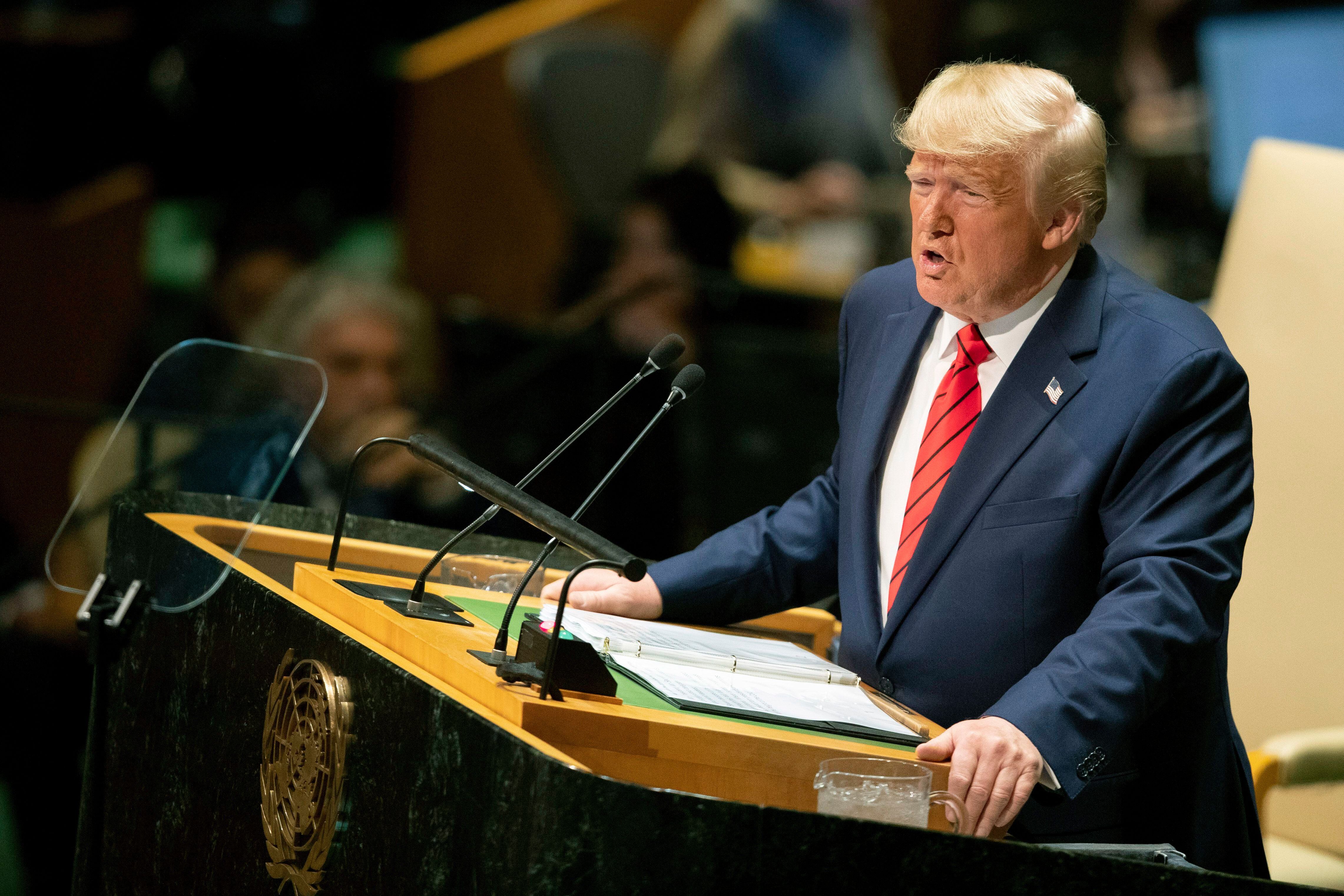
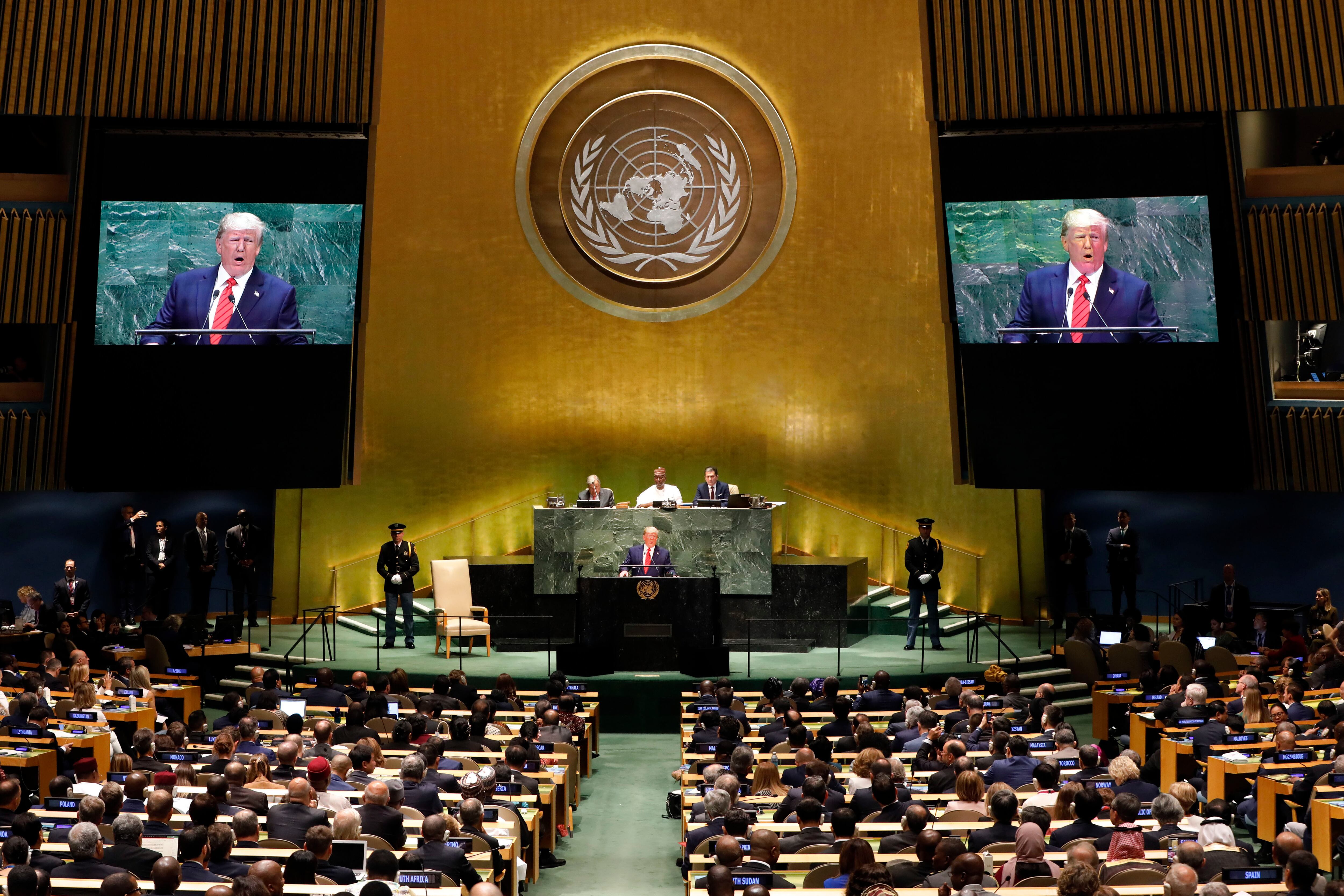
President Trump reiterated his "America first" worldview and policy agenda on Tuesday in a speech at the United Nations that bemoaned globalism and instead urged mutual support among sovereign nations.
"Wise leaders put the good of their own people and their own country first," Trump said in his third address as president to the UN General Assembly. "The free world must embrace its national foundations. It must not attempt to erase them or replace them."
However, he called for countries to work together toward common goals. "America is ready to embrace friendship with all who genuinely seek peace and respect," he said. "Many of America's closest friends today were once our greatest foes. America has never believed in permanent foes."
As with his past speeches at the UN, Trump used the platform to critique international institutions.
The president doubled down on his maximum pressure approach to Iran, a government he characterized as "one of the greatest security threats" to international peace. Trump, who pulled the U.S. out of the Iran nuclear deal last year despite global objections, threatened greater sanctions if "menacing behavior continues" and added that "no responsible government should subsidize Iran's blood lust."
Trump also called on North Korea to denuclearize and slammed Venezuelan President Nicolas Maduro, calling the embattled leader a "dictator" and "a Cuban puppet protected by Cuban bodyguards." In a not-so subtle shunning, the Venezuelan delegation in the audience visibly read a book about Simón Bolívar, the military and political leader that lead Venezuela's fight for independence.
<i>Photo Credit: Richard Drew/AP/Shutterstock</i>
On China, Trump reiterated that he will "not accept a bad deal for the American people" in order to resolve the enduring trade dispute between the two countries. He also called on Chinese President Xi Jinping to tread carefully in responding to the ongoing unrest in Hong Kong, saying that China must adhere to the governing system that protects "Hong Kong's freedom, legal system, and democractic ways of life."
He bragged of America's strong economy and lowest level of unemployment in half a century, "thanks to our pro-growth economic policies" and noted plans to meet with Japan's Prime Minister Shinzō Abe to work on a new trade agreement.
While touting the might of the U.S. military, the president said the U.S. "does not seek conflict" and desires "peace, cooperation, and mutual gain with all," although his administration will "never fail to defend America's interests." He also called on member nations to increase their contributions to global security and "pay their fair share of the tremendous defense burden" that has largely fallen on the U.S.
On migration, Trump fired back against international criticim of his illegal immigration policies, saying, "Each of you has the absolute right to protect your borders and so, of course, does our country." He also criticized "open border activists" who he said pursue a "cruel and evil" agenda that is "empowering criminal organizations that prey on innocent men, women and children."
The president also derided socialism — the "wrecker of nations and destroyer of societies" — and declared that the U.S. will never be a socialist country.
Above all, however, Trump stressed that governments lead by "patriots" are the future of the world's nation-state system.
"The true good of a nation can only be pursued by those who love it, by citizens who are rooted in its history, who are nourished in its culture, committed to its values, attached to its people, and who know that its future is theirs to build," Trump said at the end of his speech.
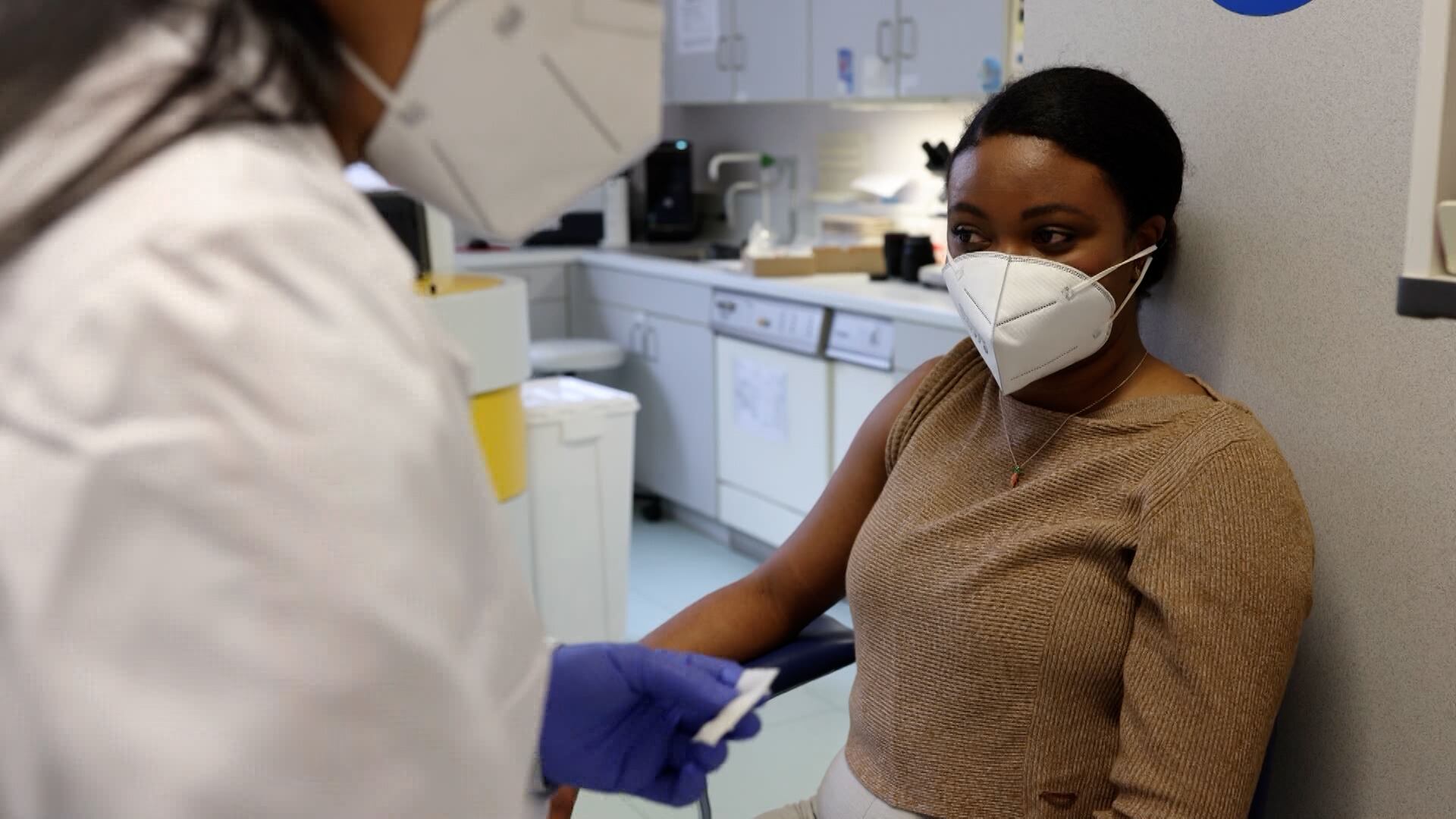
An recently conducted AP-NORC poll found that majorities of the Black and Hispanic populations in the U.S. still find themselves either somewhat worried or extremely worried over the pandemic, while more than half of white Americans responded with either being not too worried or not worried at all. Dr. Chris Pernell, the chief strategic integration and health equity officer at University Hospital, joined Cheddar News to talk about how perceptions of COVID-19 differ between groups of Americans. "We’re still seeing people get infected, and because of the toll of the disproportionate impact, we have concerns among the Black and brown community about whether or not they have an increased risk of exposure because of where they work, because of the use of public transportation, because they live in homes that they may not be able to safely quarantine and or isolate in, and because they have at baseline chronic health conditions that may make coronavirus more severe in those persons," she said.
Judith Enck, a former regional administrator for the EPA and the president of Beyond Plastics, joined Cheddar News to talk about the role of plastics in the climate crisis and California's investigation of ExxonMobil and other oil companies for misleading the public on the ability to recycle plastics. "The reason why petrochemical companies like Exxon have gotten away with selling more and more plastic is that they've lied to the public and told us don't worry about all those negative upstream impacts and downstream impacts of plastics. Just be sure to recycle it. Well, guess what? Plastics largely are not recycled," Enck said.
The ongoing war in Ukraine and the Fed's hawkish stance toward reining in inflation might be causing a frenzy among investors. Craig Erlam, a senior market analyst at foreign exchange OANDA, joined Cheddar News to talk about the current "mixed bag" markets. "It's hard to read too much into it. These are just the market conditions we have right now," he said. "Ultimately we're a little directionless at times overall, but these intraday moves are causing a lot of volatility this week."
Catching you up on what you need to know on April 29, 2022, with President Biden asking Congress for a $33 billion aid package for Ukraine, a shrinking GDP potentially leading to a recession, Beijing banning weddings and funerals while closings schools amid COVID, and more.
Buying a new home is tough right now; but for first-time buyers, it's an especially challenging time, with obstacles like rising mortgage rates and record-breaking home prices. The housing market is not expected to get much friendlier, as mortgage rates are expected to continue to climb as the Federal Reserve proceeds with its plans for rate hikes in an effort to stifle inflation. Jonathan Miller, President and CEO of real estate appraiser Miller Samuel, joins Cheddar News' Closing Bell to discuss.
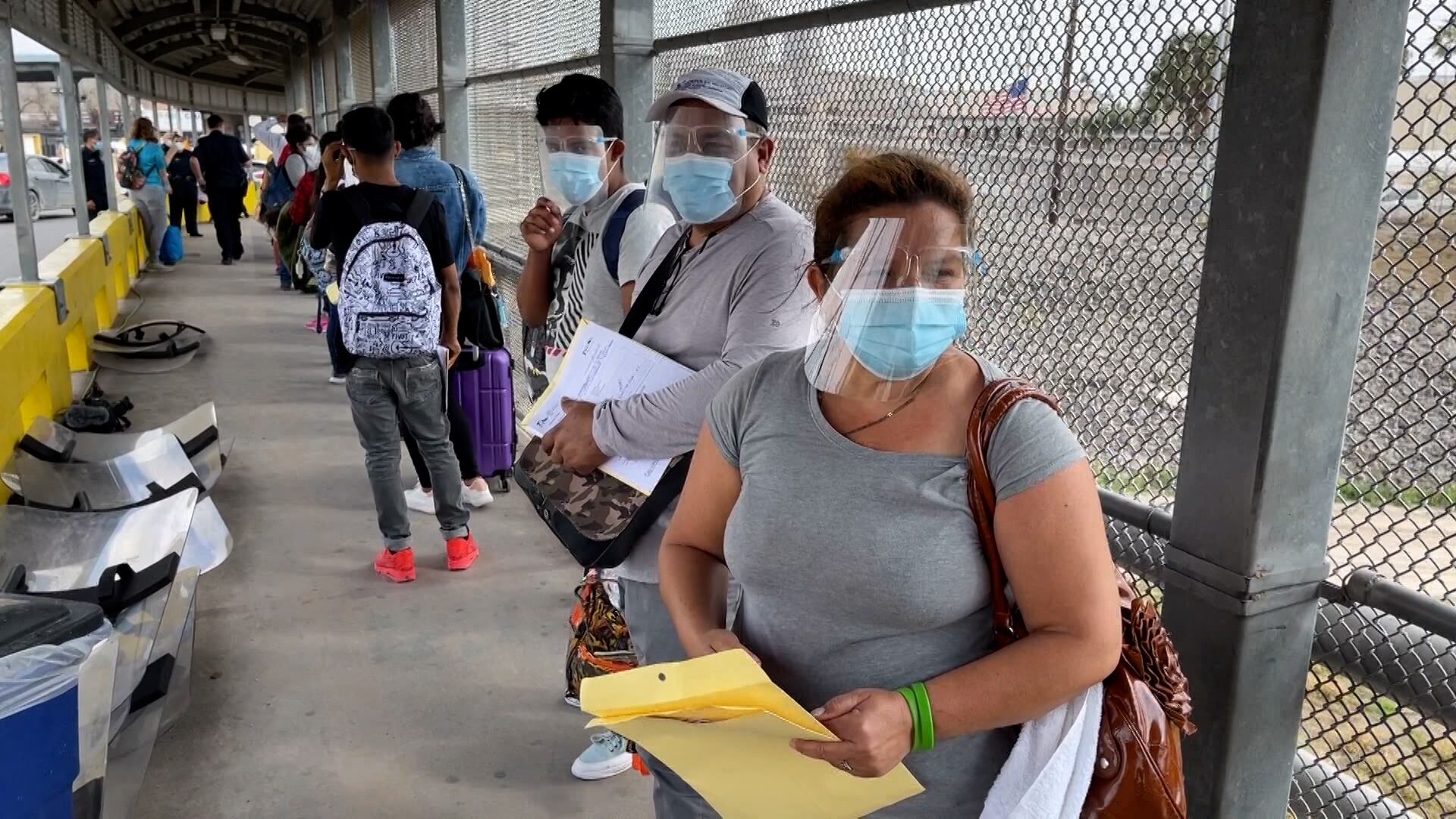
Tyler Moran, former senior adviser to President Biden on migration, joins Cheddar Politics to discuss the recent controversy around the administration's decision to end the use of Title 42, a public health order allowing the U.S. to expel migrants without going through the asylum process.
Christian Heyne, vice president of policy at the gun safety group Brady, joins Cheddar Politics to discuss President Biden's executive action on so-called "ghost guns," and to reflect on the Brooklyn subway shooting.
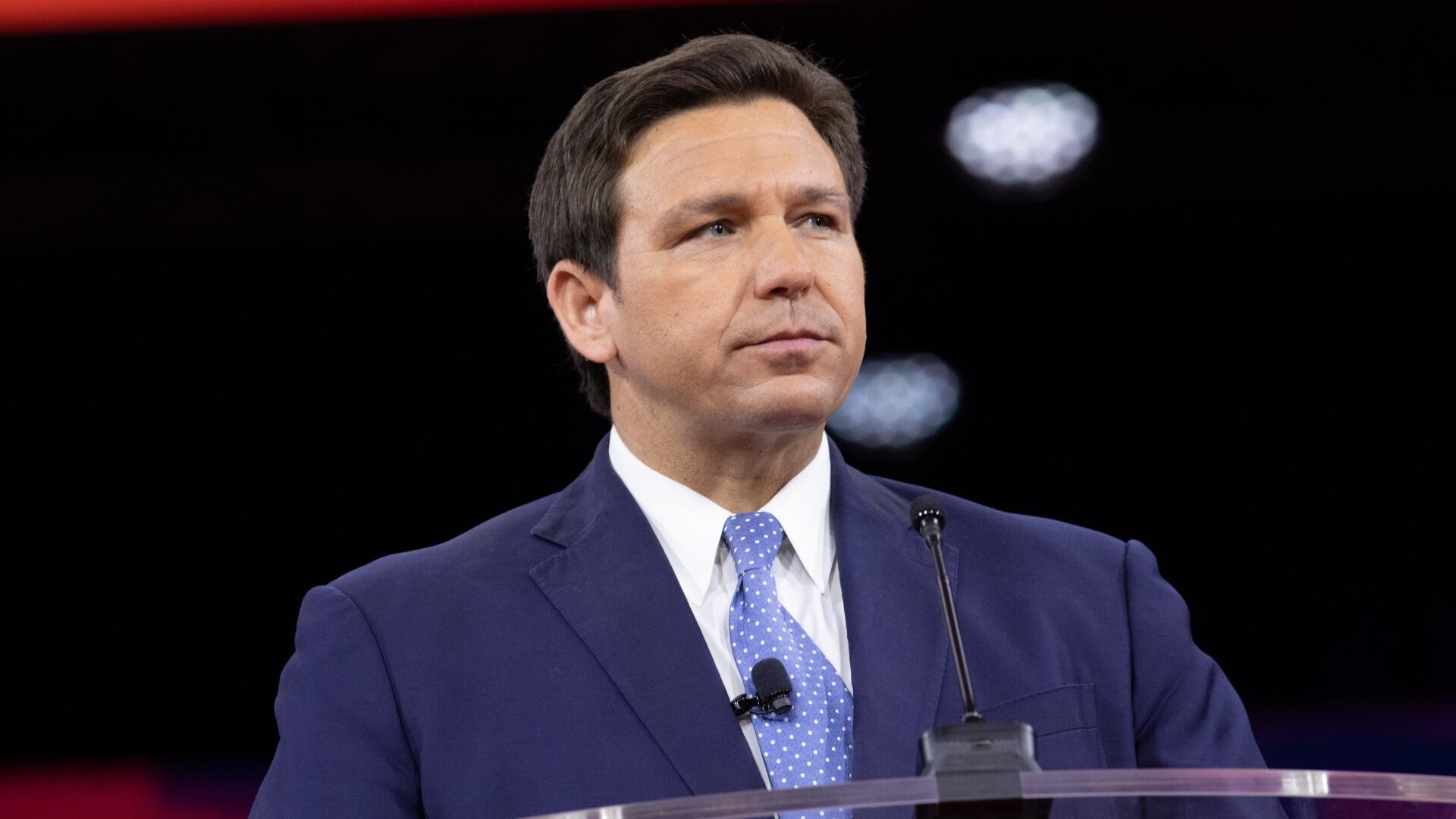
Jasmine Burney-Clark, founder of Equal Ground Education Fund and Action Fund, joins Cheddar Politics to discuss the redistricting process in Florida, and how the state's Republican Gov. Ron DeSantis proposed a map reducing the power of Black Floridians.
Ryan Thoreson, an LGBT rights researcher at Human Rights Watch, joins Cheddar Politics to discuss claims of grooming made by Republican politicians during efforts to pass so-called 'Don't Say Gay' bills.