Crystal and Chris Martin stand outside their home, Sunday, July 19, 2020 in Burton, Mich., as one of their children looks on. The Martins, who had to defer some mortgage payments, are among millions of Americans who have struggled financially during the coronavirus pandemic. Crystal has been laid off since March from her job at a roller skating rink and Chris, an X-ray technician at a Flint hospital, was laid off, then took parental leave after the birth of a child this month. A new study by NORC at the University of Chicago finds that more than a quarter of Americans report losing income, investments and savings during the pandemic. (AP Photo/Tammy Webber)
By Tammy Webber
Crystal and Chris Martin put off some payments on their home in this blue-collar town near Flint and are pinching pennies to make ends meet until they return to work. In Windsor, Connecticut, Anne Druce's family canceled home improvement projects out of an abundance of caution but remains financially secure.
As the coronavirus pandemic drags on, a new poll finds it is having different effects on Americans' economic well-being. For some, the virus has meant lost income or struggles to pay bills on time — particularly among Hispanic, Black and younger Americans. Others, most notably college-educated and older Americans, have transitioned to working from home or have experienced the nation's economic decline through a dip in the value of their investments.
"It's just all been kind of frustrating," said Crystal Martin, who lost her job managing a roller skating rink in March and waited 10 weeks for her first unemployment check. Her husband, an X-ray technician at a Flint hospital, was laid off for about month, then took parental leave after Crystal had a baby in July, to reduce the chances of bringing home the virus.
"We had to go into our savings, and we were crunching numbers to see how long it would last," said Martin, adding that the couple, who have six children in their blended family, still aren't sure if their mortgage company will add the deferred house payments to the end of their loan or demand the money all at once later this year.
Overall, roughly a quarter of Americans say they have lost savings and about as many have lost income, according to the latest COVID Response Tracking Study, conducted by NORC at the University of Chicago. About 2 in 10 report losing a job and roughly another 2 in 10 say they have put themselves at risk of exposure to the virus for work.
Meanwhile, the survey also finds about a third of Americans say their investments were negatively impacted during the pandemic. About a quarter say they have had to change their work routine, including having to work from home.
That includes Druce, who said she and her husband, James, are fortunate to have well-paying jobs — she's a process engineering consultant for an insurance company and he works for a mutual fund company — that allow working from home.
While feeling financially stable, they're saving as much money as possible — aside from spending to take a beach vacation in August with their two young boys — because "anything can change," Druce said.
"I know it sounds insanely privileged," said Druce, "but I 1,000 percent feel fortunate."
The poll finds that disparities of economic experience during the pandemic by race and ethnicity, age, and education are stark.
Beyond the dollars-and-cents impacts of the pandemic, the survey found the economic effects taking a toll on Americans' mental health, with stress rising among those who report a loss of income, a loss of savings and trouble paying bills.
Tom W. Smith, director of the Center for the Study of Politics and Society at NORC and the study's lead investigator, said people are also feeling more lonely than might be expected given the recent easing of restrictions and the reopening of businesses. That could be because people still are severely restricting normal activities, perhaps because of finances or because they're "not willing to take the chance yet" on potentially exposing themselves to the virus.
Adding to the uncertainty and anxiety: Some initiatives meant to help people get through the crisis — including extra unemployment compensation and moratoriums on evictions and utility shut-offs — are set to expire soon, said Joy Peterman, development director at the Salvation Army in Flint.
Her organization has seen a 25 percent increase in requests for assistance during the pandemic, mostly from people who were forced to seek help for the first time and many of whom were still working.
"They just didn't have enough money to continue to pay their bills (because of) shorter hours and less pay," said Peterman, who believes needs will increase in coming months. "You still have rent, you still have utilities, you still have a car payment, insurance, and the phone bill. And you still have to feed your children."
___
The survey of 2,012 adults was conducted June 22-July 6 with funding from the National Science Foundation. It uses a sample drawn from NORC's probability-based AmeriSpeak Panel, which is designed to be representative of the U.S. population. The margin of sampling error for all respondents is plus or minus 3 percentage points.
Alex Garden, Chairman and CEO at Zume, joins Cheddar Innovates to discuss how individuals can take steps to end their reliance on plastic, and Zume's partnership with global robotics company ABB to put sustainability at the forefront.
M&T Bank rang the Opening Bell at the New York Stock Exchange Thursday morning as the company celebrated a milestone of opening 100 new multicultural banking centers. David Femi, head of multicultural banking, joined Cheddar to discuss the culturally inclusive expansion as part of the bank's overarching goal to increase financial access in racially and ethnically diverse communities. "By designating branches as multicultural is just one way for us to be intentional in making sure, that number one, when [customers] come into these branches, they see people that look like them, they see people that speak their language," he said.
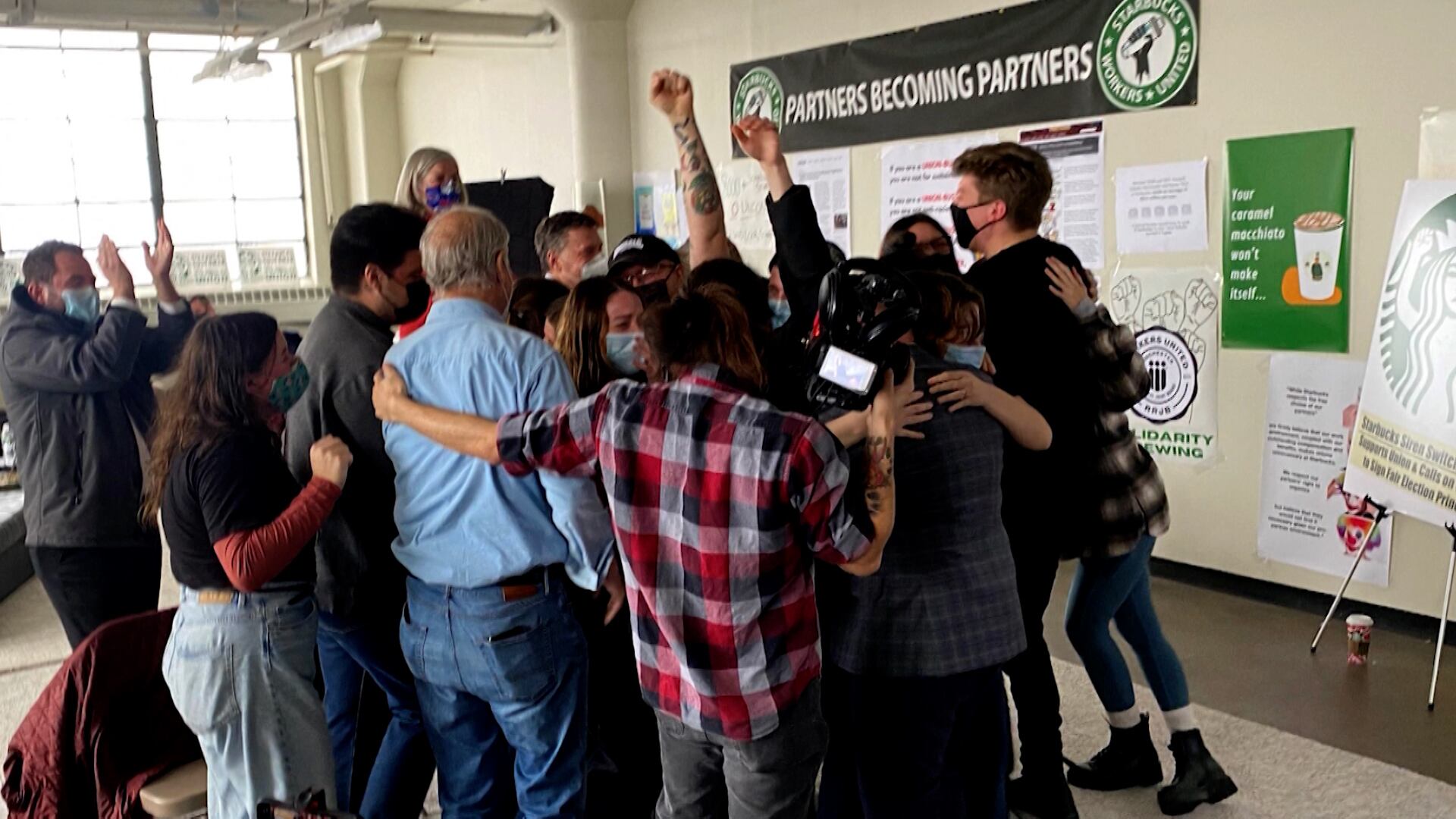
A second Starbucks location in the U.S. has officially voted to unionize. On Monday, the National Labor Relations Board announced workers at the Starbucks store located in the Buffalo, NY suburb of Cheektowaga voted 15-9 in favor of being represented by Workers United, an affiliate of the Service Employees International Union. The New York Times reports votes were tallied in December but remained inconclusive as the union challenged the ballots of several employees it said did not work at the store. A Starbucks spokesperson has said that it may appeal the labor board's decision, which comes as several other Starbucks stores across the country are also pushing to form a union. Danka Dragic, shift supervisor for the second Starbucks store in the country to unionize, joined Cheddar News' Closing Bell to discuss.
Technology-driven sustainable waste management platform, RoadRunner Recycling, recently raised a $70 million Series D round from BeyondNetZero, the climate investing venture of General Atlantic. RoadRunner says it creates and manages end-to-end waste and recycling solutions for businesses of all sizes and that its proprietary technology can boost cost savings and improve recycling rates for companies, which in turn drives sustainability for the waste industry and our world. RoadRunner Recycling founder and CEO Graham Rihn joined Cheddar News' Closing Bell to discuss.
Apple TV+ is in serious talks for the rights to stream MLB games next season, the first foray into sports content for the platform, according to the New York Post. Lee Berke, president and CEO of LHB Sports, sat down with Cheddar to discuss how such a deal might impact the tech giant and the sports content industry. "Quite often with new media platforms one of the quickest ways to create and implement a programming strategy — and actually one of the most expensive ways — is to offer up sports content," Berke noted. "So, with this package available, it puts Apple literally in the game and gives them an opportunity to demonstrate their skills in offering up a major league sport."
A.I.-enabled fintech company Qraft Technologies recently closed a $146 million investment from SoftBank Group Corp.
The companies say they are entering a partnership to accelerate artificial intelligence in the asset management industry. Qraft has already developed A.I. solutions that have been used by major financial institutions and says its new approach to asset management maximizes investment efficiency. Qraft Technologies U.S. CEO Robert Nestor joined Cheddar News' Closing Bell to discuss.
Peacock has announced a slate of original Olympic games documentaries set to premiere throughout January. The first series, 'Meddling' is now available to stream. The four-part docuseries details the 2002 winter Olympic scandal which alleged that the pairs figure skating competition had been fixed to favor Russia. Tara Lipinski, Olympic gold medalist, champion figure skater, and executive producer of ' Meddling,' joins Cheddar News discuss the series.
A decade ago, long before streaming services, the amount of binge-watching viewers could take part in was slim. Now, streaming services have established binge-watching as a viewing norm. However, how can viewers know when they've crossed the line from innocent entertainment to harmful addiction? Judy Grisel, professor of psychology at Bucknell University, joins Cheddar News to discuss a new study that identifies psychological predictors of problematic binge-watching.
Glassdoor has officially revealed its list of the best places to work in the year 2022. The top 10 on the list include tech companies and just one retail company. Senior economist at Glassdoor, Daniel Zhao, joined Cheddar to discuss more.