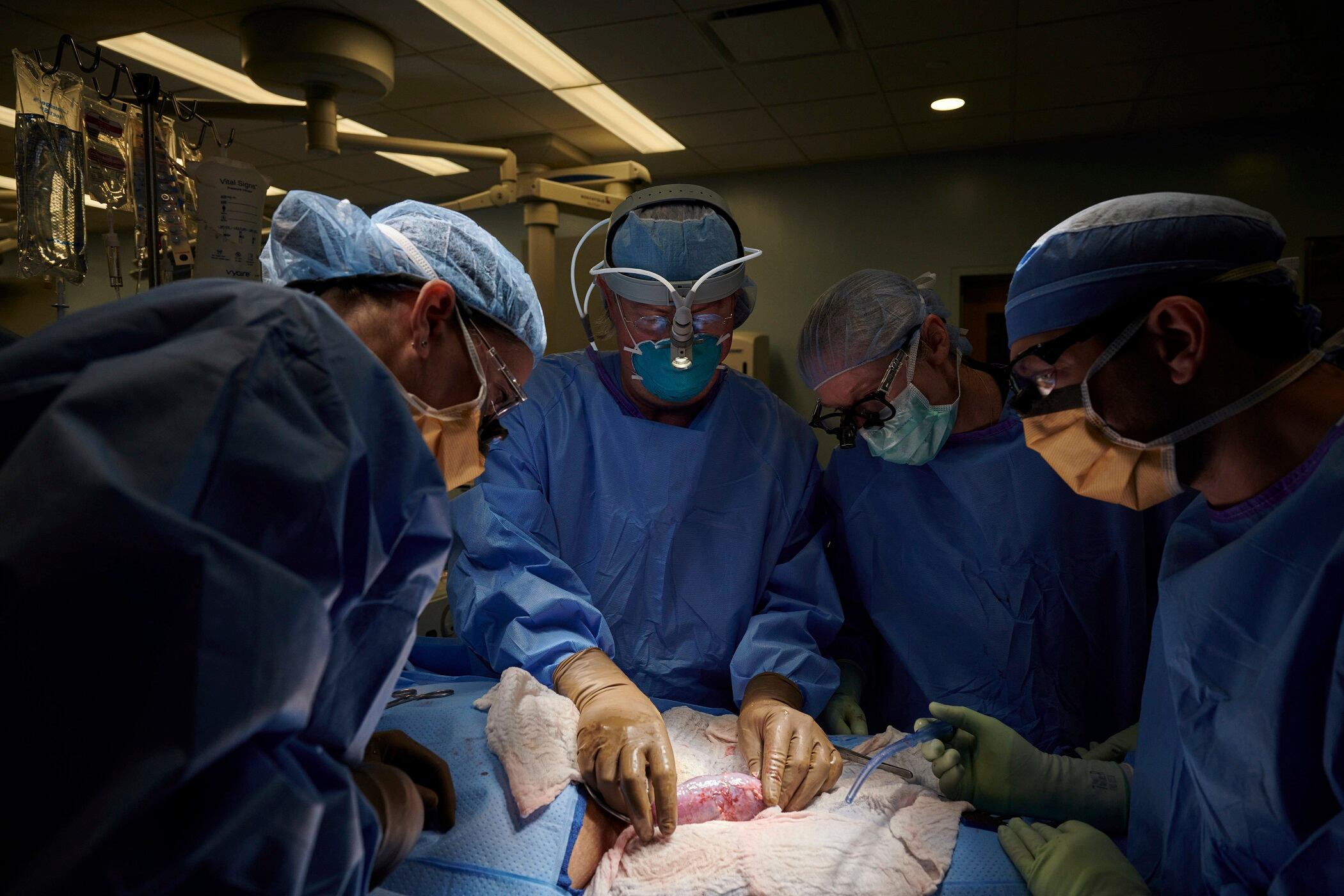
In this September 2021 photo provided by NYU Langone Health, a surgical team at the hospital in New York examines a pig kidney attached to the body of a deceased recipient for any signs of rejection. From left are Drs. Zoe A. Stewart-Lewis, Robert A. Montgomery, Bonnie E. Lonze and Jeffrey Stern. The test was a step in the decades-long quest to one day use animal organs for life-saving transplants. (Joe Carrotta/NYU Langone Health via AP)
By Carla K. Johnson
Scientists temporarily attached a pig’s kidney to a human body and watched it begin to work, a small step in the decades-long quest to one day use animal organs for life-saving transplants.
Pigs have been the most recent research focus to address the organ shortage, but among the hurdles: A sugar in pig cells, foreign to the human body, causes immediate organ rejection. The kidney for this experiment came from a gene-edited animal, engineered to eliminate that sugar and avoid an immune system attack.
Surgeons attached the pig kidney to a pair of large blood vessels outside the body of a deceased recipient so they could observe it for two days. The kidney did what it was supposed to do — filter waste and produce urine — and didn't trigger rejection.
“It had absolutely normal function,” said Dr. Robert Montgomery, who led the surgical team last month at NYU Langone Health. “It didn’t have this immediate rejection that we have worried about.”
This research is “a significant step,” said Dr. Andrew Adams of the University of Minnesota Medical School, who was not part of the work. It will reassure patients, researchers and regulators “that we’re moving in the right direction.”
The dream of animal-to-human transplants — or xenotransplantation — goes back to the 17th century with stumbling attempts to use animal blood for transfusions. By the 20th century, surgeons were attempting transplants of organs from baboons into humans, notably Baby Fae, a dying infant, who lived 21 days with a baboon heart.
With no lasting success and much public uproar, scientists turned from primates to pigs, tinkering with their genes to bridge the species gap.
Pigs have advantages over monkeys and apes. They are produced for food, so using them for organs raises fewer ethical concerns. Pigs have large litters, short gestation periods and organs comparable to humans.
Pig heart valves also have been used successfully for decades in humans. The blood thinner heparin is derived from pig intestines. Pig skin grafts are used on burns and Chinese surgeons have used pig corneas to restore sight.
In the NYU case, researchers kept a deceased woman's body going on a ventilator after her family agreed to the experiment. The woman had wished to donate her organs, but they weren’t suitable for traditional donation.
The family felt “there was a possibility that some good could come from this gift,” Montgomery said.
Montgomery himself received a transplant three years ago, a human heart from a donor with hepatitis C because he was willing to take any organ. “I was one of those people lying in an ICU waiting and not knowing whether an organ was going to come in time,” he said.
Several biotech companies are in the running to develop suitable pig organs for transplant to help ease the human organ shortage. More than 90,000 people in the U.S. are in line for a kidney transplant. Every day, 12 die while waiting.
The advance is a win for Revivicor, a subsidiary of United Therapeutics, the company that engineered the pig and its cousins, a herd of 100 raised in tightly controlled conditions at a facility in Iowa.
The pigs lack a gene that produces alpha-gal, the sugar that provokes an immediate attack from the human immune system.
In December, the Food and Drug Administration approved the gene alteration in the Revivicor pigs as safe for human food consumption and medicine.
But the FDA said developers would need to submit more paperwork before pig organs could be transplanted into living humans.
“This is an important step forward in realizing the promise of xenotransplantation, which will save thousands of lives each year in the not-too-distant future,” said United Therapeutics CEO Martine Rothblatt in a statement.
Experts say tests on nonhuman primates and last month’s experiment with a human body pave the way for the first experimental pig kidney or heart transplants in living people in the next several years.
Raising pigs to be organ donors feels wrong to some people, but it may grow more acceptable if concerns about animal welfare can be addressed, said Karen Maschke, a research scholar at the Hastings Center, who will help develop ethics and policy recommendations for the first clinical trials under a grant from the National Institutes of Health.
“The other issue is going to be: Should we be doing this just because we can?” Maschke said.
___
The Associated Press Health and Science Department receives support from the Howard Hughes Medical Institute’s Department of Science Education. The AP is solely responsible for all content.
After months of investigation, board members from U.S. big oil companies were slated to appear before a House oversight committee this week to discuss their respective roles in pushing for climate initiatives internally. However, all four board members from Exxon, Shell, Chevron, and BP said they couldn't attend due to scheduling conflicts. Climate experts are testifying in their place about how effective big oil's climate promises have been so far. Meanwhile, President Joe Biden's lead science adviser Eric Lander has resigned after an investigation found he violated workplace policy. What will this mean for Biden's climate agenda? Amy Harder, executive editor of Cipher, a publication by Breakthrough Energy, joins Cheddar Climate to discuss.
Although this week's weather is predicted to be less severe than the 2021 storm, Texans are preparing for the worst - stocking up on supplies and emptying shelves in grocery stores, once again. Some Texans still have not recovered from last year's tragedy, and are heading into the next few weeks with anxiety for what's to come. Leslie Beyer, CEO of the Houston-based energy workforce & technology council, joins Cheddar News to discuss if the Texas grid will fail again.
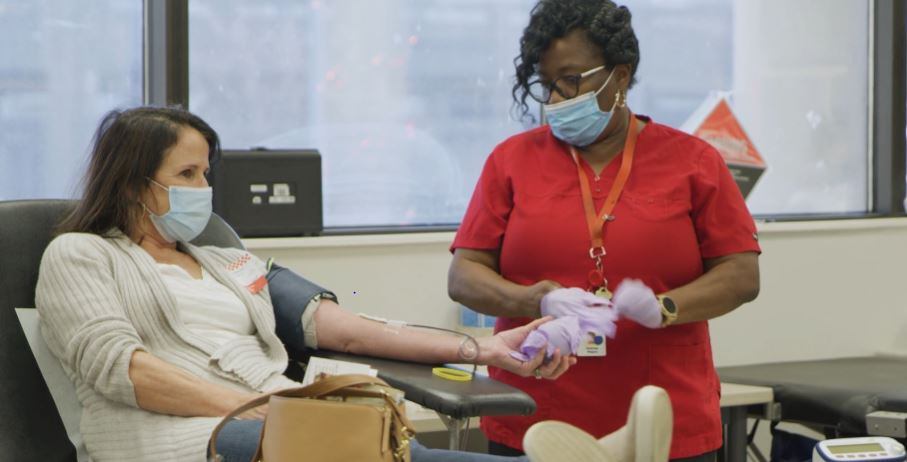
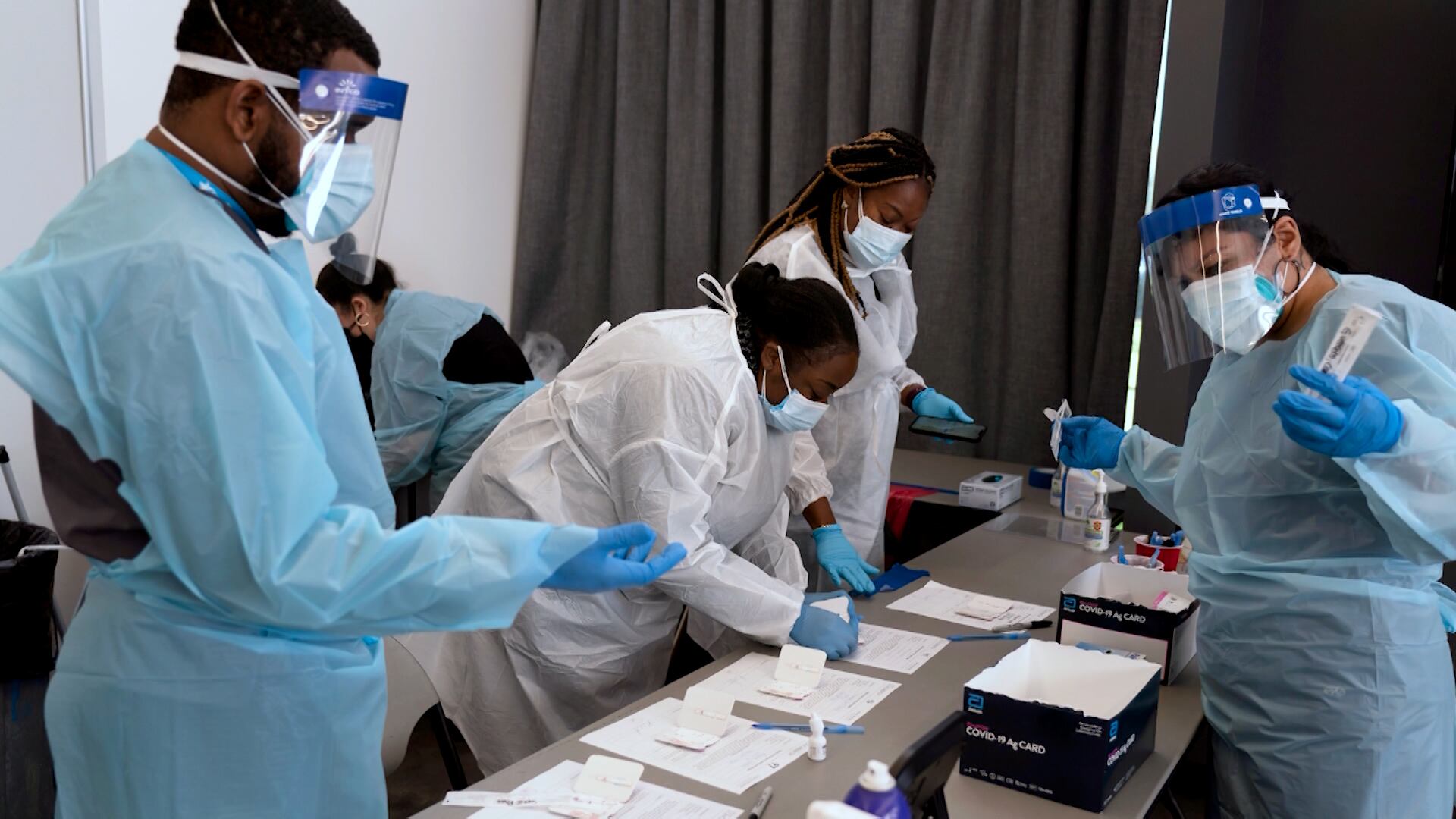
The American Red Cross has declared its first-ever "national blood crisis" in the United States. Since COVID hit the U.S. in March 2020, blood donations have declined by 10 percent. American Red Cross Medical Director, Dr. Baia Lasky joined Cheddar News to discuss the country facing the worst blood shortage in over a decade. Dr. Lasky noted that as much as 40 percent of Americans are eligible to donate blood but only about 4 percent do so. "This is going to be ongoing," she said. "This is not an acute shortage. We really do need the commitment of people to come out and donate and donate again." Appointments to donate can be made by using the Red Cross Donor App, at RedCrossBlood.org, or calling 1-800-RED CROSS (1-800-733-2767).
Eight months after the National Football League announced $1 million in research into cannabinoids, the NFL-NFLPA Joint Pain Management Committee has awarded the funding to two teams of medical researchers at the University of California San Diego and the University of Regina. The NFL says the studies will investigate the effects of cannabinoids on pain management and neuroprotection from concussion in elite football players, respectively. Cheddar correspondent Chloe Ailello spoke with Jeff Miller, the executive vice president of communications, public affairs, and policy for the NFL, about the studies, as well as the recent lawsuit filed against the NFL by former Miami Dolphins head coach Brian Flores. "Maybe we can learn things from other alternative pain approaches that are going to benefit our player population and then sports medicine as a whole," Miller said.
On this episode of Cheddar Innovates: CEO of HereAfter AI discusses how artificial intelligence can be used to preserve family history and stories, and allow you to 'talk' to loved ones that have passed; Creator of the board game 'Travel Explore Discover' explains how she came up with the idea for this informative and educational board game, and how she's using the proceeds to give back to her community; Cheddar gets a look at Curiosity Stream's 'The Humboldt Current.'
Immunologist Dr. Purvi Parikh of the Allergy & Asthma Network joined Cheddar News to break down long Covid, in which Covid symptoms remain up to two years after infection; a phenomenon that has so far mystified health experts.
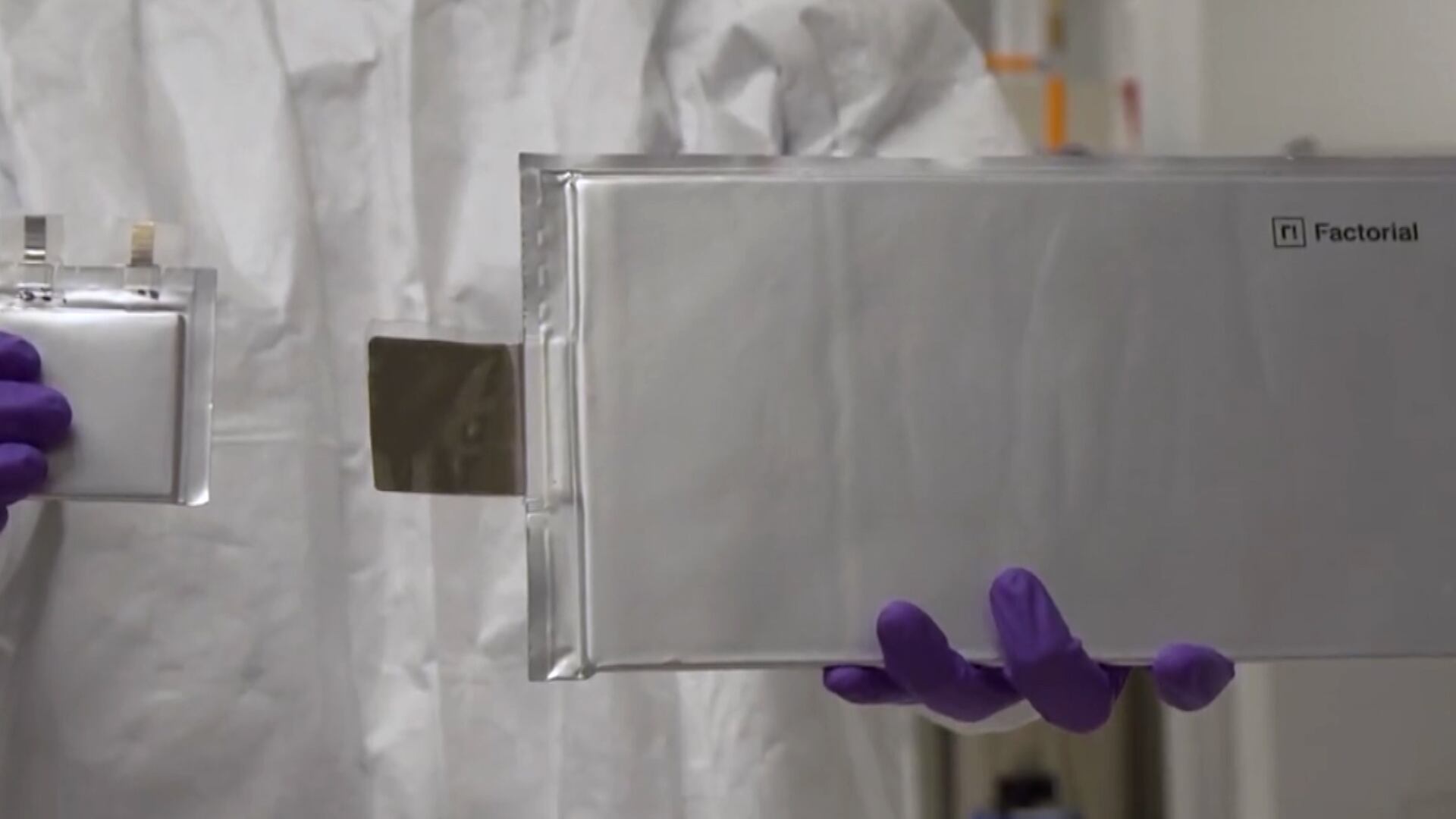
Solid-state battery maker Factorial Energy recently raised $200 million in a Series D round led by Mercedes-Benz and Stellantis. Factorial says the funding will be used to accelerate commercial production and deployment of its solid-state battery technology, which the company says is safer, and offers up to 50% more driving range than current lithium-ion technology. Factorial also has joint development agreements (announced in late 2021) with Mercedes-Benz, Stellantis, and Hyundai, three of the top 10 global automotive manufacturers, to commercialize its batteries. Factorial CEO Siyu Huang joined Cheddar News' Closing Bell to discuss.
David Malott, founder and chief architect at AI PlanetWorks joins Cheddar News to discuss the release of its augmented reality NFTs for the metaverse called 'TERA.'
A 2021 report from UK Research and Innovation found that the shipping industry makes up at least 2.5 percent of the world's total CO2 emissions. It's a problem that energy solutions company, Leclanché, is trying to solve. Founded in 1909, the company has been developing and producing batteries for more than 100 years. Today, Leclanché's lithium-ion battery is used to electrify not just ships, but also railroad locomotives, trucks, and specialty vehicles. Cheddar News spoke with Pierre Blanc, chief technology and industrial officer of Leclanché, to discuss.