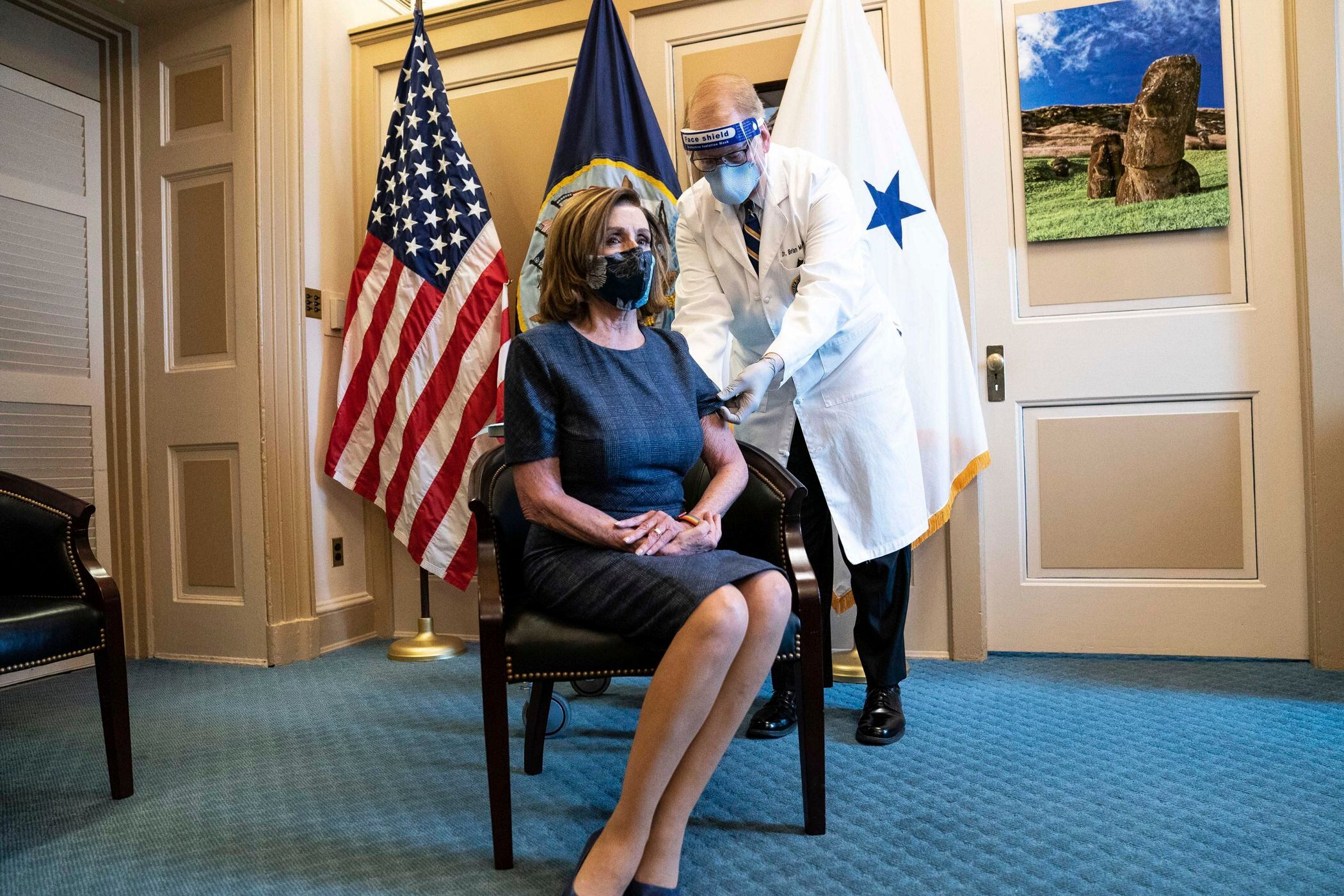
Speaker of the House Nancy Pelosi, D-Calif., sits and waits before being inoculated with a Pfizer-BioNTech COVID-19 vaccine shot by Dr. Brian Monahan, attending physician Congress of the United States in Washington, Friday, Dec. 18, 2020. (Anna Moneymaker/The New York Times via AP, Pool)
By Mary Clare Jalonick
The legislative branch of government is rapidly moving to receive the coronavirus vaccine, with both House Speaker Nancy Pelosi and Senate Majority Leader Mitch McConnell getting the shot on Friday and the top Capitol doctor urging all members of Congress to join them.
Both Pelosi and McConnell tweeted photos of themselves receiving the vaccine from the Capitol physician, Dr. Brian P. Monahan. Monahan informed lawmakers Thursday evening that they are all eligible for the shots under government continuity guidelines and asked members of the House and Senate to make appointments with his office to be vaccinated.
The leaders' vaccinations came hours after Vice President Mike Pence received it on live television and called it a “medical miracle." The public displays from all three come as top U.S. health officials are trying to convince regular Americans who may be skeptical of the vaccinations to get them and allow the country to rebound from the pandemic.
“Today, with confidence in science & at the direction of the Office of the Attending Physician, I received the COVID-19 vaccine,” Pelosi tweeted. “As the vaccine is being distributed, we must all continue mask wearing, social distancing & other science-based steps to save lives & crush the virus.”
The speaker said in October that she does not like getting shots and even had a hard time getting her ears pierced.
“They have to talk me into the flu shot under great duress each year," she said. "But if it serves as a model to other people, yes, I would take the vaccine if it is approved by regular order.”
McConnell tweeted that he had “just received the safe, effective COVID vaccine following continuity-of-government protocols. Vaccines are how we beat this virus.”
On Thursday, McConnell said that as a survivor of childhood polio, “I know both the fear of a disease and the extraordinary promise of hope that vaccines bring.”
It is unclear whether all 535 members of the House and Senate will choose to get the vaccine. Only about half of Americans say they are willing to get it, according to a survey this month by The Associated Press-NORC Center for Public Affairs Research, despite a rigorous federal review process and health officials' insistence that it is safe.
Several other members of Congress have expressed an eagerness to receive the vaccine, especially as an example to some of their constituents who may be wary. House Republican Leader Kevin McCarthy said Friday that he would also be getting the shot.
Two senators, Rob Portman, R-Ohio, and Steve Daines, R-Mont., have been participating in the vaccine trials. But lawmakers are also reluctant to be first to be vaccinated so they’re not seen as jumping the line.
Pelosi is third in the line of succession for the presidency, after President Donald Trump and Pence. Trump, who was hospitalized with COVID-19 in October, has yet to indicate when or if he will receive the shot.
Monahan, the Capitol physician, said that his office will follow a process to identify “continuity-essential staff members” in Congress after members have been vaccinated. He said his office would continue with appointments “until the small vaccine supply is exhausted.”
___
AP Congressional Correspondent Lisa Mascaro contributed to this report.
Face to face for just over two hours, President Joe Biden and Russia’s Vladimir Putin squared off in a secure video call Tuesday as the U.S. president put Moscow on notice that an invasion of Ukraine would bring enormous harm to the Russian economy.
Ahead of Instagram head Adam Mosseri's congressional hearing on the mental impact of the social platform on teens, the company announced a number of updates aimed at teen safety.
Troubled Chinese real estate giant Evergrande is once again nearing the brink of collapse. Shares of Evergrande sunk to a new record low on Monday, closing down 20 percent, as debt default fears resurfaced. Drew Bernstein, co-chairman at consultancy MarcumBP, joined Cheddar's Opening Bell to discuss. He said U.S. investors have to understand that "there is no company in China that's too big to fail, that's for sure," and that the Chinese government will be prioritizing the social welfare of the populace. Bernstein did note that it would be a managed collapse in some form.
Joan Greve, a politics reporter at The Guardian US, joined Wake Up With Cheddar to break down the implications of the Biden administration announcing a diplomatic boycott of the 2022 Beijing games in response to allegations of human rights abuses against Uyghur Muslims. She noted the significance of the move, assessing the already frayed relationship between the U.S. and China. "The Chinese have said that a boycott would be politically manipulative, and now they are actually threatening countermeasures," she said. "And that will certainly have an impact on the spirit of the games at the very least."
The Biden administration has reached an agreement with the Mexican government to resume the "Remain-in-Mexico" policy under court order. By reinstating a Trump-era border policy, asylum-seekers will be forced to stay in Mexico until their U.S. immigration court date. The program is set to resume on Monday. Ryan Devereaux, a reporter for The Intercept, joins Cheddar News to discuss.
The U.S. announced it will not send any official representation to the upcoming Beijing winter Olympics. Cheddar's Hena Doba speaks with East Asia expert Michael Swaine about the reasons behind the diplomatic move.
COVID-19 is still battering the nation's criminal justice system, causing a massive backlog in cases and delaying verdicts for months on end. This, combined with the fear of crowded prisons during a pandemic, has prompted many defendants to plead guilty in exchange for time served or probation. Tina Luongo, attorney-in-charge of the Criminal Defense Practice, joined Cheddar to discuss the court backlog, the rise in plea bargains, and why this was an issue long before the pandemic.
With so many high-profile court cases taking over the media, from the trial over the murder of Ahmaud Arbery to the trial of Kyle Rittenhouse to the ongoing Elizabeth Holmes trial, Cheddar took a look at these cases and why there is such a big interest in them. Rachel Fiset, a white collar criminal defense lawyer and partner with Zeiback, Fiset, and Coleman, and Bryan Hance, attorney-at-law, professor, and academic program director of the pre-law and paralegal studies program at National University, joined Cheddar for a roundtable discussion on why there is so much public interest in so-called courtroom drama.
Carlo and Baker discuss the sweeping new vaccine mandate in NYC that will target all private businesses. Plus, Trump's media venture gets its CEO and more.