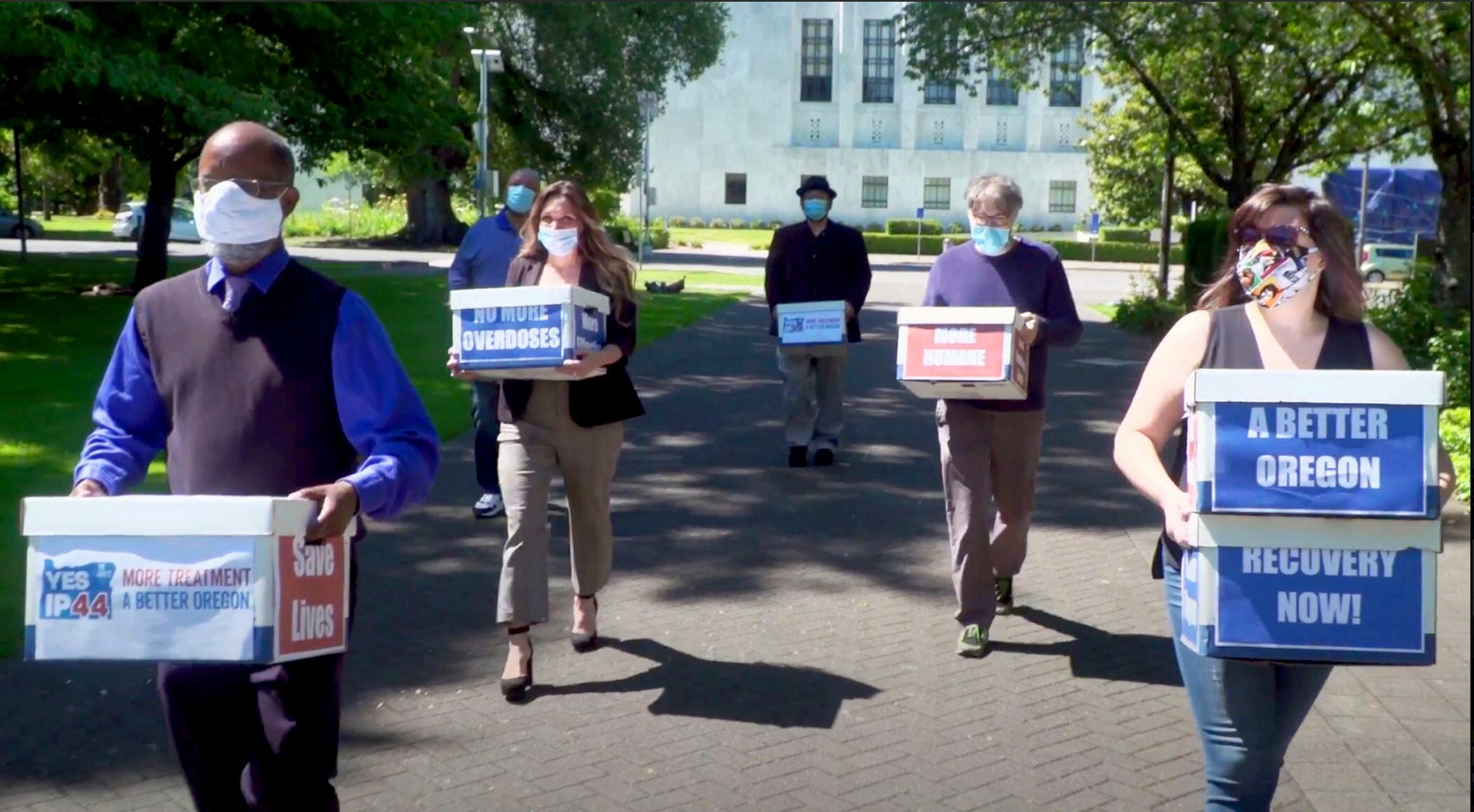
Oregon became the first state in the U.S. to decriminalize drug possession after a new law, approved by voters in November, went into effect on Monday.
“Oregon’s new law is transformational. Voters overwhelmingly agree that we must treat Substance Use Disorder as a public health crisis, not a crime. Today we take that first step,” said Tera Hurst, executive director of the Health Justice Recovery Alliance, a new advocacy group overseeing the implementation of the bill.
Measure 110, which passed with 58.5 percent of the vote in November, reclassified possession of drugs up to and including schedule 1 drugs like heroin, LSD, and methamphetamine as punishable by a $100 fine or completion of a health assessment, rather than a misdemeanor or felony charge. Access to drug treatment and recovery services, expanded under the new law, will be funded by tax revenue from legal cannabis, which exceeded $133 million in 2020, according to the state. Aside from treatment and recovery services, funds would be spent on housing and job assistance of people struggling with addiction, according to Associated Press.
Beyond promoting a health care-focused approach to drugs, the bill is expected to reduce racial disparities in drug arrests. According to a report from the Oregon Criminal Justice Commission from August 2020, the law could have the effect of reducing racial arrest disparities by a whopping 95 percent.
Activists celebrated the win.
“Today, the first domino of our cruel and inhumane war on drugs has fallen—setting off what we expect to be a cascade of other efforts centering health over criminalization,” said Kassandra Frederique, executive director of nonprofit Drug Policy Alliance. “For the first time in at least half a century, one place in the United States - Oregon - will show us that we can give people help without punishing them.”
Drug Policy Alliance funded the measure, as did Facebook CEO Mark Zuckerberg’s Chan Zuckerberg Initiative, which contributed $500,000, according to Oregon Live. It also attracted support from the American Civil Liberties Union, NAACP branches in Portland and Eugene Springfield, Oregon Nurses Association, and the Oregon Chapter of the American College of Physicians, among other groups, according to DPA.
Oregon District Attorney’s Association opposed the measure in the run up to the election, arguing “decriminalization will lead to an increase in acceptability of dangerous drugs, normalizing hazardous experimentation for our youth and increasing accessibility, surging supply and lowering costs of dangerous street drugs.”
While this approach is new in the United States, several countries, including Portugal, the Netherlands, and Switzerland, have already decriminalized possession of small amounts of hard drugs, according to the United Nations.
Portugal’s 2000 decriminalization brought no surge in drug use. Drug deaths fell while the number of people treated for drug addiction in the country rose 20% from 2001 to 2008 and then stabilized, Portuguese officials have said.
Associated Press contributed to this report.