At long last, the Democrats are set to gather for a week-long virtual convention that promises to be a shadow of its former self, as former VP Joe Biden formally accepts the party nomination. As is always the case, the nights and hours preceding the nominee's speech will feature a who's who of party bigwigs: Barack Obama. Hillary Clinton. Nancy Pelosi.
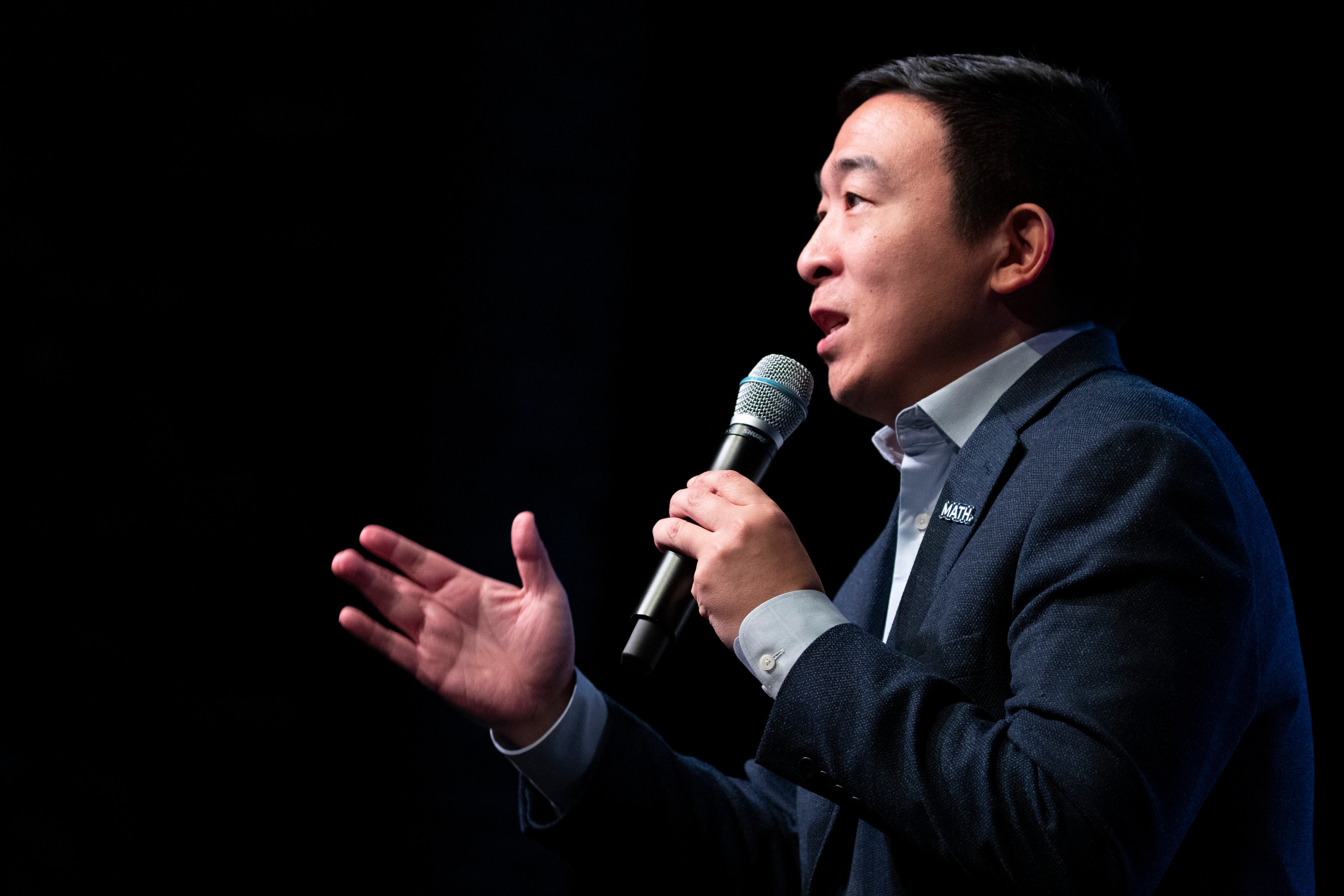
Of course, it won't be held in the 17,000-capacity Fiserv Forum in Milwaukee, Wisconsin; instead, the proceedings will look more like what the New York Times calls "a star-studded Zoom call." But even a quick glance at the four-night speakers reveals one glaring absence that DNC officials must correct if their "event" is to hold grassroots legitimacy: Andrew Yang.
Yang shot to prominence on the 2020 campaign trail with his eloquent descriptions of workforce displacement, the challenges of an increasingly digital age, and being the only candidate who crowd-surfed and danced the Cupid Shuffle. But his once-niche signature policy of Universal Basic Income quickly gained in mainstream acceptance, and as the country descended into a once-in-a-generation pandemic, the idea of direct payments became a political necessity for even the biggest party-insiders in Washington… of both parties.
In short, few have changed the national conversation quite like Andrew Yang. And the DNC is doing its voters a huge disservice by not including him in the ranks of expected speakers at the convention.
Don't get me wrong — the party is right to spotlight particular voices in an effort to unify disparate voting concerns; progressives like Vermont Senator Bernie Sanders and Rep. Alexandria Ocasio-Cortez will surely be must-watch speakers early in the week. And newly-announced VP pick Kamala Harris and Senator Cory Booker, who moved the needle on justice in policing and have publicly prosecuted the case against Donald Trump as well as anyone else, are deserving of convention placement, too.
But ignoring Yang's contributions to the Democratic cause — not to mention his rockstar-esque appeal to disaffected and young voters across this country — shows that the DNC remains out-of-touch with the forward-thinking approach that endeared Yang to the public in the first place. No candidate has done a better job elucidating the workforce challenges that contributed to the rise of Trump to begin with (especially in the heartland) and his thinking on topics such as artificial intelligence and job automation should become staples of the official Democratic Party platform.
And there's a very real representation and inclusivity component to this as well; Rep. Ted Lieu, one of the most visible Democrats on Capitol Hill, called out the DNC directly today, writing on Twitter: "Dear @DNC : Asian Americans are the fastest increasing group in America, including in multiple swing states. The gross underrepresentation of Asian American speakers in the four days of the DNC Convention is tone deaf and a slap in the face." If the Democratic Party is serious about defining itself as in-step with an increasingly diverse electorate, ignoring Andrew Yang is a gross misjudgment.
But being shunned by the DNC and powers-that-be is nothing new for Yang. He and I spoke in the spin room following the September 2019 debate in Houston, Texas, the third consecutive outing where Yang got the least amount of on-stage speaking time. He shrugged off any concerns.
"I've started to just gauge how optimally impactful the time I get is," Yang told me. "And as long as I'm making an impact with the time I get, then I'm doing great."
"We raised over a million dollars in the hours immediately afterwards [the last debate]," he added.
And that's the magic of Yang's influence: he doesn't need a lot of time to convey extremely persuasive points. The DNC would be smart to reconsider its convention lineup, and even give Yang the shortest speaking slot available; because to Yang, it doesn't matter how little time he's given. As he told me in Houston last Fall, "Americans can tell when someone is calling out the real problems and solutions, and I can do that in whatever time I'm given."
The opinions expressed by the author do not necessarily reflect the ideas and opinions of Cheddar and Altice USA.