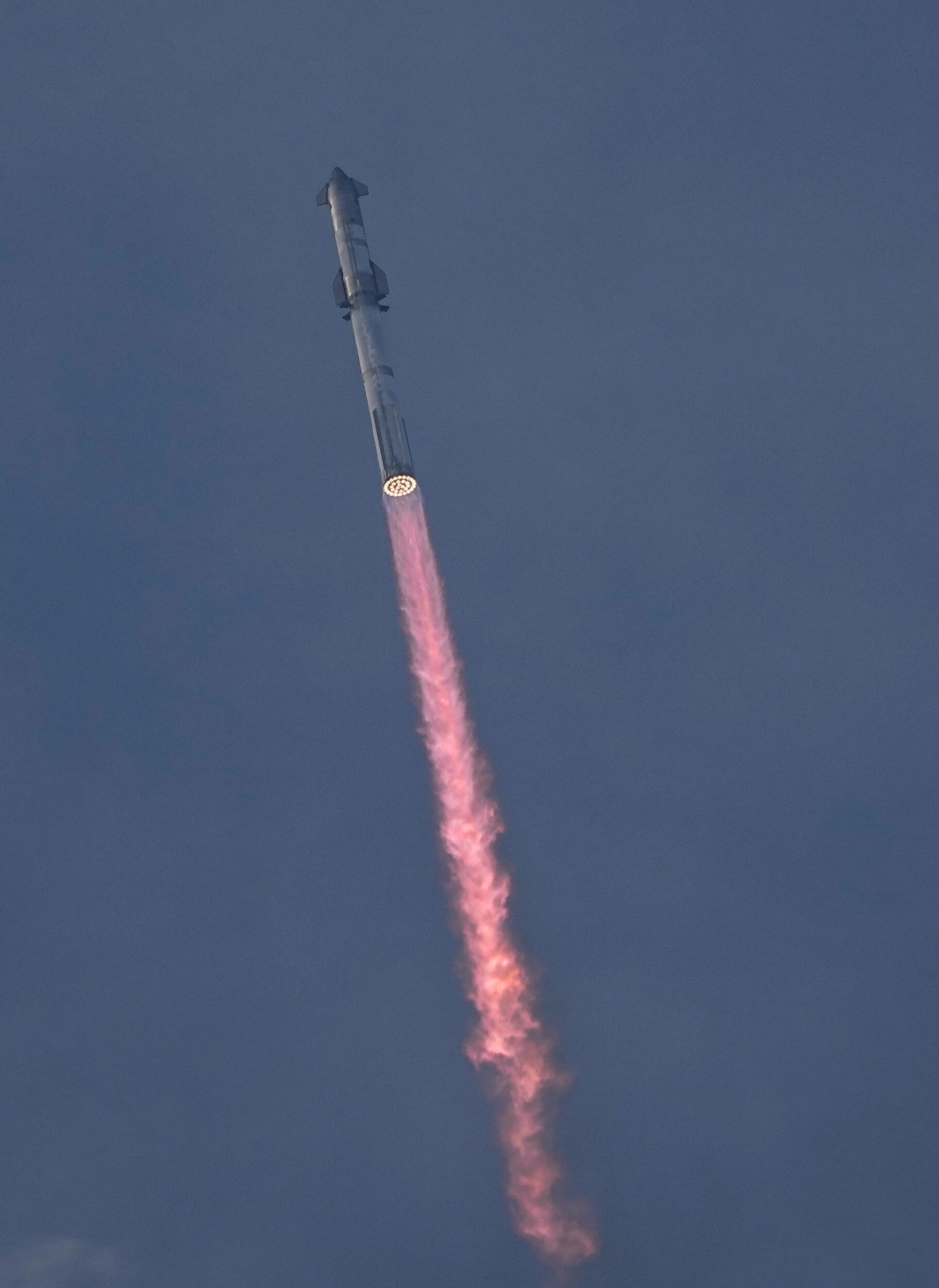
SpaceX came close to completing an hourlong test flight of its mega rocket on its third try Thursday, but the spacecraft was lost as it descended back to Earth.
The company said it lost contact with Starship as it neared its goal, a splashdown in the Indian Ocean. Until then, most everything had gone well following liftoff from the southern tip of Texas near the Mexican border.
“The ship has been lost. So no splashdown today,” said SpaceX’s Dan Huot. “But again, it’s incredible to see how much further we got this time around.”
Two test flights last year both ended in explosions minutes after liftoff. By surviving for close to 50 minutes this time, Thursday's effort was considered a win by not only SpaceX's Elon Musk, but NASA as well as Starship soared higher and farther than ever before. The space agency is counting on Starship to land its astronauts on the moon in another few years.
The nearly 400-foot (121-meter) Starship, the biggest and most powerful rocket ever built, headed out over the Gulf of Mexico after liftoff Thursday morning, flying east. A few minutes later, the booster separated seamlessly from the spaceship and plummeted into the gulf, although not exactly as planned because of what appeared to be an entry engine issue. The spacecraft continued toward the east, with no people or satellites on board.
Starship reached an altitude of about 145 miles (233 kilometers) as it coasted across the Atlantic and South Africa, before approaching the Indian Ocean. But 49 minutes into the flight — with just 15 minutes remaining — all contact was lost and the spacecraft presumably broke apart.
At that point, it was 40 miles (65 kilometers) high and traveling around 16,000 mph (25,700 kph).
SpaceX's Elon Musk had just congratulated his team a little earlier. “SpaceX has come a long way,” he said via X, formerly called Twitter. The rocket company was founded exactly 22 years ago Thursday.
NASA watched with keen interest: The space agency needs Starship to succeed in order to land astronauts on the moon in the next two or so years. This new crop of moonwalkers — the first since last century’s Apollo program — will descend to the lunar surface in a Starship after transferring from NASA's Orion capsule in lunar orbit.
NASA Administrator Bill Nelson quickly congratulated SpaceX on what he called a successful test flight as part of the space agency's Artemis moon-landing program.
The stainless steel, bullet-shaped spacecraft launched atop a first-stage booster known as the Super Heavy. Both the booster and the spacecraft are designed to be reusable, although they were never meant to be salvaged Thursday.
On Starship’s inaugural launch last April, several of the booster’s 33 methane-fueled engines failed and the booster did not separate from the spacecraft, causing the entire vehicle to explode and crash into the gulf four minutes after liftoff.
SpaceX managed to double the length of the flight during November’s trial run. While all 33 engines fired and the booster peeled away as planned, the flight ended in a pair of explosions, first the booster and then the spacecraft.
The Federal Aviation Administration reviewed all the corrections made to Starship, before signing off on Thursday’s launch. The FAA said after the flight that it would again investigate what happened.
Initially, SpaceX plans to use the mammoth rockets to launch the company’s Starlink internet satellites, as well as other spacecraft. Test pilots would follow to orbit, before the company flies wealthy clients around the moon and back. Musk considers the moon a stepping stone to Mars, his ultimate quest.
NASA is insisting that an empty Starship land successfully on the moon, before future moonwalkers climb aboard. The space agency is targeting the end of 2026 for the first moon landing crew under the Artemis program, named after the mythological twin sister of Apollo.