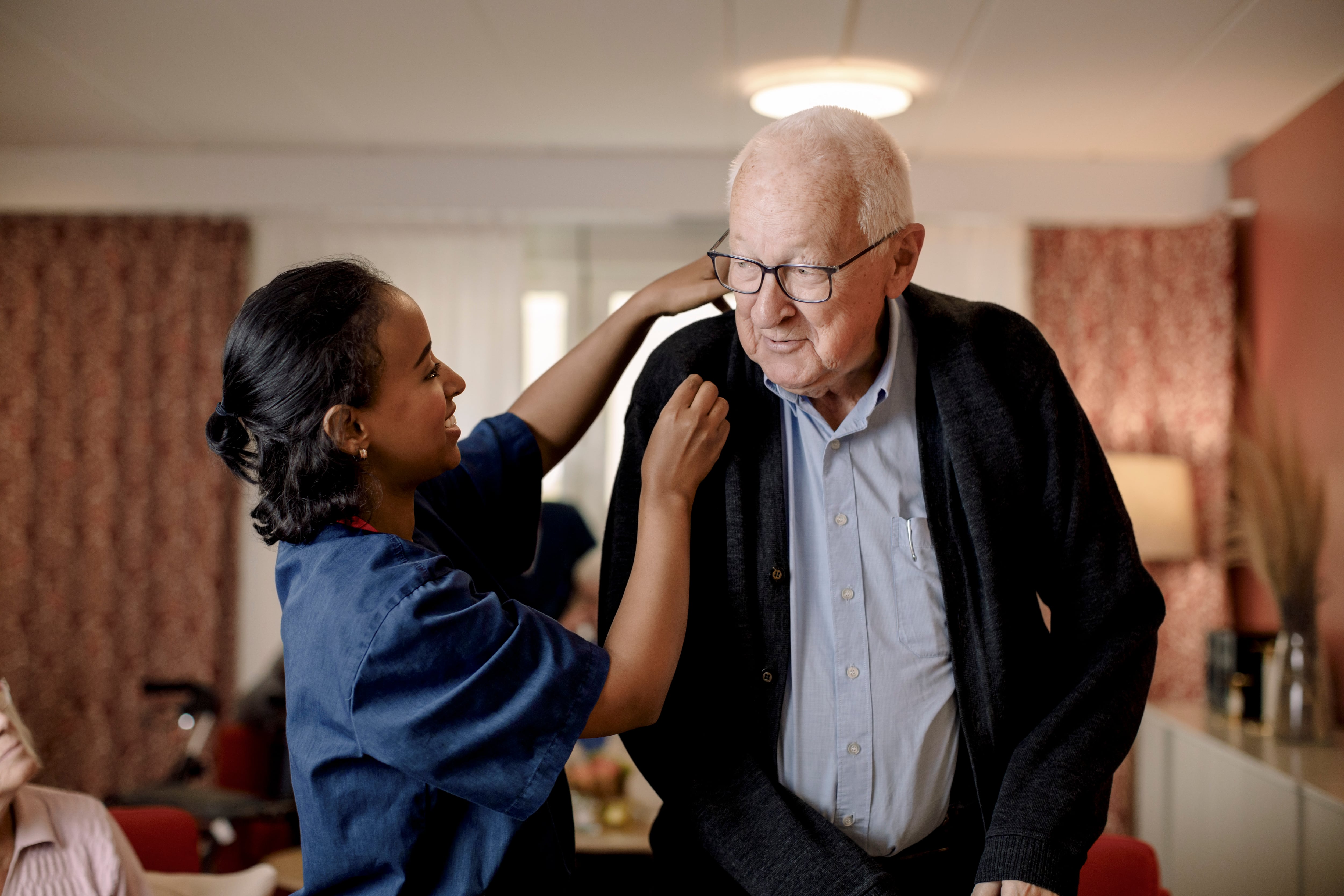
Senior man looking at female nurse helping him to wear sweater in retirement home (Maskot/Getty Images)
Americans 60 and older can get a new RSV vaccine but should discuss it with their doctor first, U.S. health officials recommended Thursday.
The newly approved vaccines are expected to be ready in the fall, a time when flu shots and updated COVID-19 shots also will be available. Those eligible for the RSV vaccine should talk with their doctor to see if it is right for them, the Centers for Disease Control and Prevention said in a statement.
The CDC said adults with chronic heart or lung disease, weakened immune systems and those living in long-term care facilities are at higher risk for the respiratory infection.
RSV, or respiratory syncytial virus, is a common cause of cold-like symptoms but it can be dangerous for infants and the elderly. A surge last year filled hospitals with wheezing children. There's no vaccine yet for kids, but one for pregnant women to prevent illness in infants may be coming too, pending approval from the Food and Drug Administration.
On Thursday, Dr. Rochelle Walensky, the outgoing CDC director, signed off on a recommendation made last week by an advisory panel of outside experts for a single dose of the vaccines made by Pfizer and GSK. The FDA approved the shots last month for adults 60 and older.
The CDC panel initially considered a stronger recommendation that everyone 65 and older get the shot. But they weakened their endorsement after several members had questions about how well it works in the feeblest of patients, whether boosters will be needed and be effective, and the cost.
Drugmaker GSK told the panel that its RSV vaccine would be between $200 and $295. Pfizer has not disclosed a price. The vaccines may hold up over multiple seasons and it’s not yet clear whether boosters will be recommended.
Others wanted a stronger endorsement for those 65 and older. Asking people to consult their doctor “is an absolute impediment" to getting more people vaccinated and an extra burden on health care providers, Robert Blancato, executive director of the National Association of Nutrition and Aging Services Programs, said Thursday.
U.S. health officials are cutting isolation restrictions for Americans who test positive for the coronavirus and shortening the time that close contacts have to quarantine.
New Year celebrations are approaching and across the world there is an urge to party. But the desire to let loose is being countered by the highly transmissible omicron variant.
Carlo and Baker cover the latest developments after a devastating tornado outbreak over the weekend, plus an eye on Omicron and inflation, and not even Spielberg can save the box office.
Reusable rocket developer Stoke Space Technologies raised $65 million in a Series A round led by Breakthrough Energy Ventures, a firm founded by Bill Gates. Stoke says its reusable rockets provide the satellite industry with low-cost, on-demand access to and from orbit. As companies like SpacX and Blue Origin are also making commitments to rocket reusability, Stoke says it is taking a different approach with a system designed to be 100% reusable, comprised of rockets designed to fly daily, like an airplane. Stoke co-founder and CEO Andy Lapsa joins Cheddar News' Closing Bell to discuss.
Humans are set to return to a place we have not been in nearly 50 years: the moon. NASA's Artemis program is expected to have astronauts back on the lunar surface by 2025. NASA says it will use what it learns on the moon to take the next giant leap - sending the first astronauts to Mars. The Artemis program also includes contributions from private companies like SpaceX, as well as academic research institutions like Georgia Tech. Georgia Tech professor of practice and former NASA astronaut Sandra Magnus joins Future of Space: Humankind's Leap Forward to discuss.
The CDC warns that COVID-19 is rapidly spreading with Omicron variant cases doubling every two days in the United States. How do current vaccines hold up against the new strain, and what does it mean for your upcoming holiday travel? Cheddar News breaks things down with infectious diseases specialist Dr. William Schaffner of Vanderbilt University School of Medicine.