Governments and energy markets worldwide remain on edge Monday as the U.S. continues to blame Iran for the drone attack on two oil installations in Saudi Arabia over the weekend. The assertion comes as the Iranian-backed Houthi militia in Yemen, which claimed responsibility for the strikes, threatens additional attacks on the oil facilities.
"We can reach wherever we want and at the time we determine," Yahya Sare'e, a Houthi military spokesman, said in a statement Monday, according to the group's Al-Masirah news outlet. Sare'e also demanded Saudi Arabia end its siege in Yemen and warned foreigners to vacate the oil installations, which are operated by Aramco, the Saudi state-owned oil company.
The Trump administration, meanwhile, maintains that the attack was perpetrated by Iran, or one of its proxies in the region — an allegation that Iran vehemently denies.
Following Saturday's attack, which resulted in no casualties, U.S. Secretary of State Mike Pompeo said Iran had launched an "unprecedented attack on the world's energy supply" and claimed there was no evidence that the drones originated in Yemen. "The United States will work with our partners and allies to ensure that energy markets remain well supplied and Iran is held accountable for its aggression," Pompeo said on Twitter.
President Trump also shifted blame to Iran, saying in recent tweets that "we know the culprit" and that the U.S. is "locked and loaded" to take responsive actions. The president also said Monday that Iran has in the past knowingly lied about its drone activity in the region, casting doubt on the country's denial.
"The U.S. allegations against Iran are baseless and outrageous," Iranian Foreign Ministry spokesman Abbas Mousavi said Monday. He added that it is "quite natural" that the Houthis would retaliate to the Saudi-led war, which has devastated much of Yemen in recent years and created one of the world's worst humanitarian crises.
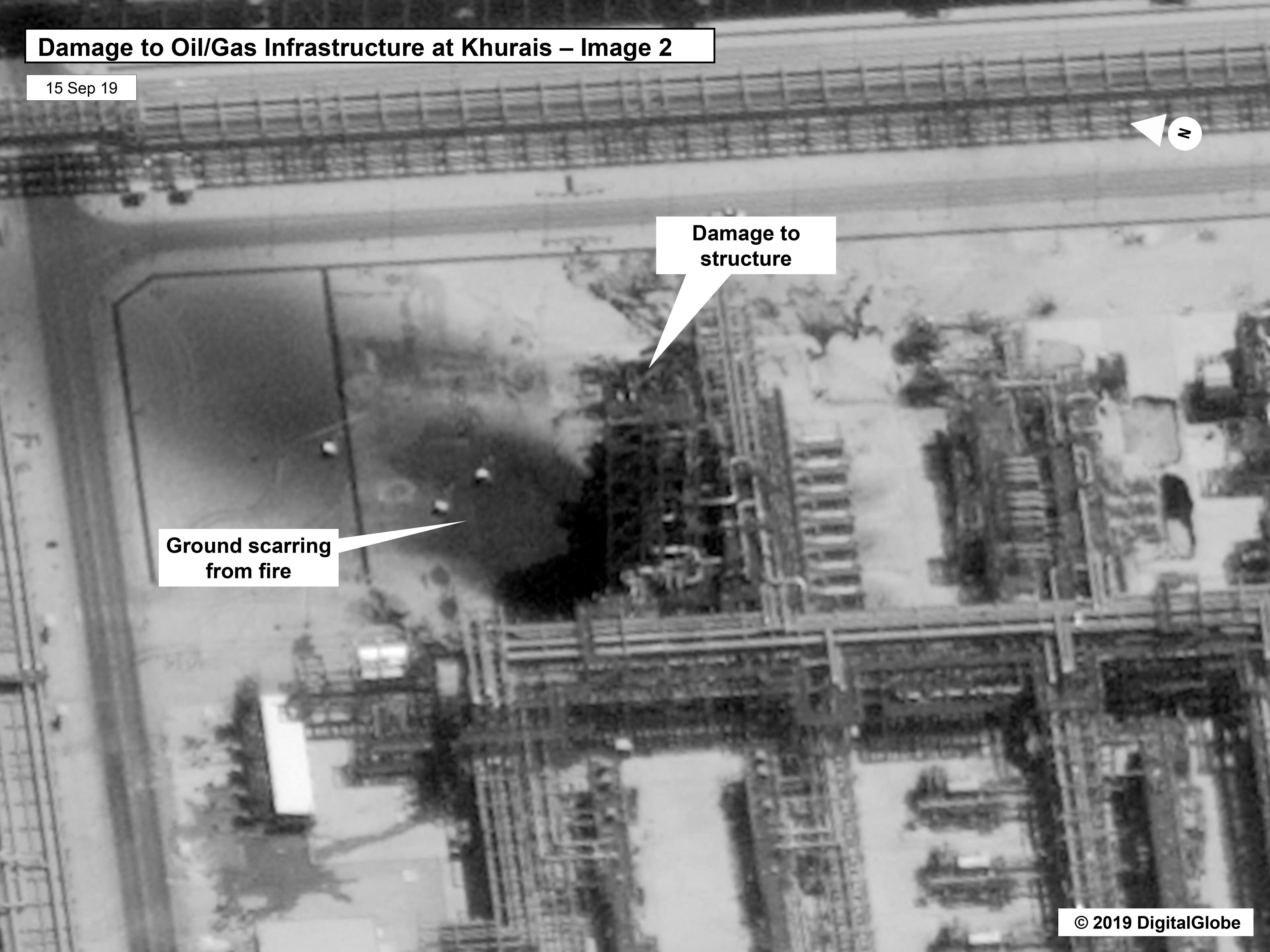
On Sunday, the U.S. released several satellite images that the government claimed supports their assessment that the attack came from north of the Kingdom — i.e. Iran or Iraq — and not from Yemen, which is south. Trump, however, noted in his tweet Sunday that the U.S. is still consulting with Saudi Arabia to verify the source of the drone. The Houthis have also not presented conclusive evidence to support their claim of responsibility.
United Nations Secretary-General António Guterres called on "all parties to exercise maximum restraint" and eschew any escalatory actions.
'The Crown Jewel of the Saudi Kingdom's Oil System'
The pre-dawn attacks on Saturday, which hit the Abqaiq and Khurais processing facilities, forced Aramco to suspend production of 5.7 million barrels of crude oil per day, the company said. The loss represents roughly 5 percent of the world's daily oil supply and over half of the Kingdom's oil production, which was 9.85 million barrels per day in August, according to U.S. government figures.
Robert McNally, the founder and president of Rapidan Energy Group, called Abqaiq the "crown jewel of the Saudi Kingdom's oil system" and "the most important facility on the planet." The attack, McNally added, "directly threatened global growth."
Global oil prices soared following the attack, increasing by nearly 20 percent to over $70 a barrel — a record intraday jump — according to S&P Global Platts, the energy and commodities research firm.
"The world is not even close to being able to replace more than 5 million [barrels per day] of Saudi Arabian exports," Bjørnar Tonhaugen, head of oil market research at Rystad Energy, said in a statement. Tonhaugen added, however, that the "bullish reaction in oil prices" will likely level out in the coming days because of Saudi Arabia's "vast quantities of crude in storage," which is estimated to equal 26 days of current exports, and the ability of the U.S. to increase supply.
In a statement over the weekend, the White House said that Trump spoke with Saudi Crown Prince Mohammad Bin Salman and reiterated the U.S.' commitment to "ensuring global oil markets are stable and well supplied." Trump later authorized the use of the nation's emergency oil supply, known as the Strategic Petroleum Reserve, to stabilize the energy market.
"PLENTY OF OIL!" the president tweeted Sunday evening.
The Saudi Minister of Energy, Prince Abdulaziz bin Salman bin Abdulaziz, also visited the damaged facilities Sunday and sought to reassure consumers and the market that the attack did not impact the supply of fuel to the domestic market, according to the Saudi Press Agency.
The attack, however, has reportedly affected Aramco's forthcoming initial public offering on the Tadawul, the Kingdom's domestic stock exchange. Citing anonymous sources, The Wall Street Journal reported Monday that Aramco — officially called the Saudi Arabian Oil Co. — and Saudi government officials are considering delaying the IPO, which was set to be executed as a two-part offering and would have reportedly valued the company at over $2 trillion.