Pump jacks draw crude oil from the Long Beach Oil Field in Signal Hill, California, on March 9, 2020. (Photo by DAVID MCNEW / AFP) (Photo by DAVID MCNEW/AFP via Getty Images)
Turbulent oil prices dropped to the low $30s on Thursday, falling to 16-year lows just hours after President Donald Trump announced a 30-day ban on travel from more than two dozen countries in Europe in an attempt to stem the spread of coronavirus.
Brent crude oil, the benchmark for global prices and for U.S. gasoline prices, had declined to nearly $33 a barrel as of midday Thursday, down from a one-day peak of $36 reached just an hour before Trump began his live remarks from the Oval Office.
West Texas Intermediate, the bellwether for U.S. shale oil production, saw a similarly dramatic drop, from $33.48 an hour before the president’s remarks Wednesday evening to close to $30 by the next afternoon.
Both Brent and WTI have seen their market values plunge by roughly a third from last week alone. Each is fetching less than half of what it was earning at the start of the year barely three months ago.
'The next 10-14 days are going to be pretty rough,' said Steven Kopits, managing director of Princeton Energy Advisors. 'There are going to be reversals here – big ones – almost on a daily basis: up 10-15 percent one day, then dropping again. So it's going to be really a rollercoaster ride without any real stability figure through at least next weekend.'
The plunging prices mirror similar slides in airline stocks: American Airlines and United Airlines have seen their market values decline by roughly 45 percent since the start of the year. Alaska Airlines’ stock price has tumbled by more than a third, while Delta, JetBlue, and Southwest have lost about a quarter of their respective market values.
Budget carrier Frontier Airlines on Thursday was offering up to 90 percent off on its domestic flights.
For both oil and airlines, the travel ban on Europe worsens the sudden drop-off of global demand sparked by the COVID-19 pandemic, which has spurred countries across the world to institute restrictions on travel, tourism, and shipping.
But greatly exacerbating the crisis, the oil sector, in particular, is also now drowning in an oversupply of crude, a deluge unleashed by the eruption of a price war between Saudi Arabia and Russia.
The two countries, the world’s No. 2 and No. 3 oil producers behind the U.S., failed last weekend to renew an agreement on production cuts that had helped shore-up flagging prices. In response, Saudi Crown Prince Mohammed bin Salman announced a surprise price cut and a sudden increase in production in a move widely seen as an attempt to both grab market share and punish Moscow by torpedoing the oil prices that both Saudi Arabia and Russia depend on for revenue.
Oil prices quickly began to nosedive. The pain is particularly pronounced among U.S. oil and gas producers, who rely on techniques such as hydraulic fracturing – or fracking – and horizontal drilling to extract fossil fuels from porous shale rock formations deep underground, which are more expensive than conventional drilling.
The biggest players in the U.S. shale oil industry, such as Occidental Petroleum and Continental Resources, have seen their market values drop by as much as 50 percent. Job losses in the sector are expected to reach tens of thousands. If benchmark oil prices fall to $26-28, not seen since February 2016 after Saudi Arabia last ramped-up production to grab market share, producers may be forced to shut-in their wells and stop extraction altogether.
'We're pretty close to that here,' Kopits said. 'If the Saudis persist in this policy for an extended period of time, we will be seeing out-and-out bankruptcies in the shale sector in significant numbers. Things are really dire if you have to shut-in your production.'
Without an agreement between Russia and Saudi-led OPEC – a partnership often referred to as OPEC-plus – consulting firm Rystad Energy warned Wednesday that prices could fall even further into the low-$20s.
'The global oil market has lost its regulator and now only market mechanisms can dictate the balance between supply and demand,' Espen Erlingsen, Rystad’s head of upstream research, said in a statement.
Nonetheless, Airlines 4 America, the main trade group for U.S. airlines, praised the administration’s moves in a statement Wednesday evening.
'We commend President Trump for continuing to take decisive action to protect the health and well-being of the American people. For U.S. airlines, the safety of our passengers, crew and cargo is – and always will be – our top priority,' A4A President and CEO Nicholas Calio said. 'The unforeseen outbreak of the coronavirus has directly impacted the U.S. airline industry, which is critical to the U.S. and global economies. This action will hit U.S. airlines, their employees, travelers and the shipping public extremely hard. However, we respect the need to take this unprecedented action and appreciate the Administration’s commitment to facilitate travel and trade.'
The push to regulate the gig worker economy is gaining steam as the share of workers who participate in freelancing through businesses like Uber and Lyft have also exponentially grown during the pandemic. Employment attorney Mark Kluger, founding partner at Kluger Healey, LLC, joined Cheddar to break down how the battle to reclassify gig workers will continue in the new year, and why the issue continues to generate conflict. "More and more workers are using gig work as their primary source of income and as a result of that they are not like employees in the sense that they don't have benefits like health insurance," Kluger noted.
Renewable energy company Heliogen has gone public via a SPAC merger with blank check company Athena Technology Acquisition Corp. on the NYSE. Joining Cheddar, founder and CEO Bill Gross went into why he felt the end of 2021 was the best time to get into the public markets. "If you think of the Industrial Revolution and the digital revolution, this renewable revolution is probably going to be as big or larger than that," he said. "So we're going to use this capital to scale our business, to meet more customer demand, to do more projects in parallel, and to scale our research and development to continue to drive down the price to be competitive with fossil fuels."
Carl "The Moon" Runefelt, a Bitcoin investment expert, recently made a hefty purchase of a $2 million Bugatti sports car at a Dubai dealership. The Swedish crypto evangelist joined Cheddar to talk about how he made the big acquisition of a luxury item he had long had his eye on and why he chose the dealership, The Car Vault, to make the unprecedented transaction. "They accepted crypto directly, and that was important to me," he said. "I am not going to go to any car dealership that don't accept crypto, and that's kind of a principle I have today."
Marjorie Mesidor, Partner at Phillips & Associates, joined Wake Up With Cheddar to break down the latest trends in the job market, as the demand for labor has recovered, but as the number of people willing to fill positions remains relatively low.
2021 proved that crypto currency is here to stay. This year saw more and more adoptions of crypto, from top athletes looking to be paid in bitcoin, to Elon Musk even experimenting with bitcoin and dogecoin payments for a bit over at Tesla. And it wasn't all bitcoin either - other cryptos like Cardano and Solana saw some action in 2021 as well. Patrick McConlogue, CEO of Overline and former Citadel Investment Group Engineer explains why 2021 was such a good year for crypto, and what to expect in 2022.
2021 saw markets continue to be impacted by the onslaught of the coronavirus pandemic -most recently in the form of the Omicron variant- in addition to the global supply chain shortage, and increased inflation. But it wasn't all bad news, as crypto soared throughout the year, and meme stocks continued to have a moment. With the year coming to a close, investors are keeping an eye out to see if they should expect more of the same in the new year. Chris Vecchio, Senior Analyst, at DailyFX tells us what market trends to be on the watch for in 2022.
2021 proved to be yet another formidable year for Tesla. In a year that saw electric vehicles carve out their own space in the transportation world, the company made further strides, keeping its spot on top even as new companies threatened competition. Tesla was able to hit the trillion dollar valuation mark, increase vehicle deliveries even as the world grappled with supply chain and delivery issues and sign a major deal with Hertz this year. And of course, you can't talk about Tesla without talking about Elon Musk, CEO and founder of the company, richest man in the world and Time Magazine Person of the Year, who saw plenty of successes in 2021 as well. Al Root, Senior Writer at Barron’s, explains just how good a year it was for Tesla.
The S&P CoreLogic Case-Shiller 20-city home price index showed an 18.4 percent surge in October as the housing market continues to boom. October's levels are a slight downturn from the roughly 19 percent increase the index saw in September, but come roughly in line with economist expectations. Michael J. Romer, Managing Partner, Romer Debbas joined Wake Up with Cheddar to discuss.
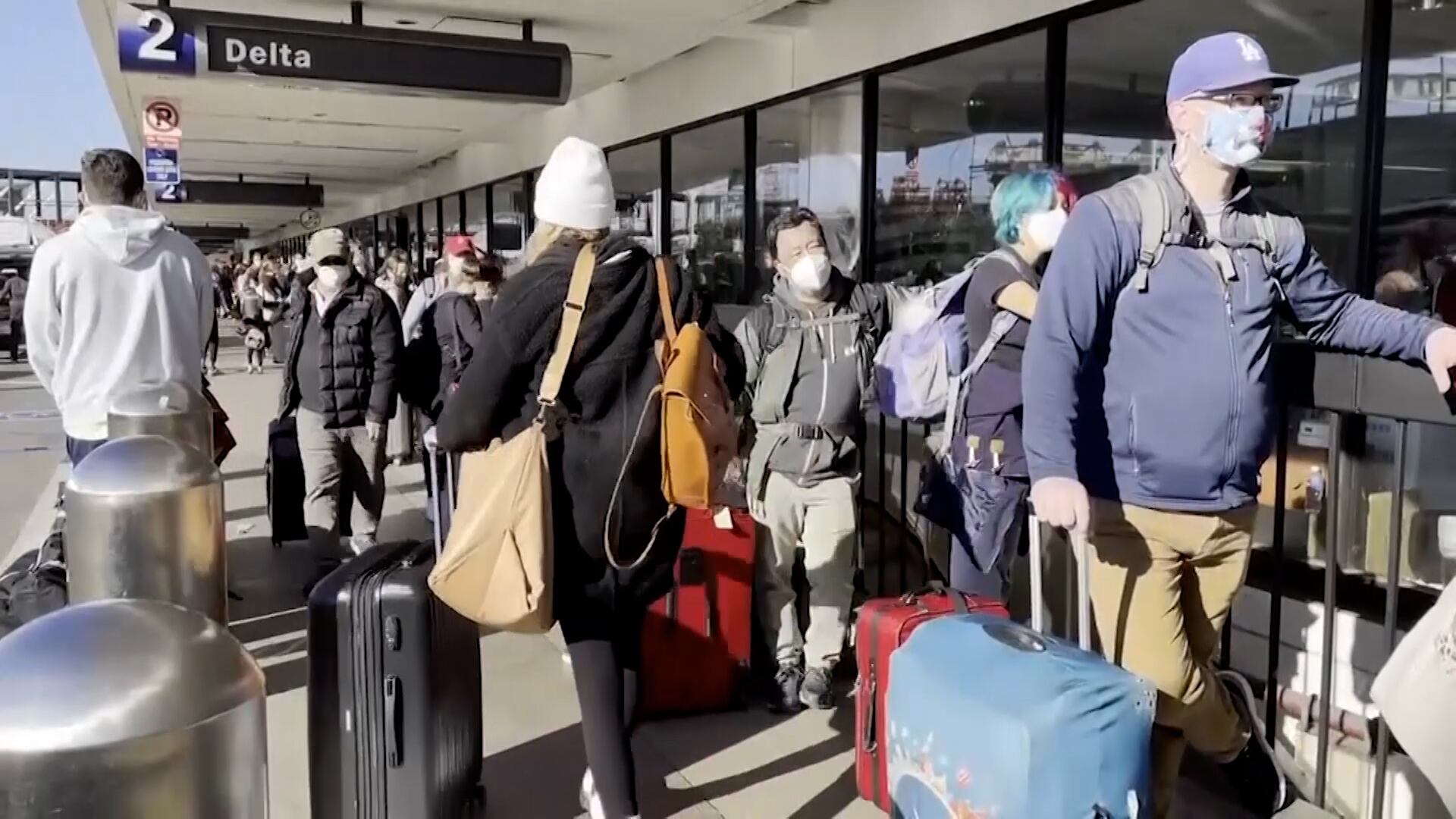
U.S. airlines have canceled more than 6,000 flights since Christmas eve, causing headaches for travelers.
Airlines cited staffing shortages amid the omicron outbreak as the primary reason for the interruptions to service. The cancellations come at the busiest time of year for air travel. Steve Shur, President, The Travel Technology Association joined Wake Up with Cheddar to discuss.
Dr. Soumi Eachempati, co-founder and CEO of Cleared4 and former professor of surgery and public health at Weill Cornell Medical College, joined Cheddar to breakdown what people should know about the recently FDA-approved emergency use of Merck and Pfizer's COVID-19 treatment pills. He noted that not only do people need to be aware of other medications they are taking that could cause adverse effects if coupled with COVID-19 pill treatments, he also talked about the intense in-take regiment. "The Merck pills are actually about 40 pills over five days. The Pfizer ones are three pills over five days, so people have to be prepared for that because it is a lot of pills you'll have to take to get full value from these drugs," Eachempati told Cheddar.