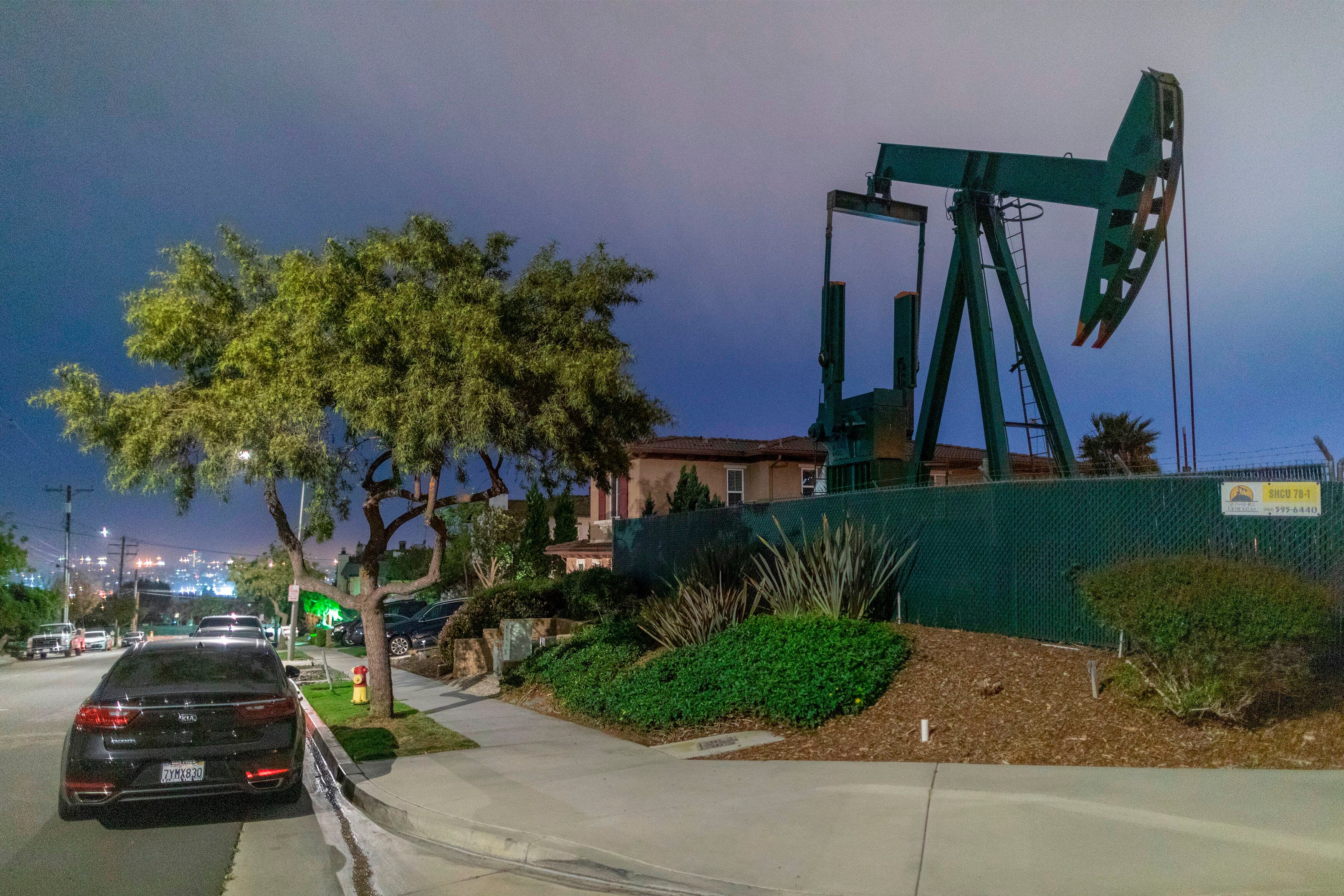
Pump jacks draw crude oil from the Long Beach Oil Field near homes in Signal Hill, California, on March 9, 2020. (Photo by DAVID MCNEW/AFP via Getty Images)
Oil prices plunged early Monday on renewed fears of a prolonged slowdown in demand and an even greater glut in supply.
Prices of Brent crude, the benchmark for global oil prices and for U.S. gasoline, had fallen as low as $22.63 a barrel as of Monday morning, down 17% from Friday. The price of West Texas Intermediate, or WTI, the bellwether for U.S. shale oil production, also fell about 6% to roughly $20 a barrel.
The price drops came on the heels of President Trump’s decision Sunday to extend the country’s social distancing guidelines another 30 days – meaning that Americans and U.S. businesses will almost certainly need to continue following the practices as late as April 30. Trump had previously said that he’d hoped to see some businesses resume normal operations as early as Easter on April 12 – a prediction that was roundly criticized by health experts.
“That recommendation effectively stymies American oil demand by putting a lid on gasoline and jet fuel consumption,” said Ellen Wald, president of Transversal Consulting and a senior fellow at the Atlantic Council Global Energy Center.
Meanwhile, adding to the downward pressure on prices, Saudi Arabia on Monday morning announced that it plans to step up its oil exports in May. The move is being driven by the reduction in domestic demand – due to the kingdom’s own social distancing practices to slow the spread of coronavirus – and the completion of new power plants that burn natural gas instead of oil, Wald said.
The developments – and the resulting crash in prices – promise to prolong the pain for U.S. shale oil producers. The sector needs WTI prices to be, on average, more than twice as high as they are now – at least $46 a barrel – to turn a profit, according to a quarterly survey published last week by the Federal Reserve Bank of Dallas. The bank called the results the “bleakest since the survey’s inception” in 2016.
Saudi Arabia, the world’s No. 2 oil producer behind the US. and the top oil exporter, triggered the crash in oil prices earlier this month. The kingdom slashed prices and ramped up production in a move widely seen as aimed at Russia, after the Kremlin declined to renew an agreement with Saudi Arabia and OPEC to cut oil production to help shore-up global prices.
Wealthfront’s CFO Alan Iberman talks the $2.05B IPO and the major moment for robo banking as the company bets on AI, automation, and “self-driving money."
A rare magnum of Dom Pérignon Vintage 1961 champagne that was specially produced for the 1981 wedding of Prince Charles and Lady Diana has failed to sell during an auction. Danish auction house Bruun Rasmussen handled the bidding Thursday. The auction's house website lists the bottle as not sold. It was expected to fetch up to around $93,000. It is one of 12 bottles made to celebrate the royal wedding. Little was revealed about the seller. The auction house says the bids did not receive the desired minimum price.
The New York Times and President Donald Trump are fighting again. The news outlet said Wednesday it won't be deterred by Trump's “false and inflammatory language” from writing about the 79-year-old president's health. The Times has done a handful of stories on that topic recently, including an opinion column that said Trump is “starting to give President Joe Biden vibes.” In a Truth Social post, Trump said it might be treasonous for outlets like the Times to do “FAKE” reports about his health and "we should do something about it.” The Republican president already has a pending lawsuit against the newspaper for its past reports on his finances.
OpenAI has appointed Slack CEO Denise Dresser as its first chief of revenue. Dresser will oversee global revenue strategy and help businesses integrate AI into daily operations. OpenAI CEO Sam Altman recently emphasized improving ChatGPT, which now has over 800 million weekly users. Despite its success, OpenAI faces competition from companies like Google and concerns about profitability. The company earns money from premium ChatGPT subscriptions but hasn't ventured into advertising. Altman had recently announced delays in developing new products like AI agents and a personal assistant.
President Donald Trump says he will allow Nvidia to sell its H200 computer chip used in the development of artificial intelligence to “approved customers” in China. Trump said Monday on his social media site that he had informed China’s leader Xi Jinping and “President Xi responded positively!” There had been concerns about allowing advanced computer chips into China as it could help them to compete against the U.S. in building out AI capabilities. But there has also been a desire to develop the AI ecosystem with American companies such as chipmaker Nvidia.