In this July 24, 2020, file photo, healthcare worker Rahaana Smith instructs passengers how to use a nasal swab, at a drive-thru COVID-19 testing site at the Miami-Dade County Auditorium, in Miami. U.S. health officials have sparked a wave of confusion after posting guidelines that coronavirus testing is not necessary for people who have been in close contact with infected people. (AP Photo/Wilfredo Lee, File)
By Mike Stobbe
U.S. health officials have sparked a wave of confusion after posting guidelines that coronavirus testing is not necessary for people who have been in close contact with infected people.
The new guidance was posted earlier this week on the website of a federal agency, the Centers for Disease Control and Prevention.
The CDC previously had advised local health departments to test people who have been within 6 feet of an infected person for more than 15 minutes. But on Monday a CDC testing overview page was changed to say that testing is no longer recommended for symptom-less people who were in close contact situations.
There was a caveat, however. Testing may be recommended for those with health problems that make them more likely to suffer severe illness from an infection, or if their doctor or local state officials advise they get tested.
CDC officials referred all questions to the agency's parent organization, the U.S. Department of Health and Human Services in Washington, D.C. That suggests that HHS ordered the change, not CDC, said Jennifer Nuzzo, a Johns Hopkins University public health researcher.
HHS officials have offered little explanation but scheduled a briefing for Wednesday afternoon to answer questions.
Across the country, public health experts called the change bizarre. They noted that testing contacts of infected people is a core element of public health efforts to keep outbreaks in check and that a large percentage of infected people — the CDC has said as many as 40 percent — exhibit no symptoms.
"I was taken aback and didn't know that it was under consideration," said John Auerbach, president of Trust for America's Health, a nonprofit that works to improve U.S. preparedness against disease. "The recommendation not to test asymptomatic people who likely have been exposed is not in accord with the science."
Ultimately, restricting testing could be self-defeating, because it could skew the numbers and create a perception that rates of infection are higher. Testing people who appear to be healthy would tend to lower the overall rate of positive results while narrowing testing to people who are sick would raise the overall positive rate, Auerbach said.
Why HHS would order such a change quickly became a matter of speculation. Dr. Carlos del Rio, an infectious diseases specialist at Emory University, suggested in a tweet that there are two possible explanations.
One is that it may be driven by testing supply issues that in many parts of the country have caused delays in results of a week or more, he suggested.
The other is that President Donald Trump simply wants to see case counts drop, and discouraging more people from getting tested is one way to do it, he said.
Dr. Tom Frieden, who was head of the CDC during the Obama administration, said the move follows another recent change: to no longer recommend quarantine for travelers coming from areas where infections are more common.
"Both changes are highly problematic" and need to be better explained, said Frieden, who now is president of Resolve to Save Lives, a nonprofit program that works to prevent epidemics.
Frieden said he, too, believes HHS forced CDC to post the changes. He called it "a sad day" because "CDC is being told what to write on their website."
___
Associated Press writer Ricardo Alonso-Zaldivar in Washington, D.C. contributed to this report.
___
The Associated Press Health and Science Department receives support from the Howard Hughes Medical Institute's Department of Science Education. The AP is solely responsible for all content.
If some members of Congress have their way, there might finally be a 'TLDR' on sites' terms of service, introduced by the terms-of-service labeling, design, and readability act – or TLDR for short. With this act, users will actually understand what they're agreeing to or the many ways in which their data is being used before pressing 'accept.' J.D. sat down with co-sponsor of the bill and Senator Bill Cassidy, to discuss.
President Joe Biden's first year in office is wrapping up. What has he achieved, and what else remains on the table while the Democrats have control of Washington? Amid an ongoing pandemic and rising inflation, Biden's approval rating is at an all-time low and his party is plagued by infighting. Will he be able to continue pushing key parts of his agenda? Paul Glastris, former Bill Clinton speechwriter & Editor-in-chief of 'Washington Monthly,' joins Cheddar News' Closing Bell to discuss the president's achievements in his first year, where he's fallen short, and what he must do in order to get more of his agenda signed into law.
Tech giants Meta, Amazon, Alphabet, and Apple are faced with a bipartisan antitrust legislation effort underway in the Senate Judiciary Committee. The companies stand accused of promoting their own goods and services over smaller competitors on their platforms, holding too much monopolistic power via their app stores and services. Adam Kovacevich, founder and CEO of Chamber of Progress, a technology industry trade group, joined Cheddar to argue that the bills that are being debated currently could end up hurting consumers, rather than helping.
Concerns over inflation have become one of the biggest worries for executives. A survey from The Conference Board shows that more than 900 CEOs consider inflation a top tier concern, a major shift from last year's survey that had it as a low-level concern. Rebecca Ray, Executive Vice President, Human Capital, The Conference Board joined Cheddar's Opening Bell for more.
Jordan Zakarin, Media Producer at A More Perfect Union, joined Cheddar News to break down the latest from Colorado, where at least 8,700 Kroger employees walked off the job in demand of increased benefits and wages.
With the 2022 Winter Olympics in Beijing rapidly approaching, clouds of controversy continue to swirl around China's treatment of the Uyghur Muslim minority population, its surveillance state, and security for visiting athletes. Phelim Kine, China correspondent for Politico, joined Cheddar to break down the big storylines surrounding the Beijing Games and highlight what he saw as the complete disregard by top corporate sponsors like P&G, Airbnb, Intel, Visa, and Coca-Cola, for the controversies. "They spend $100 million for every Olympics that they sponsor, and they have frankly shown absolute willful indifference to any type of entreaty to essentially be more vocal about their concerns about human rights in China," he said. Kine also touched on the data privacy fears for athletes as visiting contingents are being told to carry burner phones to avoid security risks.
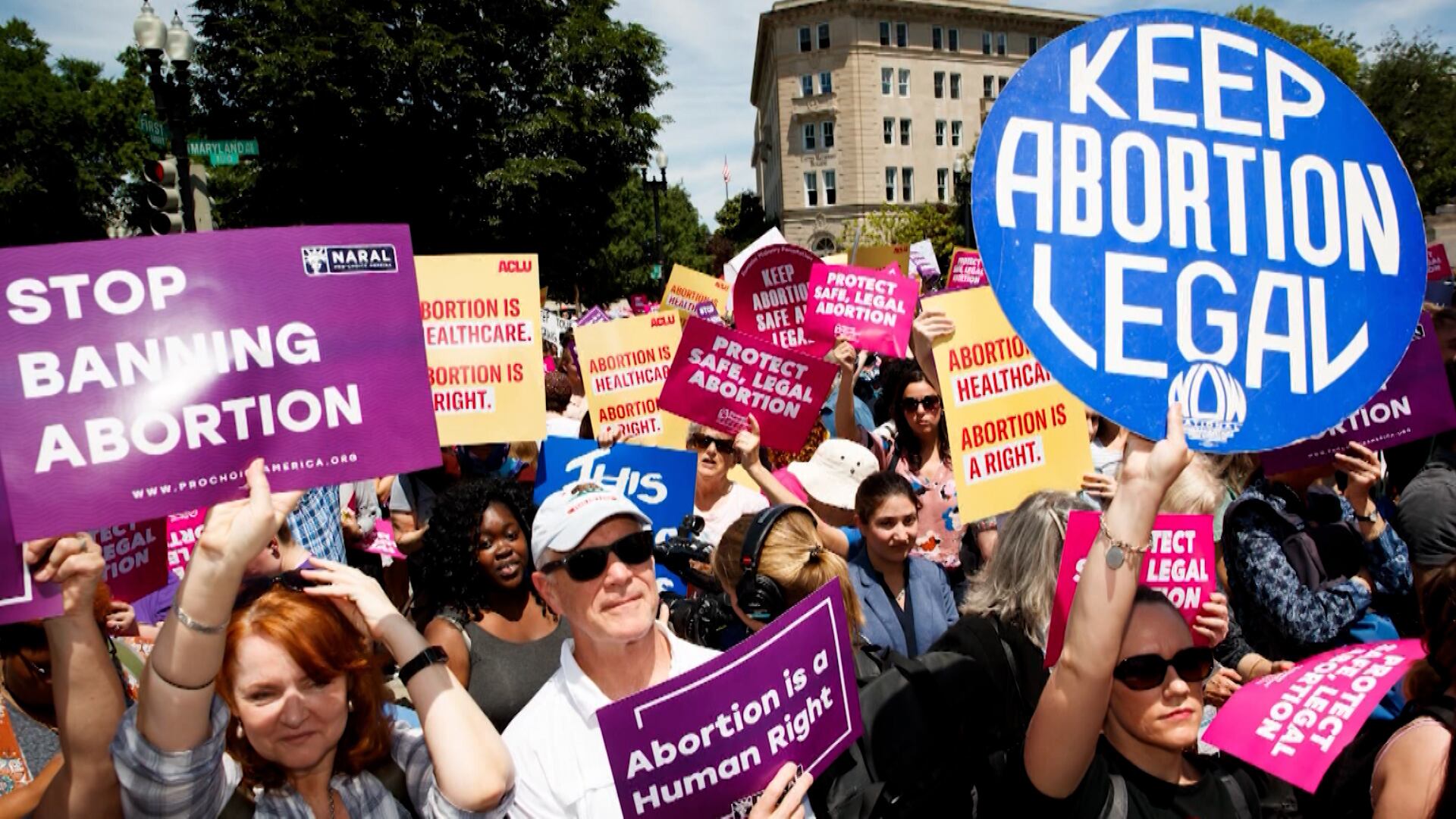
Texas's six-week abortion ban remains in effect after a federal appeals court ruling on Monday. The U.S. court of appeals for the fifth circuit temporarily transferred the case to the Texas Supreme Court, which is expected to leave the dispute in limbo for months to come. Katie Barlow, attorney and media editor of SCOTUSblog, joins Cheddar News to discuss.
Hugh Odom, founder and president of Vertical Consultants, shared his expertise on telecommunications with Cheddar on the safety issue raised about 5G deployment by airlines. The installation was partially delayed again on Tuesday as the airlines warned of potentially catastrophic delays in a letter to the Biden administration. Later, both Verizon and AT&T relented and put a pause on some of the implementations. "The first thing the Biden administration needs to do is get everybody in the room and say, look, aviation industry, identify the problem — wireless industry, come up with a solution," said Odom.
Dave Levinthal, deputy Washington Bureau chief at Insider, joins Cheddar News to discuss Gallup's new survey that reveals more Americans leaned Republican by the end of 2021.